
Case Facts
JoAnn LeDoux, an Army nurse, sued Outliers, Inc. - doing business as Thesis, Thesis Nootropics, Find My Formula, and Formula - along with its manufacturing partners Brand Nutraceuticals and Brand Packaging Group, alleging the company’s nootropic supplement kits were adulterated with amphetamines and other undisclosed ingredients. LeDoux took a quiz on Thesis’s website, was sold a personalized subscription of four capsule types (“Logic, Motivation, Energy, and Clarity”), and purchased and used them from mid-March through late September 2021.
A routine military urinalysis on August 16, 2021 came back positive for amphetamines on September 27, 2021, showing 4,997 nanograms per milliliter of D-amphetamine, in the same three-to-one ratio of D- to L-amphetamine found in Adderall. The Army flagged LeDoux’s record for “IL-DRUG ABUSE ADVERSE ACTION,” she was passed over for promotion, and she was later court-martialed for wrongfully using amphetamine - a charge on which she was acquitted in December 2022. Independent testing complicated her theory of the case: a follow-up LabCorp urinalysis and hair-follicle test came back negative, and outside labs (NSF International and Alkemist Labs) that tested samples of the actual Thesis products she’d been taking found no amphetamines in any of them.
On January 9, 2026, Judge Cartwright granted Defendants partial summary judgment (Dkt. 202), dismissing with prejudice any claim resting on the theory that Thesis’s supplements caused LeDoux’s positive urinalysis. That ruling followed the exclusion, under Federal Rule of Civil Procedure 37(c)(1), of four experts LeDoux had disclosed after the case’s deadlines - Dr. Steven Dezell, Dr. Catherine Okano, Dr. Ronald Shippee, and a second report from Mr. James Kababick. A footnote in that order flagged, but reserved for a separate order, Defendants’ argument that Kababick’s first report also contained citations “hallucinated” by generative AI.
That separate order became Dkt. 265, in which the court sua sponte sanctioned LeDoux’s attorney, Jocelyn Stewart, for generating false citations with artificial intelligence and submitting them to the court without verification. On August 18, 2026, in the order at issue here (Dkt. 269), Cartwright excluded two more of LeDoux’s experts, granted Defendants summary judgment on all of LeDoux’s remaining claims, and dismissed the case with prejudice and without leave to amend.
The Setup
Plaintiff’s counsel used an AI tool to generate a “formatted citation table” of academic articles. She handed that same AI-generated table to two different experts - Mr. James Kababick and Dr. Ronald Shippee - as an appendix to their reports.
The Failure
Neither expert checked it. Both signed reports containing citations that didn’t hold up. The court’s sanctions order recounts that LeDoux admitted “she used Claude or ChatGPT to ‘generate a formatted citation table’ for academic articles” and “provided the same AI-generated citation table to both experts as an appendix, and neither expert caught the errors in the citation data before signing their reports.”
The fallout reached a third expert. Dr. Gabriel Holguin’s report - offered on the separate question of whether LeDoux’s symptoms after she stopped taking Thesis products were consistent with stimulant withdrawal - also contained “‘hallucinated’ citations to academic articles which appear generated by artificial intelligence.” LeDoux had already withdrawn the portions of Holguin’s report containing those citations, along with three of his four original opinions, because they tied back to the urinalysis theory the court had already rejected. That withdrawal didn’t insulate the rest of his report.
The Ruling
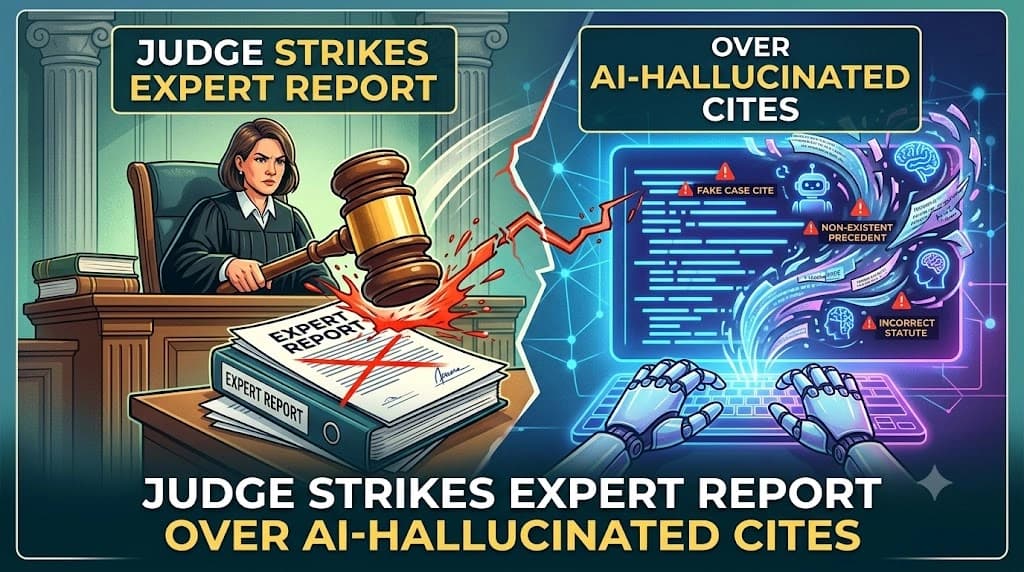
Applying Federal Rule of Evidence 702 and the Daubert standard, Defendants moved to exclude Holguin, arguing his opinion was unreliable in part because of the hallucinated citations. Cartwright agreed. Quoting a Minnesota case handling a similar problem, she found that the hallucinated citations “shatter[] his credibility with this Court” - even though, as she acknowledged, “Plaintiff’s counsel was not asked to provide information about these citations” specifically. What mattered was that “the errors are similar to those in other expert reports” tied to the same AI-generated citation table episode described in the sanctions order.
The court wrote: “This level of involvement from counsel in drafting (with AI) the list of materials supposedly relied upon by Dr. Holguin, and Dr. Holguin’s lack of diligence in verifying the sources that he represented were the basis for his opinion, prevent Plaintiff from meeting her burden to show that Dr. Holguin’s opinion is ‘based on sufficient facts or data,’ is ‘the product of reliable principles and methods,’ or ‘reflects a reliable application of the principles and methods to the facts of the case.’” Citing a separate case involving AI-generated legal citations, the court added that although the fabricated citations existed only in the withdrawn portions of Holguin’s opinion, they “undermine[] the overall credibility” of the report as a whole. The court excluded Holguin’s opinion entirely.
With Holguin gone, LeDoux had no expert testimony linking her medical symptoms to Thesis’s products - a defect the court found independently fatal to her damages claim, on top of a separate ruling that Defendants’ $13,000 unconditional payment already exceeded the maximum she could recover on a purchase-price theory. Both grounds, not the AI issue alone, led the court to grant summary judgment on the last of LeDoux’s claims and dismiss the case with prejudice.
The Kicker
The experts didn't run the AI. Counsel did. But that didn't save them. Once an expert signs a report, the citations are theirs - regardless of who typed the prompt.
Three Failure Points, Three Different People, One Outcome
→ The attorney trusted AI output without verifying it before filing.
→ The experts trusted a citation table handed to them without checking a single source.
→ The plaintiff’s underlying claims went down too, and summary judgment followed shortly after - on largely unrelated causation and damages grounds — but the credibility damage from the AI citations was already done.
The Lesson
It isn't new; AI just raised the stakes. Experts have always been told to verify anything counsel hands them before it goes into a report. That rule didn't change because the source of the bad citations was an AI tool instead of a sloppy paralegal. Courts are now treating hallucinated citations as a Rule 702 reliability problem - not just an embarrassing footnote.
Takeaways
If you're retaining experts:
Ask directly whether AI tools touched the drafting process anywhere, including materials counsel supplied, and who verified the sourcing.
If you're an expert:
Check every citation in every document that lands in your report, regardless of who prepared it or what tool they used. Your signature is the only verification that matters to the court.