

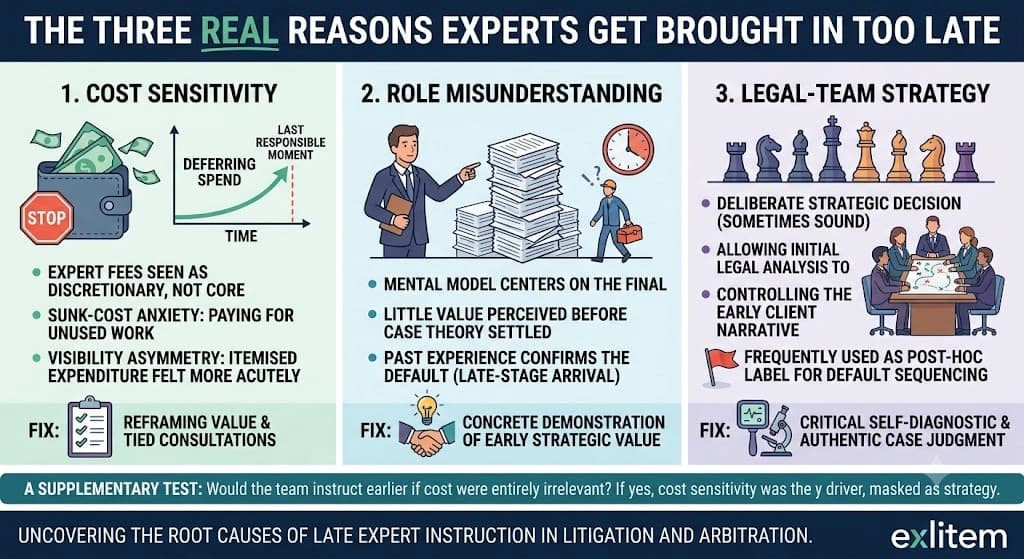
Late expert instruction is rarely the product of a single, identifiable mistake. It is more often the visible symptom of one of three distinct, underlying causes, each with its own logic, its own psychology, and its own specific fix. Cost sensitivity, a genuine misunderstanding of what an expert's role actually involves, and deliberate, if sometimes mistaken, legal-team strategy each produce the same outward result, an expert instructed later than the case would have ideally allowed, but they arise from entirely different places and respond to entirely different interventions.
Treating late instruction as a single, generic problem, to be addressed with a single, generic fix, misses this distinction and tends to produce solutions that work for one underlying cause while doing nothing for the other two. Diagnosing which of the three is actually driving delay in a specific firm, or a specific case, is a necessary first step before any intervention is likely to produce a meaningful, lasting change in practice.
Reason One: Cost Sensitivity
The most visible driver of delay is straightforward cost sensitivity, but it is worth examining more closely than the surface explanation suggests, because the underlying psychology is more specific than simply "experts are expensive." Expert fees are frequently mentally categorized, by clients and sometimes by the legal team managing the budget on their behalf, as a discretionary or supplementary cost rather than a core, necessary component of case preparation, in a way that legal fees for the same work rarely are. This categorization is not accidental; it reflects how expert engagement is often positioned, as an add-on brought in once the "real" legal work has established the shape of the case, rather than as a foundational input to that work from the outset.
This mental accounting has a specific, predictable effect on timing. Costs categorized as discretionary get deferred more readily than costs categorized as necessary, almost regardless of their actual strategic value, simply because deferring a discretionary cost feels lower-risk in the moment than deferring a cost already understood to be unavoidable. A legal team that has internalized expert fees as discretionary will naturally gravitate toward deferring that spend until the last responsible moment, not because anyone has made a deliberate, reasoned case for that timing, but because the categorization itself creates a default toward delay that requires no further justification.
Sunk-cost anxiety compounds this further. Clients and legal teams alike are often genuinely worried about paying for expert work that ultimately goes unused, if a case settles or resolves before the technical evidence is ever formally needed. This worry is not irrational, but it is frequently applied more strictly to expert costs than to comparable legal costs incurred at a similarly early, similarly uncertain stage of a case, revealing that the underlying concern is less about waste in the abstract and more about a specific discomfort with expert spend in particular, discussed further below in terms of how this specific driver responds to different fixes than the other two.
There is also a visibility asymmetry worth naming. Legal fees accrue steadily and continuously throughout a case, absorbed into a client's expectations as simply the ongoing cost of being in a dispute. Expert fees, by contrast, often arrive as a more distinct, itemized commitment, a specific engagement letter with a specific budget attached, which makes the decision to incur them feel more like a discrete, deliberate choice than the comparatively invisible, incremental accumulation of legal fees. This asymmetry in how the two costs are experienced, even when their underlying magnitude is comparable, makes expert costs a more natural target for deferral simply because deferring them requires declining one specific, visible decision rather than resisting a continuous, less visible flow.
Reason Two: Role Misunderstanding
The second driver is a genuine misunderstanding of what value an expert can actually add before a case theory is fully formed. Many lawyers, including experienced ones, have a mental model of an expert's role that centers almost entirely on the final report, the document produced late in a case that presents a technical analysis supporting a specific conclusion. Under this mental model, there is very little for an expert to meaningfully do before the facts, the case theory, and the specific questions requiring analysis have all been settled, since the report itself cannot be written until those things exist.
This mental model is not unreasonable given how many lawyers first encounter expert evidence in their own careers, typically as junior associates managing logistics around an already-engaged expert late in a case, rather than as participants in an early, exploratory conversation about how expert input might shape a still-developing theory. Professional experience shapes professional intuition, and a career spent mostly seeing experts arrive late naturally produces the intuition that arriving late is simply what experts do, rather than a specific choice with specific costs, discussed at length elsewhere in this content series.
This misunderstanding is distinct from cost sensitivity in an important way: it is not really about money at all. A lawyer operating under this mental model would not necessarily object to paying for early expert involvement if convinced it added genuine value; the barrier is a belief that early involvement has little value to add, a belief that no amount of cost discipline or budget flexibility resolves on its own. This is precisely why addressing role misunderstanding requires a different intervention than addressing cost sensitivity, a distinction explored further below.
This driver is also reinforced by how expert relationships are often structured commercially. An expert whose engagement is typically initiated by a request for a specific report, rather than by an open-ended request for early input, receives a steady stream of professional experience that confirms the same mental model from the other direction. Over time, both sides of the relationship, instructing lawyers and the experts they instruct, can settle into a mutually reinforcing pattern where late-stage report production becomes the assumed default, simply because it is the pattern both sides have the most direct professional experience with.
Reason Three: Legal-Team Strategy
The third driver is the most defensible in principle and the most frequently misapplied in practice: a genuine, deliberate strategic decision to delay expert involvement, based on specific reasoning about how the case should unfold. Some of this reasoning is entirely sound. A legal team might reasonably want its own initial legal analysis to develop somewhat before bringing in outside technical input, avoiding the risk of anchoring too early on a specific framing before the full legal picture has taken shape. A legal team might also, quite reasonably, want to control the narrative presented to a client in the earliest stages of a matter, before introducing additional voices and perspectives that could complicate an already difficult early conversation.
The trouble is that genuinely sound strategic reasoning of this kind is considerably rarer, in practice, than the frequency with which "strategy" gets invoked to explain a specific instance of late instruction. A legal team that has not actually engaged in the kind of deliberate reasoning described above, but instead simply defaulted to a familiar sequencing of case activities, out of habit rather than genuine strategic choice, can still describe the resulting delay as strategic after the fact, without the underlying reasoning actually having occurred at the time the timing was effectively decided.
There is a further, genuinely legitimate strategic consideration worth acknowledging specifically: some legal teams delay formal expert engagement deliberately while pursuing a limited, informal technical consultation instead, precisely the kind of tiered approach discussed elsewhere in this content series. In these cases, what looks from the outside like simple delay is actually a considered choice to capture much of the value of early input at lower cost and commitment, which is a genuinely sound version of the third driver rather than a case of the label being misapplied.
This driver differs from the first two in a specific and important respect: it sometimes reflects genuinely correct judgment rather than a problem requiring a fix at all. The challenge is distinguishing the cases where legal-team strategy genuinely and correctly counsels delay from the cases where the language of strategy is being used, whether consciously or not, to describe what was actually simple default sequencing, a distinction discussed at length elsewhere in this content series regarding the difference between genuine case-specific judgment and unexamined process failure.
How These Three Reasons Interact and Compound
These three drivers rarely operate in isolation, and understanding how they interact matters for diagnosing what is actually happening in a specific instance of delay. Cost sensitivity and role misunderstanding compound each other directly: a lawyer who genuinely believes early expert involvement adds little strategic value has no internal counterweight to a client's cost concerns, and readily defers to those concerns without pushing back, since doing so requires no sacrifice of a benefit the lawyer does not believe exists in the first place.
Legal-team strategy, meanwhile, sometimes functions as a convenient post-hoc label applied to delay that actually originated in one of the other two drivers. A legal team that deferred expert engagement primarily out of cost sensitivity or role misunderstanding can still describe the resulting timeline, after the fact, using the language of deliberate strategy, since "we decided to wait" sounds more considered than "we didn't think about it" or "the client was hesitant to spend," even where the underlying reality more closely resembles the latter two.
Role misunderstanding and legal-team strategy can also interact in a more subtle way. A lawyer who genuinely believes an expert has little to contribute before the case theory is settled will naturally frame that belief, when asked, in the language of strategic sequencing, "we wanted our own analysis to develop first," without necessarily recognizing that the underlying belief is closer to a general assumption about expert value than a specific, case-relevant strategic judgment. This makes the two drivers particularly difficult to distinguish from the outside, since both produce very similar-sounding explanations even though only one reflects genuine, case-specific reasoning.
Which Reason Is Actually Driving Delay in a Given Case
A useful diagnostic approach is to ask a specific sequence of questions when examining any instance of late instruction. First: was cost explicitly raised as a concern by the client or the legal team at the point earlier instruction might have occurred? If yes, cost sensitivity is likely playing a significant role. Second, independent of cost: did anyone on the legal team actually believe earlier expert involvement would have added meaningful value, even if that belief was not acted upon? If the honest answer is no, role misunderstanding is likely present, regardless of whether cost was ever explicitly discussed.
Third: is there a specific, articulable reason, beyond general comfort with familiar sequencing, that the legal team wanted its own analysis to develop further before involving an expert? A specific, substantive answer to this question suggests genuine strategic reasoning; a vague or after-the-fact answer suggests the "strategy" label is covering for one of the other two drivers instead.
A useful supplementary test for this third question is asking whether the stated strategic reason would have changed the actual timing decision if cost had been entirely irrelevant. If the honest answer is that the team would have instructed the expert earlier regardless of the stated strategic reasoning, had cost genuinely not been a factor, this suggests cost sensitivity was doing more of the real work than the strategic explanation lets on, even where some genuine strategic reasoning was also present.
What Addresses Each Reason Specifically
Cost sensitivity responds best to reframing expert spend in the specific cost terms discussed elsewhere in this content series, comparing the predictable cost of early, appropriately scoped involvement against the considerably less predictable cost of compressed, late-stage engagement, and to structuring early involvement through limited, capped consultations that directly address the sunk-cost anxiety driving much of the reluctance.
Role misunderstanding responds best to direct, concrete demonstration of the strategic value early expert involvement can add, ideally through specific examples relevant to the kind of matters a particular legal team regularly handles, rather than through abstract argument alone. Lawyers who have personally experienced the value of early collaborative engagement with an expert, even once, tend to update their mental model considerably faster than those exposed only to general advocacy for the practice.
Legal-team strategy, where it reflects genuine reasoning, does not need to be addressed at all; it should be respected as legitimate case-specific judgment. Where it is functioning as cover for one of the other two drivers, the appropriate response is the diagnostic process described above, pressing for the specific reasoning behind the claimed strategic choice and addressing whatever underlying driver that pressure actually surfaces.
What This Means for Firms and Clients
For firms, the implication is to recognize that a single training session or policy statement addressing "the importance of early expert instruction" is unlikely to move the needle much, since it addresses none of the three specific drivers directly. A more effective approach tailors the intervention to whichever driver is actually most prevalent within a specific practice group or firm culture.
For clients, the implication is to raise cost concerns explicitly and directly with counsel rather than allowing them to operate as an unstated background pressure that counsel then has to infer and manage indirectly. A direct conversation about the specific cost-benefit tradeoff, discussed elsewhere in this content series, generally produces a better outcome than cost sensitivity operating as an unexamined, ambient constraint on the legal team's decision-making.
Frequently Asked Questions
Is one of these three reasons more common than the others? Role misunderstanding is likely the most pervasive, since it operates independently of any specific client's budget and shapes a lawyer's own instinct about when to raise the timing question in the first place, before cost or strategy even enter the conversation.
Can genuine legal-team strategy and one of the other two drivers be present in the same case simultaneously? Yes, and this is common. A legal team might have some genuine strategic reason for modest delay while also being influenced by unexamined cost sensitivity or role misunderstanding that extends the actual delay considerably beyond what the strategic reasoning alone would justify.
How can a firm tell whether its own practice reflects genuine strategy or one of the other two drivers dressed up as strategy? Reviewing a sample of past matters and asking, specifically, whether a documented, substantive reason for the actual timing exists, or whether the explanation only emerged after the fact, is a reliable diagnostic applied honestly.
Does addressing role misunderstanding require expensive training programs? Not necessarily. Even informal case debriefs that specifically highlight instances where early expert input meaningfully shaped a favorable outcome can shift practitioner intuition considerably, at very low cost relative to formal training initiatives.
Conclusion
Late expert instruction has three distinct, recurring root causes, cost sensitivity, role misunderstanding, and legal-team strategy, each producing the same visible outcome through an entirely different underlying mechanism. Treating all instances of delay as a single, generic problem obscures this distinction and leads to interventions that address one driver while leaving the other two untouched. Diagnosing which specific driver is actually at work in a given firm, or a given case, is the necessary first step toward an intervention that actually changes practice rather than simply restating the general importance of earlier instruction without addressing why the delay is actually happening.
Key Takeaways
● Late expert instruction typically traces back to one of three distinct drivers, cost sensitivity, role misunderstanding, or genuine legal-team strategy, each requiring a different specific fix.
● Cost sensitivity often stems from expert fees being mentally categorized as discretionary rather than necessary, creating a default toward delay that requires no active justification.
● Role misunderstanding is frequently the most pervasive driver, since many lawyers' professional experience of expert engagement is limited mostly to late-stage report production rather than early, collaborative involvement.
● Legal-team strategy is the only one of the three drivers that can reflect genuinely sound judgment, but it is also frequently invoked after the fact to describe delay that actually originated in one of the other two.
Position yourself where the legal industry looks for expertise - sign up on exlitem.com to get discovered by leading lawyers and high-value clients.