
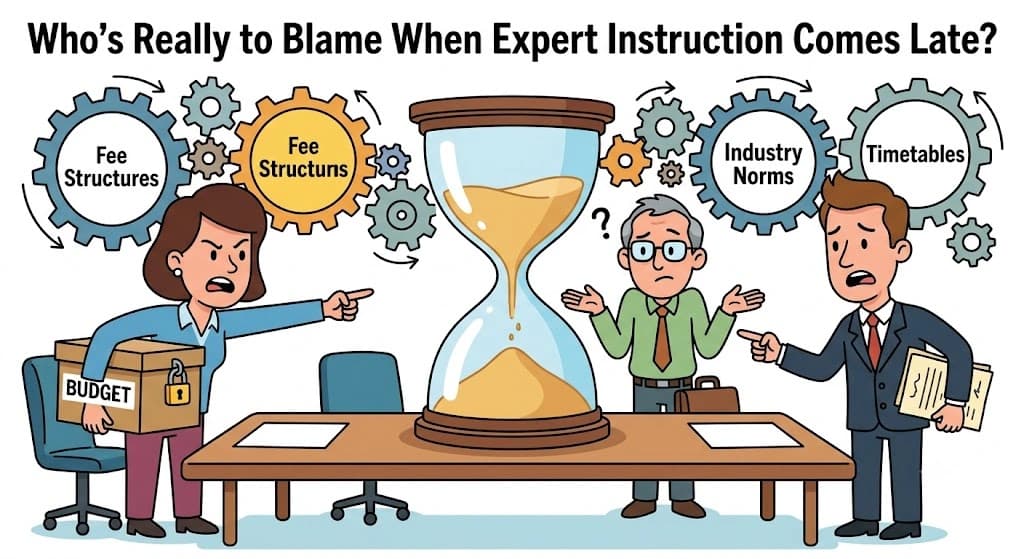
By the time a case team is discussing why the expert was brought in so late, the conversation has usually already turned to assigning responsibility. Counsel points to a hesitant client who took weeks to approve the associated budget. The client points to a legal team that never clearly explained why earlier engagement mattered or raised the question with enough urgency to prompt a faster decision. Both accounts are often at least partly accurate, which is precisely the point. Late instruction is rarely the fault of a single party acting in isolation, and the instinct to locate a single responsible actor, however satisfying in the moment, usually obscures more than it reveals about what actually happened and what would prevent it from happening again.
This piece takes the blame question seriously enough to actually examine it, rather than dismissing it as unproductive from the outset, because understanding how responsibility genuinely distributes across clients, counsel, and the broader structural conditions surrounding a case is a necessary step toward figuring out what would actually change the pattern, distinct from simply agreeing that "everyone shares some responsibility" without examining what each party's specific contribution actually looks like.
The Case for Client Responsibility
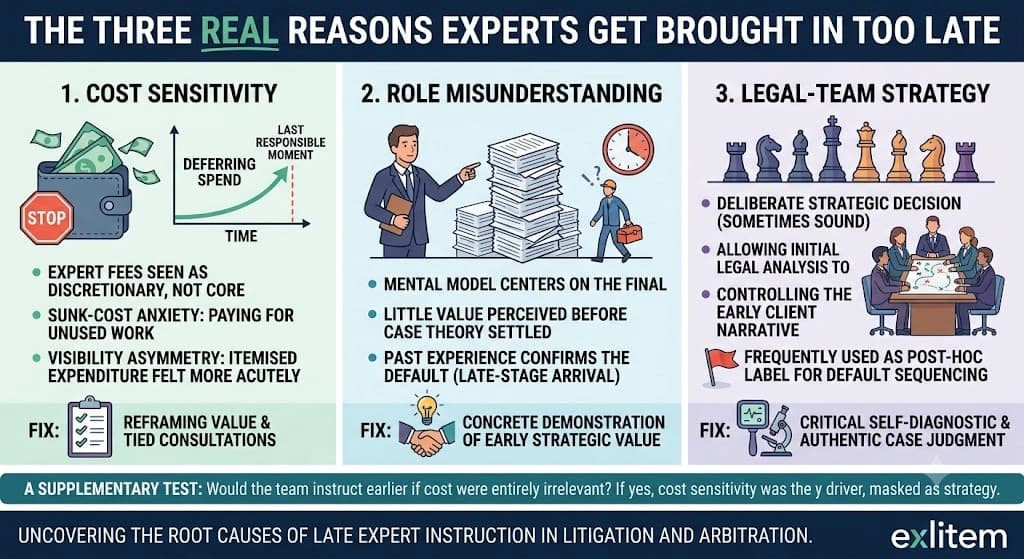
Clients genuinely do contribute to delay in identifiable, specific ways. Budget approval processes, particularly in organizations with layered internal sign-off requirements, can introduce real delay between when counsel first raises the possibility of expert engagement and when that engagement is actually authorized to proceed. This delay is not always a matter of client indifference; it often reflects genuine institutional friction, a need to secure sign-off from a specific budget holder, a preference to wait for more certainty about the dispute's trajectory before committing further spend, that counsel has limited ability to accelerate directly.
Clients also sometimes underweight the strategic value of early expert involvement, for reasons closely related to the role misunderstanding discussed elsewhere in this content series. A client without direct prior experience in complex disputes may reasonably, if incorrectly, assume that expert evidence is something needed only once a case is clearly heading toward a hearing, rather than something valuable considerably earlier in a matter's development. This is a genuine client contribution to delay, though one that reflects understandable inexperience rather than any failure of diligence on the client's part.
Repeat clients with substantial prior litigation or arbitration experience present a somewhat different picture, and it is worth distinguishing them from first-time or infrequent clients specifically. A sophisticated, repeat client who has been through the consequences of late instruction before, and continues to default toward delay regardless, is exercising a more genuinely informed choice than a first-time client encountering these tradeoffs for the first time, which means the same outward behavior, deferring expert engagement, can reflect meaningfully different levels of client responsibility depending on the client's own prior experience with the specific tradeoff being made.
There is also a more difficult version of client responsibility worth naming directly: clients who explicitly instruct counsel to delay expert engagement as a cost-control measure, against counsel's own recommendation, accepting the associated risk knowingly. In these specific instances, responsibility genuinely sits primarily with the client, since counsel raised the issue appropriately and the client made an informed, if ultimately costly, choice to proceed differently.
Even in these clearer instances, though, it is worth asking how genuinely informed the client's decision actually was. A client told simply that early instruction "would be advisable" has received meaningfully less information than a client shown the specific cost comparison and risk mechanics discussed elsewhere in this content series. The line between a client making a genuinely informed choice to accept risk and a client declining a recommendation that was never actually made concrete enough to evaluate properly is often blurrier in practice than it appears once the matter has already gone wrong and the parties are looking back at what happened.
The Case for Counsel Responsibility
Counsel's contribution to delay is, in many instances, considerably larger than the client-blame narrative suggests, because much of what looks like client hesitation actually traces back to how, or whether, counsel raised the timing question in the first place. A client cannot make an informed decision about early expert engagement if counsel never presents it as a genuine, time-sensitive choice with specific consequences attached to delay, discussed in detail elsewhere in this content series regarding the actual cost mechanics of compression.
This is where the role misunderstanding and cost sensitivity dynamics converge most directly on counsel's own conduct. A lawyer who does not personally believe early expert engagement adds significant value has little incentive to press the point with a client who might otherwise be receptive to a well-made case for it. The client's ultimate hesitation, in these situations, is less an independent client failing and more a downstream consequence of counsel's own uncertainty about the value being recommended, an uncertainty the client has no independent way to detect or correct for.
There is also a professional dynamic worth naming candidly: some lawyers hesitate to press a client on discretionary-seeming spend early in a relationship, particularly with a new client, out of a reasonable concern about appearing to prioritize fee generation over the client's own cost interests. This instinct is understandable and often reflects genuine professionalism, but it can produce a systematic under-advocacy for early expert engagement specifically because the topic involves cost, a dynamic that would not apply to a purely strategic recommendation involving no comparable financial dimension.
Counsel also bears specific responsibility for how the cost conversation itself gets framed. A recommendation presented as "we should consider bringing in an expert at some point" invites exactly the kind of open-ended deferral discussed elsewhere in this content series as the default outcome of an unmarked, non-urgent request. A recommendation presented with specific timing, specific cost comparison, and a specific consequence of further delay puts genuine decision-making pressure on the client in a way the vaguer version never does, and the difference between these two framings sits entirely within counsel's control.
The Role of Institutional and Structural Factors
A third source of responsibility, distinct from either client or counsel individually, involves the broader structural conditions surrounding how legal disputes are typically managed. Fee arrangements that create disincentives for early expert spend, whether through fixed early-stage budgets that do not anticipate expert costs or billing structures that make expert fees harder to absorb into existing client relationships than incremental legal fees, shape timing decisions independent of any individual client's or lawyer's specific judgment.
Industry convention plays a similarly structural role. In practice areas or jurisdictions where late expert instruction is simply the well-established norm, both clients and counsel absorb that norm as the default expectation, making early instruction feel like an unusual departure requiring special justification rather than a genuinely available and often superior default choice. This structural inertia operates independently of any specific client's or lawyer's individual reasoning, shaping the baseline expectation both sides bring into a given matter before any case-specific conversation about timing even occurs.
Tribunal and institutional procedural timetables also play a role, sometimes inadvertently encouraging later instruction by not building an early technical scoping step, discussed elsewhere in this content series, into the standard procedural calendar. A case management framework that does not prompt the timing question at all leaves the decision entirely to the parties' own initiative, and initiative, as discussed throughout this content series, is precisely the resource most likely to be in short supply amid the many competing demands of active case management.
The broader expert market itself contributes a further structural factor worth naming. Highly regarded experts in specialized fields are often booked considerably in advance, and a legal team that waits to instruct until late in a case may find that the specific expert best suited to the matter is unavailable on the compressed timeline the delay has created, forcing a choice between a less well-matched available expert or an even more compressed engagement with the originally preferred one. This scarcity dynamic operates independently of any individual client's or lawyer's specific reasoning about timing, yet it meaningfully shapes the actual consequences of whatever timing decision gets made.
Why the Blame Question Itself Is the Wrong Framing
Having taken the blame question seriously enough to examine each party's genuine contribution, it becomes clear why settling on a single responsible party is usually the wrong goal. Late instruction typically results from an interaction between a client's reasonable uncertainty, counsel's own conviction about the value of early engagement, and structural conditions that shape the default expectations both sides bring into the conversation. Removing any single one of these contributing factors would likely have changed the outcome, which means no single factor can honestly be identified as the sole or even primary cause.
This matters practically, not just philosophically, because a firm or practitioner focused on identifying a single responsible party tends to direct all of its corrective effort at that one party, missing the other contributing factors entirely. A firm convinced that clients are primarily responsible for delay invests in better client education and communication, which helps, but leaves counsel's own uncertainty about early value entirely unaddressed. A firm convinced counsel is primarily responsible invests in training lawyers to raise the issue more assertively, which also helps, but does nothing about structural fee arrangements that create disincentives independent of any individual lawyer's advocacy.
What Shared Responsibility Actually Looks Like in Practice
Genuine shared responsibility, properly understood, does not mean diluting accountability until no one feels obligated to change anything specific. It means recognizing that a durable fix requires action from more than one direction simultaneously: counsel raising the timing question earlier and more specifically, clients engaging with that question seriously rather than defaulting to deferral, and firms or institutions addressing the structural conditions that make delay the path of least resistance for both sides.
This distributed responsibility also means the specific corrective action differs depending on which party is best positioned to address a given contributing factor. Counsel is best positioned to address how the timing question gets framed and presented. Clients are best positioned to address internal budget-approval friction once they understand its downstream cost, discussed elsewhere in this content series. Firms and institutions are best positioned to address structural fee arrangements and procedural timetables that shape default expectations independent of any individual case's specific circumstances.
A Framework for Moving Past Blame to Prevention
A more productive approach than assigning blame after the fact is building a specific, forward-looking checkpoint into case planning, discussed at length elsewhere in this content series, that requires the timing question to be raised explicitly, with specific reasoning documented, at the outset of every matter. This does not eliminate the possibility of late instruction in cases where it is genuinely, deliberately warranted, but it removes the possibility of delay occurring simply because no one on either side of the relationship raised the question early enough to matter.
This kind of forward-looking checkpoint also has a useful side effect: it makes any eventual instance of late instruction considerably easier to evaluate honestly after the fact, since there will be a specific, documented record of what was actually discussed and decided at the relevant early stage, rather than a reconstructed, after-the-fact narrative assembled once delay has already become a source of friction between client and counsel.
Building this checkpoint into standard practice also changes the emotional tenor of any later conversation about timing considerably. A documented record showing that the question was raised, discussed, and consciously decided, even if the eventual decision favored delay, removes much of the after-the-fact finger-pointing that otherwise tends to develop once a compressed timeline has produced visible costs. Both client and counsel can point to the same shared record rather than relying on differing recollections of an informal conversation that occurred, if it occurred at all, without any specific documentation behind it.
What This Means for Clients, Counsel, and Firms
For clients, the implication is to engage actively with the timing question when counsel raises it, asking directly about the specific cost and risk tradeoffs involved rather than defaulting to deferral simply because early spend feels like the more conservative choice in the moment.
For counsel, the implication is to raise the timing question specifically, early, and with a clear articulation of the actual tradeoffs involved, rather than presenting it vaguely or waiting for a client to ask about it independently, recognizing that much of what looks like client hesitation is actually a downstream consequence of how the recommendation itself was framed.
For firms, the implication is to examine the structural conditions, fee arrangements, standard case planning practices, that shape default timing expectations independent of any individual case, since these structural factors often do more to determine actual practice than any individual client's or lawyer's specific judgment in a given matter.
Frequently Asked Questions
Is it ever accurate to say a specific instance of late instruction was entirely the client's fault, or entirely counsel's? Occasionally, in cases where one party clearly raised the issue appropriately and the other clearly disregarded it without good reason, but these clean-cut instances are considerably less common than the more typical situation of shared, interacting contribution from multiple sources.
Does focusing on shared responsibility let individual parties off the hook for genuine failures? Not if applied honestly. Shared responsibility means identifying each party's specific, genuine contribution, not diluting accountability until no one is expected to change anything.
How can a firm know whether its own late-instruction pattern reflects client behavior, counsel behavior, or structural factors? Reviewing several past instances and asking, specifically, whether the timing question was raised clearly and early by counsel, and how the client responded when it was, tends to reveal which factor is actually driving the pattern in a specific practice.
What is the single most effective step for addressing all three sources of responsibility at once? A documented, mandatory checkpoint requiring the timing question to be raised and answered early in every matter addresses the structural gap directly, while also creating the conditions for both counsel and clients to engage with the substantive tradeoff more deliberately than either would otherwise.
Should clients ask their counsel directly whether a specific instance of late instruction reflected genuine strategy or something else? Yes, and this kind of direct, non-accusatory question, asked in the spirit of improving future practice rather than assigning blame for a past decision, tends to produce a more useful and more honest answer than either silence or an adversarial post-mortem.
Conclusion
Late expert instruction rarely traces back to a single party's clear, isolated failure. Clients genuinely contribute through budget friction and understandable inexperience with the strategic value of early engagement. Counsel genuinely contributes through uncertainty about that value and through how the timing question, when raised at all, actually gets framed and presented. Structural and institutional factors genuinely contribute by shaping the default expectations both sides bring into a case before any specific conversation occurs. Identifying a single responsible party misses this interaction and tends to produce corrective efforts that address only part of the actual problem. A forward-looking checkpoint, requiring the timing question to be raised explicitly and answered with documented reasoning, addresses all three sources of contribution simultaneously in a way that after-the-fact blame assignment never can.
Key Takeaways
● Late expert instruction typically results from an interaction between client budget friction, counsel's own uncertainty about early value, and structural factors, not from a single party's isolated failure.
● Much of what looks like client hesitation actually traces back to how, or whether, counsel raised the timing question in specific, time-sensitive terms in the first place.
● Structural factors, fee arrangements, industry convention, and procedural timetables that omit an early scoping step, shape default expectations independent of any individual client's or lawyer's specific judgment.
● A documented, mandatory checkpoint requiring the timing question to be raised and answered early in every matter addresses client, counsel, and structural contributions simultaneously, more effectively than assigning blame after delay has already occurred.
Position yourself where the legal industry looks for expertise - sign up on exlitem.com to get discovered by leading lawyers and high-value clients.