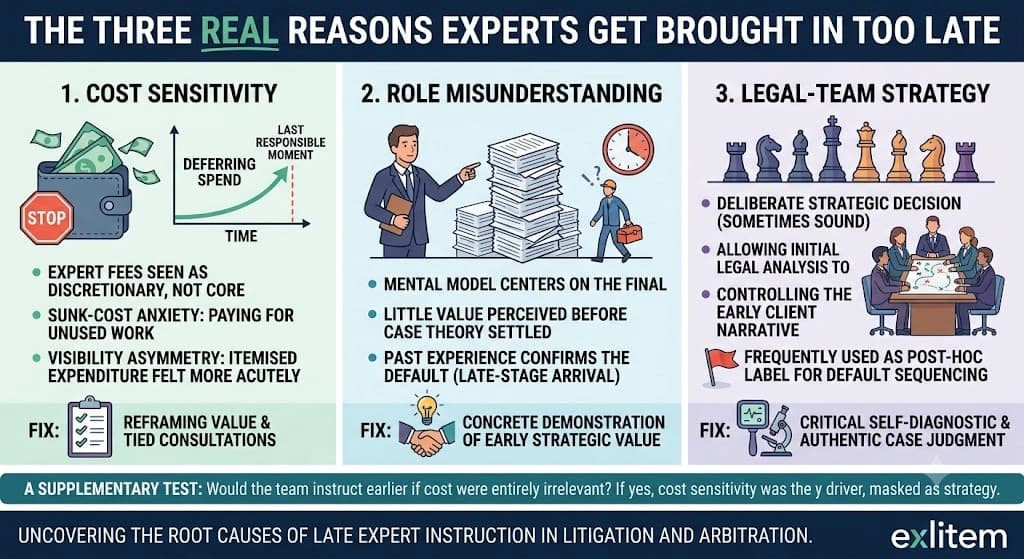


If the underlying reluctance to instruct an expert early is, in significant part, a matter of cost sensitivity, discussed at length elsewhere in this content series, the obvious next question is whether removing the cost risk would actually solve the problem. If pre-dispute expert consultation costs were reliably recoverable from the losing party at the end of a case, the same way many jurisdictions treat other categories of reasonably incurred litigation cost, would legal teams and clients actually start instructing experts earlier as a matter of course? The question is worth taking seriously on its own terms, rather than assuming the answer is an obvious yes simply because it addresses the most visible driver of delay.
This is a genuinely useful thought experiment precisely because it isolates one specific variable, cost risk, from the other contributing factors discussed elsewhere in this content series, role misunderstanding and structural convention among them. Testing whether fixing cost risk alone would be sufficient reveals a good deal about how much of the late-instruction problem is actually financial and how much runs deeper.
Why Cost Recoverability Matters for Timing Decisions in Principle
The basic logic behind the proposal is straightforward. Much of the reluctance to instruct an expert early stems from uncertainty about whether that cost will ultimately be justified, discussed elsewhere in this content series in terms of sunk-cost anxiety, the specific worry that a case will settle or resolve before the technical evidence is ever formally needed, leaving the client to absorb an expense that turned out, in hindsight, to have been unnecessary. If a client and their counsel could be reasonably confident that a well-scoped, appropriately documented pre-dispute expert consultation would be recoverable as a cost of the eventual proceeding, at least in cases that do proceed to a contested outcome, that specific anxiety would be meaningfully reduced.
There is also a signaling effect worth considering. A cost regime that explicitly treats early, well-scoped expert consultation as a recoverable, reasonable litigation cost sends a broader message about what constitutes prudent case preparation, potentially shifting the underlying convention discussed elsewhere in this content series over time, beyond its immediate effect on any single case's specific cost calculation. Practices that are explicitly sanctioned and recoverable tend to become normalized more quickly than practices that remain technically permissible but financially uncertain.
There is a further, more subtle mechanism worth considering: the effect on the specific conversation between counsel and client discussed at length elsewhere in this content series. A lawyer recommending early expert engagement to a client currently has to make that recommendation while also carrying some uncertainty about whether the associated cost will ultimately prove worthwhile if the case does not proceed to a contested outcome. Removing that uncertainty does not just change the client's calculation directly; it also changes how confidently and specifically counsel can make the recommendation in the first place, addressing part of the counsel-side hesitation discussed elsewhere in this content series as distinct from, but related to, the client's own cost sensitivity.
The Current State of Recoverability
Cost recovery practices vary considerably across jurisdictions and institutional settings, and the honest starting point for this discussion is that the treatment of pre-dispute expert costs is often genuinely uncertain rather than clearly established one way or another. Many cost regimes focus primarily on costs incurred once formal proceedings have begun, with earlier, pre-filing costs treated with more caution or scrutiny, reflecting a reasonable underlying concern that costs incurred before a dispute has crystallized are harder to connect clearly to the eventual proceeding and therefore harder to characterize confidently as reasonably and necessarily incurred.
This uncertainty itself is arguably a significant part of the problem, independent of whatever the underlying substantive rules actually permit in a given jurisdiction. A cost that is technically recoverable but uncertain enough in practice that no prudent legal team would confidently rely on that recoverability when making an early timing decision provides little of the behavioral benefit that clear, well-established recoverability would provide. The gap between "recoverable in principle" and "reliably treated as recoverable in practice, with enough certainty to actually influence behavior" matters enormously here, and it is a gap that exists in many cost regimes regardless of the specific formal rules on the books.
This pattern is worth comparing to how other categories of pre-proceeding cost have historically been treated, since expert consultation is not unique in facing this kind of recoverability ambiguity. Costs associated with early investigation, document preservation, and preliminary factual analysis have, in many settings, gone through a similar evolution, moving gradually from uncertain, case-by-case treatment toward more settled, predictable recoverability as institutional practice and precedent accumulated around what constitutes a genuinely reasonable early cost. There is no obvious reason pre-dispute expert consultation could not follow a similar trajectory over time, though the pace of that evolution depends heavily on how consistently and clearly institutions and cost-assessing bodies choose to address the specific question.
Why Recoverability Alone Might Not Be Enough
Even a jurisdiction or institutional setting with clear, reliable recoverability for pre-dispute expert costs would likely only address part of the underlying problem, because cost sensitivity is only one of the drivers discussed elsewhere in this content series. Role misunderstanding, the genuine belief among many lawyers that early expert involvement has limited strategic value, would remain entirely unaffected by a change in cost recoverability rules, since the barrier in these cases was never really about who ultimately bears the expense.
Structural convention, discussed elsewhere in this content series as a distinct contributing factor, would also likely persist even with more favorable cost recovery rules, at least in the near term. Practices that have become deeply embedded as the default expectation across a practice area or jurisdiction tend to shift gradually even when the underlying incentive structure changes, since much of the resistance to change is habitual rather than purely rational, a pattern well documented across many areas of professional practice beyond litigation specifically.
There is also a genuine risk that improved recoverability could be offset, in practice, by increased scrutiny of exactly what counts as a reasonable, properly scoped pre-dispute consultation. A cost regime that makes early expert costs more readily recoverable in principle but subjects them to more demanding documentation and justification requirements in practice may not actually reduce the behavioral friction discussed throughout this piece, even if the formal recoverability improves on paper.
A further limitation worth naming is that cost recoverability, even where clear and reliable, only addresses risk borne by the ultimately successful party. A client who loses a dispute, or settles on terms that do not include a favorable costs award, absorbs the pre-dispute expert cost regardless of how generous the applicable recoverability rules are for a winning party. This means cost recoverability reform, however well designed, cannot fully eliminate the underlying financial risk that drives cost sensitivity; it can only improve the expected value calculation for a party with a reasonably strong claim, which, while genuinely useful, still leaves real, irreducible risk in play for every case.
What Would Need to Change Beyond the Rule Itself
For cost recoverability to actually shift timing behavior meaningfully, it likely needs to be paired with genuine, reliable predictability in how that recoverability gets applied in practice, not just a favorable rule that remains uncertain in its actual application. This suggests that institutional guidance clarifying specifically what documentation and scoping would support a strong claim for recoverability of pre-dispute expert costs would do more practical work than the underlying substantive rule alone, giving legal teams a clear, actionable standard to work toward rather than a general principle whose practical application remains genuinely uncertain.
Awareness also matters considerably. A favorable, reliable cost recovery framework that practitioners are not broadly aware of, or do not trust to apply consistently based on limited or inconsistent past experience, will do little to change actual timing behavior regardless of how well-designed the underlying rule is. This connects back to the role-misunderstanding and structural-convention drivers discussed above, since genuine behavior change requires the improved rule to actually reach and be trusted by the practitioners whose timing decisions it is meant to influence.
There is also a useful role here for firms and practice groups specifically, distinct from institutional rule-making. A firm that develops its own internal, well-documented track record of successfully recovering pre-dispute expert costs across several matters builds exactly the kind of trusted, practitioner-level confidence that broader institutional guidance alone may take considerably longer to establish. This suggests that firms genuinely interested in shifting their own timing practices need not wait entirely on external rule clarification; building and circulating internal evidence of successful recovery, even from a modest number of matters, can meaningfully shift internal confidence and, by extension, internal timing behavior.
Practical Steps Counsel Can Take Now, Regardless of the Rule
Independent of how favorable or uncertain the applicable cost recovery framework happens to be, counsel can take specific steps to strengthen the case for recoverability of early expert costs where a claim for recovery might later be made. Documenting, contemporaneously, the specific reasoning behind an early expert engagement, why the consultation was scoped as it was, what it was intended to address, creates a clearer record supporting a later recoverability argument than a less-documented, more informal early engagement would.
Scoping the early engagement clearly and proportionately, discussed elsewhere in this content series regarding tiered, appropriately capped preliminary consultations, also strengthens the case for recoverability, since a modest, clearly justified early consultation is considerably easier to characterize as a reasonable litigation cost than an open-ended, more expansive engagement undertaken before the dispute's scope was genuinely clear.
Raising the recoverability question directly with the client, as part of the broader early-timing conversation discussed elsewhere in this content series, also helps, since a client who understands both the risk and the potential recoverability of an early expert cost is better positioned to make a genuinely informed decision than one presented with the cost in isolation, without any discussion of how that cost might ultimately be treated if the matter proceeds to a contested outcome.
It is also worth counsel considering, on a case-by-case basis, whether the engagement letter with the expert itself should be drafted with an eye toward supporting a later recoverability argument, for instance by clearly articulating the specific technical questions the consultation is meant to address and how those questions relate to the anticipated dispute. An engagement letter that reads as a clear, professional response to a specific, identifiable need supports a recoverability argument considerably better than one drafted in more generic or open-ended terms, and this is a low-cost drafting discipline available to any legal team regardless of the broader uncertainty in the applicable cost regime.
A Balanced Verdict: Would This Actually Fix It?
The honest answer is that improved cost recoverability would likely help, meaningfully, with the specific slice of the late-instruction problem that traces back to cost sensitivity, particularly the sunk-cost anxiety component discussed above, but it would not fully resolve the problem on its own, since role misunderstanding and structural convention operate largely independently of the underlying cost calculus. This is a genuinely useful finding rather than a disappointing one: it suggests that cost recovery reform is worth pursuing as one meaningful lever among several, rather than either dismissing it as pointless or expecting it, on its own, to solve a problem that has multiple distinct, only partially overlapping causes.
This also suggests a practical priority ordering for anyone genuinely interested in shifting timing practice broadly. Improved, reliable, well-publicized cost recovery guidance is worth advocating for and would likely produce real, if partial, behavioral change. Pairing that advocacy with the kind of direct, concrete demonstration of early expert value discussed elsewhere in this content series, addressing role misunderstanding specifically, would likely produce a considerably larger combined effect than either intervention pursued in isolation.
What This Means for Clients, Counsel, and Institutions
For clients, the implication is to ask counsel directly, when considering early expert engagement, about the likely recoverability of that specific cost under the applicable rules, rather than assuming either full recoverability or no recoverability without a specific, informed answer.
For counsel, the implication is to document and scope early expert engagements with an eye toward strengthening any later recoverability argument, treating this as standard practice rather than an afterthought considered only if a cost dispute later arises.
For institutions and rule-making bodies, the implication is that clarity and predictability in how pre-dispute expert costs are treated does more practical work than the underlying substantive generosity of the rule itself, suggesting that clear guidance and consistent application should be prioritized alongside, or even ahead of, simply expanding formal recoverability in the abstract.
Frequently Asked Questions
Are pre-dispute expert costs generally recoverable? This varies considerably by jurisdiction and institutional setting, and the honest answer in many cases is genuine uncertainty rather than a clear yes or no, which is itself a significant part of the behavioral problem discussed throughout this piece.
Does clearer cost recoverability guarantee earlier expert instruction? No. It would likely help address the cost-sensitivity driver of delay specifically, but role misunderstanding and structural convention, discussed elsewhere in this content series, would likely persist independently of any change in cost recovery rules.
What can counsel do now to strengthen a future recoverability argument for early expert costs? Documenting the specific reasoning behind the engagement contemporaneously, scoping it proportionately and clearly, and discussing the recoverability question directly with the client all strengthen the eventual position, regardless of how the underlying rules are ultimately applied.
Should clients rely on the assumption that early expert costs will be recovered? Not without a specific, informed conversation with counsel about the applicable rules and the likely strength of a recoverability argument in the specific case, given the genuine uncertainty that exists in many cost regimes on this particular question.
Would this issue benefit from clearer guidance at the institutional or rule-making level? Very likely. Institutions and cost-assessing bodies that publish clear, specific guidance on what documentation and scoping supports recoverability of pre-dispute expert costs would reduce a meaningful source of uncertainty that currently falls to individual practitioners to navigate case by case, often without much reliable precedent to draw on.
Conclusion
Cost-recovery clauses and favorable cost regimes for pre-dispute expert consultation would likely help address the specific slice of the late-instruction problem that traces back to genuine cost sensitivity, but they would not resolve the broader pattern on their own, since role misunderstanding and structural convention operate largely independently of the underlying cost calculus. The most effective path forward likely combines advocacy for clearer, more reliably applied cost recovery guidance with the kind of direct demonstration of early expert value needed to shift the other, non-financial drivers of delay discussed throughout this content series. Treated as one lever among several rather than a single, complete solution, cost recoverability is a genuinely useful piece of the broader fix.
Key Takeaways
● Improved cost recoverability for pre-dispute expert consultation would likely meaningfully reduce the sunk-cost anxiety that drives much of the cost-sensitivity component of late instruction.
● The genuine uncertainty in how many cost regimes treat pre-dispute expert costs is itself a significant part of the problem, independent of what the underlying substantive rules formally permit.
● Cost recoverability alone would not resolve the late-instruction problem fully, since role misunderstanding and structural convention operate largely independently of the underlying cost calculus.
● Counsel can strengthen the case for recoverability now, regardless of the applicable rules, through contemporaneous documentation, proportionate scoping, and direct conversation with clients about the recoverability question.
Position yourself where the legal industry looks for expertise - sign up on exlitem.com to get discovered by leading lawyers and high-value clients.