
Case Background
Seagen Inc., a biotechnology company based in Bothell, Washington, filed a patent infringement lawsuit against Daiichi Sankyo Co., Ltd., a Japanese pharmaceutical corporation, in the United States District Court for the Eastern District of Texas, Marshall Division, on October 19, 2020. AstraZeneca Pharmaceuticals LP and AstraZeneca UK Ltd. later intervened in the case as co-Defendants.
Cause
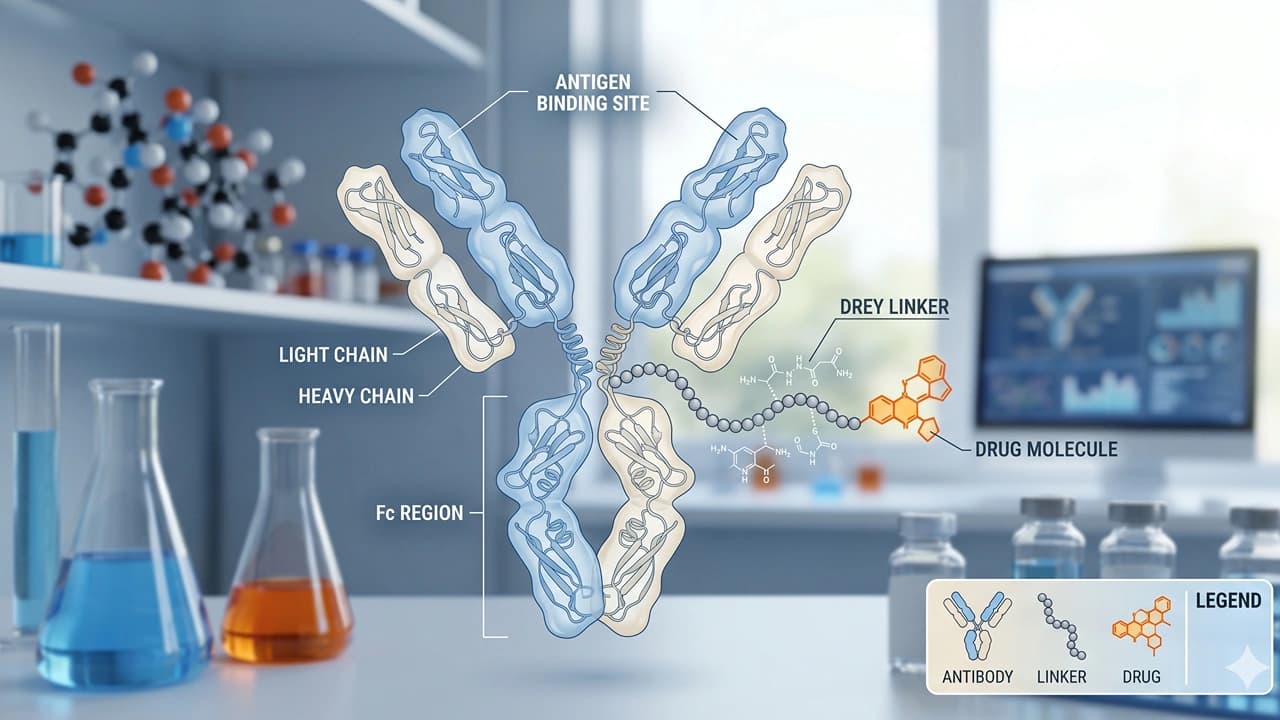
Seagen accused Daiichi Sankyo of infringing U.S. Patent No. 10,808,039 (the '039 patent), which covered technology related to antibody-drug conjugates (ADCs). Seagen claimed that Daiichi Sankyo's drug DS-8201, marketed as Enhertu, used a linker technology that fell within the scope of the '039 patent's claims. According to Seagen, the '039 patent covered ADCs with a protease-cleavable linker made of four amino acids, where each amino acid was either glycine or phenylalanine.
Injury
Seagen alleged that Daiichi Sankyo made, used, sold, offered for sale, and imported Enhertu into the United States without permission, causing Seagen to lose profits it would have otherwise earned from its patented technology. Seagen also claimed that Daiichi Sankyo's infringement extended to inducing and contributing to infringement by others, including importers, manufacturers, sellers, and users of Enhertu.
Damages Sought
Seagen requested a judgment that Daiichi Sankyo infringed the '039 patent, a finding that the infringement was willful, an award of damages including lost profits or a reasonable royalty, pre-judgment and post-judgment interest, attorney fees, and an enhancement of damages under 35 U.S.C. § 285 due to the alleged exceptional nature of the case. Seagen also asked for a running royalty on future sales.
Key Arguments and Proceedings
Legal Representation
Plaintiff: Seagen Inc.
· Counsel for Plaintiff: Michael A. Jacobs | Matthew A. Chivvis | Bryan Wilson | Pieter S. de Ganon | Melissa R. Smith | T. John Ward Jr | Charles Everingham IV | Andrea L. Fair | Sara Horton | Andrew Thompson (Tom) Gorham | Evelyn Li-Jin Chang | Harry Lee Gillam , Jr | Hyun Kyu Christopher Han | Jack Wesley Hill | James Travis Underwood | Matthew I Kreeger
Defendants: Daiichi Sankyo Co., Ltd., AstraZeneca Pharmaceuticals LP, and AstraZeneca UK Ltd.
· Counsel for Defendants: Deron R. Dacus | J. Mark Mann | Preston K. Ratliff II | Alexandra J. Cho | Amanda L. Pober | Ariell Bratton | Ashley Mays-Williams | Dana Weir | Garrett J Schuman | Gregory Blake Thompson | Isaac S Ashkenazi | Jacob A. Silvers | Jeffrey A. Pade | Jessica M Stauring | Justin T Fleischacker | Kyotaro Ozawa | Lucas L Kressel | Michael J Fisher | Nicholas Lane Evoy | Shannon Marie Dacus | Susan S. Hwang
Claims
Seagen claimed that the '039 patent covered ADCs with a specific linker structure, consisting of a stretcher unit that bonded to a sulfur atom on a cysteine residue of an antibody, a tetrapeptide amino acid unit made up only of glycine and phenylalanine, and a spacer unit connecting the amino acid unit to the drug. Seagen alleged that Enhertu contained a linker with the amino acid sequence GGFG, which matched this description, and that the drug-to-antibody ratio in Enhertu fell within the range claimed in the patent.
Seagen further claimed that Daiichi Sankyo knew about the patent application that led to the '039 patent since at least 2008 and knew about the specific application that became the '039 patent since at least June 2020. Based on this, Seagen argued that Daiichi Sankyo's infringement was willful and that Daiichi Sankyo had compared its own linker technology to Seagen's in internal articles, analyses, and presentations.
Defense
Daiichi Sankyo Japan denied nearly every allegation in Seagen's complaint, including the claims of infringement, the description of antibody-drug conjugate technology, and the assertion that Enhertu's linker matched the patent's claims. Daiichi Sankyo also raised several defenses, arguing that it did not infringe any valid claim of the '039 patent, either directly or indirectly.
Daiichi Sankyo's central defense at trial focused on the validity of the '039 patent itself. The company argued that the patent, which was filed in July 2019, claimed priority back to a 2004 patent application. Daiichi Sankyo contended that the 2004 application did not provide written description support for the specific tetrapeptide linker made only of glycine and phenylalanine that was claimed in the '039 patent. According to Daiichi Sankyo, the 2004 application broadly described millions of possible amino acid combinations for the linker, but never specifically disclosed or pointed to the narrow group of 81 glycine/phenylalanine-only tetrapeptides covered by the '039 patent claims.
Daiichi Sankyo also argued that the '039 patent failed to meet the enablement requirement, meaning the patent did not teach a skilled person how to make and use the full range of inventions covered by its claims without excessive experimentation. Since the patent covered any drug moiety that could be intracellularly cleaved from the antibody, and ADC science was highly unpredictable, Daiichi Sankyo argued that a skilled person would need to run tests on each individual ADC to determine whether it worked as claimed.
Additionally, Daiichi Sankyo raised defenses including prosecution laches, claiming Seagen unreasonably delayed prosecuting the patent application, as well as estoppel, waiver, unclean hands, and prosecution history estoppel. Daiichi Sankyo also argued that its pipeline products, including U3-1402, DS-1062, DS-7300, and DS-6157, did not infringe as a matter of law under the safe harbor provision of 35 U.S.C. § 271(e)(1).
Jury Verdict
The jury reached its verdict on April 8, 2022. The jury found that Seagen proved by a preponderance of the evidence that Daiichi Sankyo infringed at least one of the asserted claims of the '039 patent. The jury also found that Daiichi Sankyo did not prove by clear and convincing evidence that any of the asserted claims, claims 1 through 5, 9, and 10, were invalid.
The jury further found that Seagen proved Daiichi Sankyo's infringement was willful. For damages, the jury awarded Seagen $41,820,000 to compensate for infringement occurring between October 20, 2020, and March 31, 2022.
Appeal Judgment
Following the verdict, the district Court denied Daiichi Sankyo's motion for judgment as a matter of law and entered final judgment in favor of Seagen. Daiichi Sankyo appealed the decision to the United States Court of Appeals for the Federal Circuit.
On December 2, 2025, the Federal Circuit reversed the district Court's decision. The appeals Court found that the 2004 application did not provide adequate written description support for the narrow group of glycine/phenylalanine-only tetrapeptides claimed in the '039 patent, and that the patent did not meet the enablement requirement because it covered too broad a range of drug moieties without teaching how to make and use all of them without excessive experimentation. As a result, the Federal Circuit ruled that the '039 patent was invalid, reversed the denial of judgment as a matter of law, and vacated the jury's findings of willful infringement and the damages award.
Court documents are available upon request at [email protected]