

Case Background
Viasat, Inc. filed a patent infringement lawsuit against Kioxia Corporation and Kioxia America, Inc. in the United States District Court for the Western District of Texas, Waco Division. Viasat filed its First Amended Complaint on April 22, 2022, asserting that Kioxia infringed U.S. Patent No. 8,615,700, titled "Forward error correction with parallel error detection for flash memories."
Viasat described itself as a global communications company founded in 1986 and headquartered in Carlsbad, California. Viasat stated that its engineers used knowledge gained from designing error-correction systems for satellites and fiber optics to design an improved architecture for error correction in flash memory. Kioxia Corporation, formerly known as Toshiba Memory Corporation, was a corporation organized under the laws of Japan with its principal place of business in Tokyo. Kioxia America, Inc., formerly Toshiba Memory America, Inc., was a subsidiary of Kioxia Corporation organized under the laws of California, with its principal place of business in San Jose, California, and an established place of business in Round Rock, Texas.
Cause
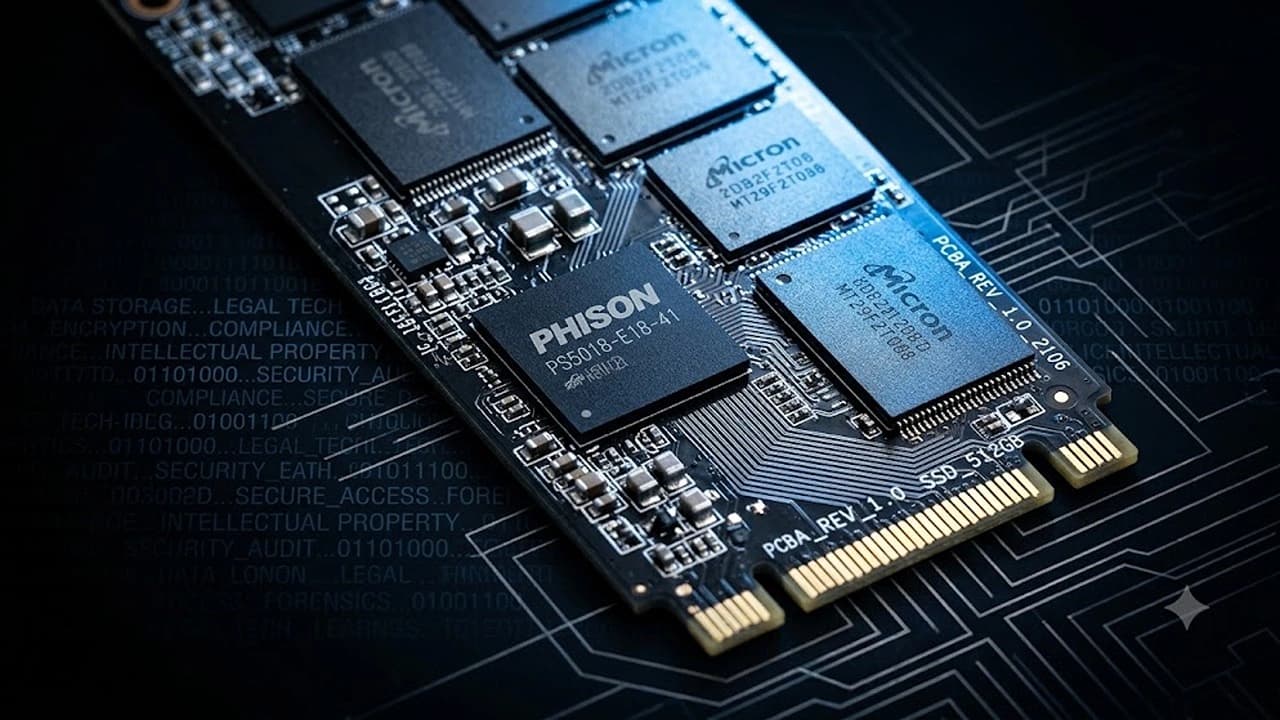
Viasat alleged that Kioxia infringed the '700 patent through the manufacture, use, and sale of NAND-flash-memory-containing products, including Enterprise SSDs, Data Center SSDs, and Client SSDs. Viasat identified Kioxia's KSG60ZSE256G SSD as an example of an infringing product, alleging that its controller used an error correction system that Kioxia referred to as Quadruple Swing-By Code, or QSBC. Viasat alleged that claim 1 of the '700 patent covered a flash memory decoder comprising a decoding module configured to generate multiple partially decoded data streams, an error detection module with multiple sub-modules operating in parallel, and an error correction module that was communicatively coupled with and physically separate from the error detection module.
Injury
Viasat alleged that Kioxia had infringed and continued to infringe the '700 patent, and that Kioxia had known of the patent and the infringement allegations since December 7, 2021, the date Kioxia consented to service of the original complaint. Viasat alleged that Kioxia continued to sell the accused products after that date. Viasat sought monetary damages for this infringement.
Damages Sought
Viasat asked the Court to enter judgment that Kioxia infringed one or more claims of the '700 patent, and to award damages sufficient to compensate Viasat under 35 U.S.C. § 284. Viasat also asked the Court to find the case exceptional under 35 U.S.C. § 285 and award attorneys' fees, to find that Kioxia willfully infringed the patent and award enhanced damages under 35 U.S.C. § 284, and to award costs, expenses, and pre-judgment and post-judgment interest.
Key Arguments and Proceedings
Legal Representation
Plaintiff / Counter-Defendant: Viasat, Inc.
· Counsel for Plaintiff/Counter-Defendant Viasat, Inc.: J. Scott McBride | Jordan Golds | Macgregor Lebuhn | Matthew R. Ford | Nevin M. Gewertz | Nosson D. Knobloch | Ravi D. Shah (terminated 01/07/2026) | Samara Hoose (terminated 01/23/2024) | Tulsi E. Gaonkar | James Travis Underwood | Jessica R. Bernhardt | Meg E. Fasulo | Melissa Richards Smith
Defendants: Kioxia Corporation | Kioxia America, Inc.
· Counsel for Defendants/Counter-Plaintiffs Kioxia Corporation and Kioxia America, Inc.: Lute Yang (terminated 12/29/2025) | Michael Hawes | Spencer Packard (terminated 06/13/2024) | Bradley Bowling (terminated 04/07/2023) | Brandon Chen (terminated 07/12/2023) | Craig D. Cherry | Elizabeth L. Flannery | Mark D. Siegmund | Michael A. Silliman | Nolan Edward Sullivan McQueen | Robinson Vu (terminated 12/29/2025) | Roger J. Fulghum
Key Arguments or Remarks by Counsel
Claims
Viasat alleged that Kioxia infringed at least claims 1 and 17 of the '700 patent by making, using, selling, offering for sale, and importing the accused products without authority or license, in violation of 35 U.S.C. § 271(a). Viasat also alleged induced infringement under 35 U.S.C. § 271(b), asserting that Kioxia encouraged its customers to operate the accused products in a manner that used the patented technology. Viasat further alleged contributory infringement under 35 U.S.C. § 271(c), asserting that Kioxia's flash-memory controllers had no substantial non-infringing use. Viasat alleged that Kioxia's infringement was willful because Kioxia had known of the '700 patent and its infringement since no later than December 7, 2021, and continued selling the accused products afterward.
Defense
Kioxia denied that Viasat held any right, title, or interest in the '700 patent, and denied that it had infringed the patent, directly or indirectly, literally or under the doctrine of equivalents. Kioxia asserted that the claims of the '700 patent were invalid for failure to comply with 35 U.S.C. §§ 101, 102, 103, 112, and/or 120. Kioxia asserted that Viasat's claims were barred in whole or in part by estoppel and waiver, including prosecution history estoppel. Kioxia asserted that any damages were limited under 35 U.S.C. §§ 286, 287, and 288, and that Viasat could not recover damages for any activity occurring before Kioxia received actual notice of the infringement allegations. Kioxia asserted that Viasat could not establish willful infringement or show that the case was exceptional under 35 U.S.C. § 285.
Kioxia America, Inc. filed counterclaims against Viasat seeking a declaratory judgment that KAI did not infringe any claim of the '700 patent and a declaratory judgment that all claims of the '700 patent were invalid. Viasat answered these counterclaims and denied that KAI was entitled to a declaratory judgment of non-infringement or invalidity.
Jury Verdict
The jury returned its verdict on July 16, 2026. The jury found that Viasat proved by a preponderance of the evidence that Kioxia infringed Claim 16 of the '700 patent with respect to three controllers identified in the verdict form as Canopus, Deneb, and Elnath. The jury answered "Yes" for all three controllers, and under the terms of the verdict form, a "Yes" answer constituted a finding for Viasat as to each controller.
Having found infringement, the jury awarded Viasat $229,025,021.00 in damages to compensate Viasat for Kioxia's infringement. The jury further found that this award constituted a running royalty to compensate Viasat for Kioxia's past infringement through March 30, 2026, rather than a one-time lump sum payment covering all past and future use.
The jury foreperson signed and dated the verdict form on July 16, 2026, certifying that the jury unanimously concurred in every element of the verdict. The Clerk of the U.S. District Court for the Western District of Texas filed the verdict on July 16, 2026, as Document 295 in the case docket.
Court documents are available upon request at [email protected]