Case Background
David Alan Cole and his wife, Kimberly Cole, sued Sig Sauer, Inc. over an unintended discharge of a P320 pistol. They filed the suit in Somerset County Superior Court. Sig Sauer removed it to the U.S. District Court for the District of Maine in August 2023.
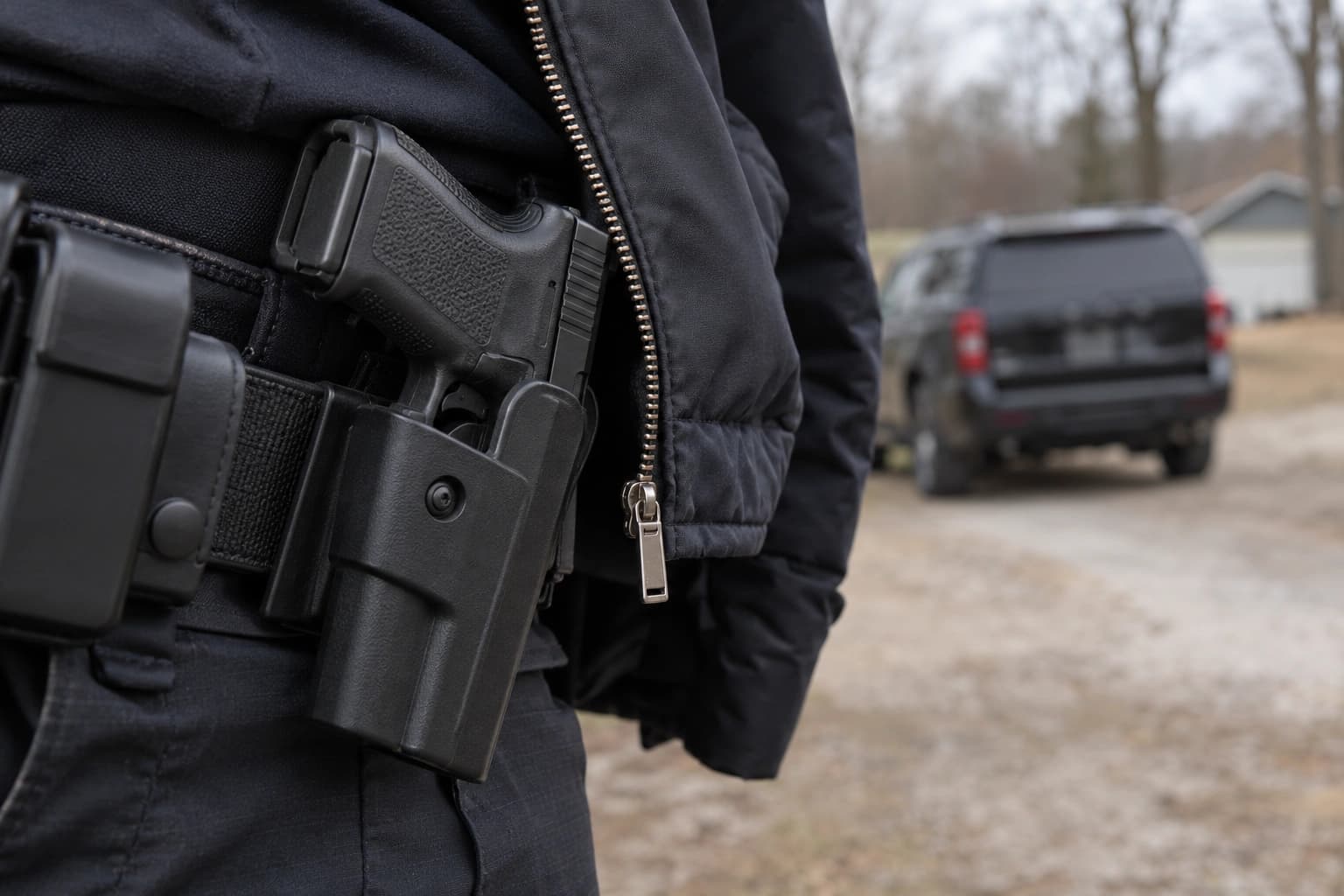
Cole worked as a detective with the Somerset County Sheriff’s Office. The office issued him the P320 as his service firearm. On May 4, 2022, the pistol discharged while holstered on his belt. Cole was executing a search warrant in Sangerville, Maine, with officers from Somerset and Piscataquis counties.
The Coles alleged that the P320 was defectively designed because it lacked external safety features. They pointed to a tabbed trigger or thumb safety as safer options. According to the Court’s summary judgment order, all expert witnesses concluded that the trigger was actuated. They found that a zipper on Cole’s coat most likely contacted the trigger. The parties disputed whether the P320’s design made it defective.
Cause
According to the complaint, the incident occurred after officers secured the residence. Cole planned to walk to his vehicle to retrieve items. He held his jacket in both hands while walking. The P320 remained in its holster on his belt. Cole then heard a gunshot and realized that he had been struck.
Sig Sauer's final pretrial memorandum described the pistol as holstered in a Blackhawk Serpa CQC paddle holster. It stated that Cole was removing his jacket on the gun side. Sig Sauer said testing established that a foreign object inadvertently activated the trigger. It identified the jacket's zipper tab as the most likely object.
Injury
The complaint alleged that the bullet struck Cole's upper right thigh. It exited the same area and penetrated his right calf. The bullet then reached his right ankle. It remained there until surgeons removed it.
Cole underwent emergency surgery on his right leg. He underwent a second surgery two days later. He remained hospitalized for three days following the procedures. The defense memorandum stated that Cole later returned to his detective position.
Damages
Cole sought compensation for physical and emotional injuries. His claimed damages included past, current, and future losses. Plaintiffs sought economic and noneconomic damages. They also claimed medical, attendant-care, and life-care expenses.
The complaint also alleged mental anguish, inconvenience, diminished enjoyment of life, physical deformity, handicap, and embarrassment. It claimed lost earnings and diminished earning capacity. Plaintiffs alleged that some injuries and impairments would continue into the future.
Kimberly Cole asserted a loss-of-consortium claim. She alleged that David's injuries affected their love, assistance, companionship, consortium, and society. Plaintiffs also sought punitive damages. The complaint alleged continuing medical treatment and counseling expenses.
Key Arguments and Proceedings
Legal Representation
Plaintiff(s): David Alan Cole | Kimberly Cole.
Counsel for Plaintiff(s): Michael T. Bigos | Joseph G.E. Gousse [Terminated: 03/04/2026] | Robert J. Mongeluzzi | Robert W. Zimmerman | Larry Bendesky | Ryan D. Hurd | Michael T. Benz | Samuel A. Haaz
Defendant(s): Sig Sauer, Inc.
Counsel for Defendant(s): Martha C. Gaythwaite | Jeffrey D. Russell | Kristen E. Dennison | Mark V. Franco [Terminated: 06/05/2025] | Brian Keith Gibson | Douglas F. Hartman | Brett R. Leland | Demetrio F. Aspiras [Terminated: 06/05/2025] | Jonathan T. Woy [Terminated: 08/12/2024]
Key Arguments or Remarks by Counsel
Claims
Plaintiffs asserted eight counts. They alleged negligence. They also alleged strict products liability under Maine’s products liability statute. They further asserted fraudulent concealment and negligent failure to warn.
The remaining claims alleged defective design or manufacture and breach of implied warranty of merchantability. Kimberly Cole asserted loss of consortium. Plaintiffs also sought punitive damages based on alleged actual or implied malice.
Plaintiffs argued that safer alternatives existed. They identified external safety mechanisms, including tabbed triggers, manual thumb safeties, and grip safeties. They also challenged the warnings and testing associated with the P320.
Defense
Sig Sauer denied that the P320 could fire without trigger actuation. It denied that the pistol was defective or unreasonably dangerous. It also denied that its warnings were inadequate.
The defense argued that the P320 contained redundant internal safeties. It maintained that accidental discharges could involve foreign objects or other circumstances affecting firearms. Sig Sauer also challenged evidence concerning other incidents and its Voluntary Upgrade Program.
Sig Sauer raised several affirmative defenses. They included improper use, adequate warnings, negligence of others, contributory negligence, and intervening cause. The defenses also included pre-existing conditions, failure to mitigate, assumption of risk, setoff, government-standard compliance, misuse, and state-of-the-art arguments.
Pre-trial Motion
Sig Sauer moved for summary judgment. It argued that the P320 was not defective and that Plaintiffs could not prove causation.
On March 31, 2026, the Court denied the motion. It found genuine issues for trial on design defect, inadequate warning, and proximate causation. All remaining claims proceeded to trial.
Jury Verdict
On August 7, 2026, the Court ruled on Sig Sauer’s renewed motion for judgment as a matter of law. It granted the motion on the fraudulent concealment claim and denied it on the remaining claims.
The jury returned its verdict the same day. The filed verdict form showed questions on strict product liability and breach of warranty of merchantability.
The first question addressed strict product liability. It asked whether Plaintiffs proved the P320 was defective and unreasonably dangerous when sold. The question covered both the pistol’s design and Defendant’s failure to provide adequate warnings. The jury marked “No.”
The form directed the jury to skip the follow-up causation question after that finding. The jury did not decide whether any defect legally caused Cole’s injuries under that claim.
The next question shown addressed breach of warranty of merchantability. It asked whether Plaintiffs proved the P320 had a defect when sold. The question asked whether that defect made the pistol unfit for its ordinary purposes. The jury marked “No.”
The jury answered “No” to both liability questions shown on the form. It did not award damages to David or Kimberly Cole.
The Court entered judgment for Defendant Sig Sauer and against both Plaintiffs on August 10, 2026.
Post-trial Motions
Plaintiffs filed a Rule 59 motion for a new trial on September 8, 2026. They raised two grounds.
First, Plaintiffs alleged that Defendant played an undisclosed testing video at trial on August 6, 2026. They stated that Defendant's expert Derek Watkins conducted rebuttal testing in July 2025 that was never produced in discovery. The video was played during the direct examination of Defendant's expert Dr. Eric Warren. Plaintiffs argued the video showed Watkins actuating a tabbed-trigger P320 in seconds. They maintained that their own expert, Dr. William Vigilante, had taken nearly two minutes in comparable testing. Plaintiffs alleged the undisclosed video undermined Dr. Vigilante's credibility on a central issue. The Court struck the video and instructed the jury to disregard it. Plaintiffs argued the instruction could not cure the prejudice. They also alleged that Dr. Warren offered surprise testimony about undisclosed Agency Arms tabbed-trigger testing not referenced in any expert report.
Second, Plaintiffs alleged that defense counsel made repeated references throughout trial to unintended discharges involving other manufacturers. They named Glock, Smith & Wesson, Colt, Remington, and Winchester. Plaintiffs argued these references exceeded the Court's pretrial ruling on admissible similar incidents. They moved for sanctions, which the Court denied. The Court gave a general instruction that lawyers' questions are not evidence. Plaintiffs argued the cumulative effect of the references denied them a fair trial. They noted the jury deliberated approximately 13 hours over two days. Sig Sauer opposed the motion on September 29, 2026. Plaintiffs filed a reply on October 13, 2026. The motion remained pending as of October 27, 2026.
Court Documents:
Documents are available for purchase upon request at [email protected]