
Case Background
Aldin Lewis, an Oklahoma City resident, sued truck driver Wilayat Hussain and his employer, Chandi 209 Trucking, Inc. The suit followed a late-night collision on an Oklahoma County roadway. The dispute centered on whether Hussain stopped at a stop sign and whether Chandi properly vetted him.
Lewis filed his Petition in the District Court of Oklahoma County on October 3, 2024. Defendants removed the case to federal court on October 23, 2024, citing diversity of citizenship. The case proceeded in the U.S. District Court for the Western District of Oklahoma before Judge Patrick R. Wyrick.
Cause
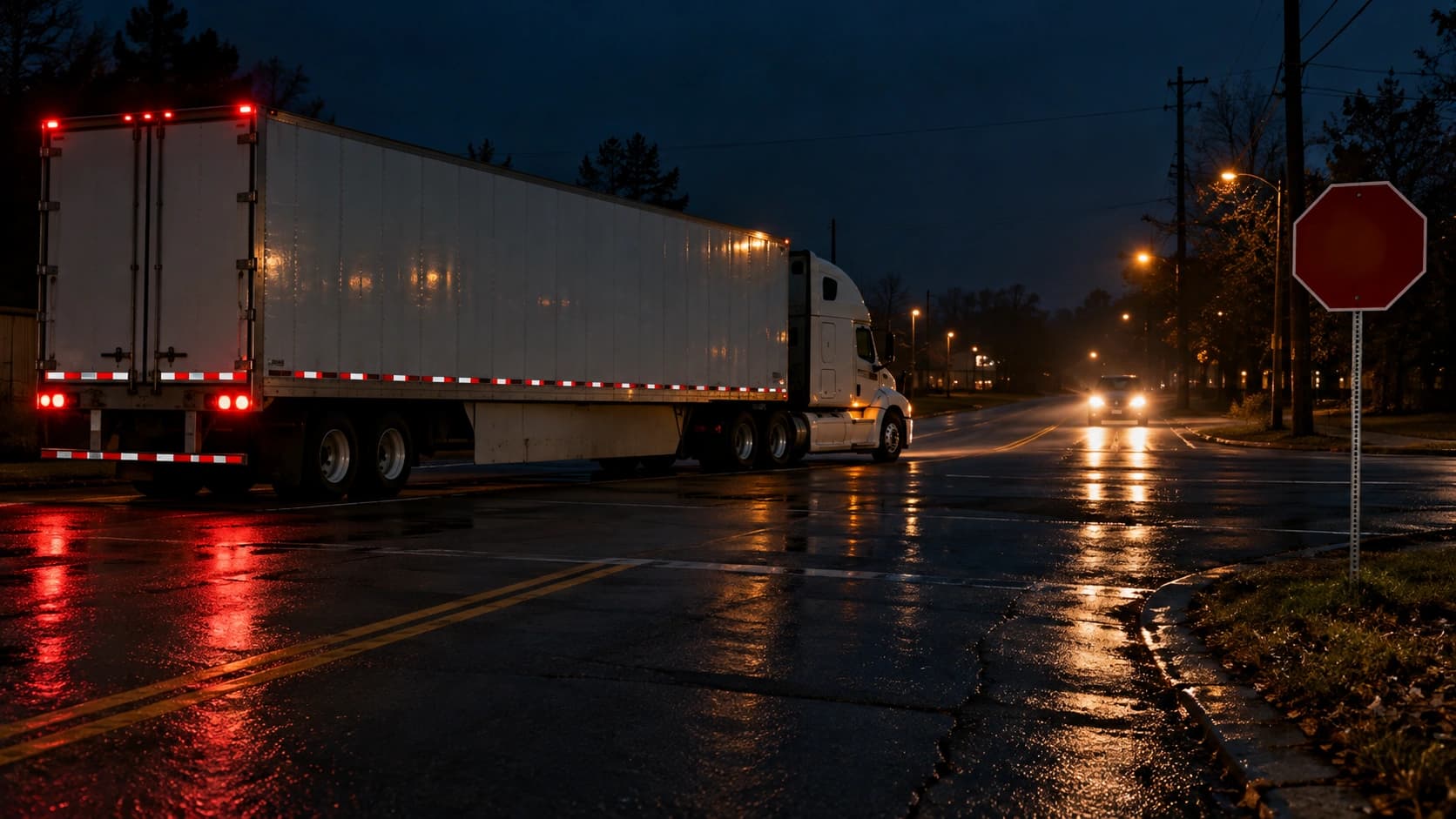
The crash occurred on March 3, 2024, at or near the intersection of W. Reno Avenue and Frontier Drive. Hussain was driving a tractor-trailer for Chandi at the time.
According to the Court, Hussain was turning right when Lewis's vehicle struck the trailer's left rear side. The parties disputed whether Hussain failed to stop at a stop sign before making the turn.
Lewis alleged that Hussain operated the truck recklessly and negligently while working for Chandi. Hussain admitted in his Answer that he was acting within the course and scope of his employment.
Injury
The Petition alleged that Lewis sustained personal injuries in the crash. According to the Court's post-trial order, the jury heard evidence that Lewis suffered a cervical fracture. He wore a neck brace for about three months.
Lewis described significant pain, restricted movement, and reliance on others for ordinary household tasks. He underwent physical therapy and pain management treatment. Plaintiff's expert disclosures flagged a possible cervical decompression and fusion at C5/C6, and possibly at C6/C7.
Damages
Lewis sought past and future damages for pain and suffering, disability, and medical expenses. He also claimed lost income and loss of enjoyment of life. He demanded judgment above the federal diversity threshold. Finally, he requested punitive damages, if appropriate.
Key Arguments and Proceedings
Legal Representation
Plaintiff(s): Aldin Lewis
Counsel for Plaintiff(s): Nathan D. Rex | L. Grant Gibson | Travis Leverett | James A. Scimeca
Defendant(s): Wilayat Hussain | Chandi 209 Trucking, Inc.
Counsel for Defendant(s): Maurice G. Woods, II [Terminated: 04/14/2026] | Seth A. Caywood | Ashley H. Leavitt
Claims
Lewis asserted negligence and negligence per se against Hussain. He sought to hold Chandi vicariously liable for Hussain's driving. He also brought direct claims against Chandi for negligent entrustment, negligent hiring, negligent training, and negligent retention.
Defense
Both Defendants denied negligence and causation. They argued that third parties, or Lewis himself, caused the crash. They also invoked sudden emergency and unavoidable casualty.
Defendants disputed the extent of Lewis's injuries and raised assumption of risk. They sought a reduction of medical bills under 12 O.S. § 3009.1. They also argued that punitive damages were unwarranted and unconstitutional.
Pre-trial Motion
On March 11, 2026, the Court granted in part and denied in part Defendants' Motion for Summary Judgment. The Court found genuine factual disputes on proximate cause and negligent entrustment. It denied judgment on negligence per se, finding summary judgment an improper vehicle for a pleading challenge. Defendants had stipulated that Hussain acted within the scope of his employment. Applying Jordan v. Cates, the Court granted judgment on the negligent hiring, training, and retention claims.
Expert Testimony
The case went to trial on March 24, 2026. Hussain did not appear, so the jury heard his videotaped deposition.
Lewis called crash reconstruction specialist Jason Riddle, ACTAR #2688, of Riddle Reconstruction & Consulting. According to the Court's post-trial order, Riddle testified that Lewis took evasive action after perceiving the truck. He denied ever saying that Lewis braked improperly. Asked who caused the wreck, Riddle answered, “Mr. Hussain by not stopping and yielding from the stop sign.”
Defendants relied on accident reconstruction expert Ronald L. Blevins. Defendants later asserted that both reconstruction experts agreed Lewis did not brake until about one second before impact. The Court rejected the claim that this evidence showed, without dispute, that Lewis caused the crash.
Lewis's treating physicians testified through trial depositions. Dr. Qualls E. Stevens, a neurosurgeon with Neurosurgical & Spine Associates of Oklahoma, testified about cervical fusion surgery. He recommended it “to try to address the compression that was on his nerves and his spinal cord.” He opined that Lewis's symptoms would not resolve without it.
Dr. Justin R. Porter, an interventional pain management specialist with Oklahoma Pain Management, also testified. He said Lewis “will require additional future treatments as a result of his injuries.” He cited therapy, chiropractic adjustments, and “probably some repeat injections.” He noted that surgery might become necessary.
Life care planner Ashley G. Lastrapes, PhD, of Stokes & Associates, built on those recommendations. She estimated Lewis's future care costs at between $356,422.84 and $799,665.91. Her plan included 10 to 40 epidural injections, cervical fusion surgery, physical therapy, and regular diagnostic imaging.
Jury Verdict
On March 26, 2026, the jury returned unanimous verdicts for Lewis. It found Hussain and Chandi, by and through Hussain, liable for negligence. The jury assigned 95% of the negligence to Defendants and 5% to Lewis.
The jury also found Chandi liable for negligent entrustment. By clear and convincing evidence, it found that Chandi acted in reckless disregard of the rights of others.
The jury fixed Lewis's actual damages at $4,500,000. The verdict form instructed that the Court would reduce that amount by Lewis's share of fault. In a separate punitive damages phase, the jury awarded $3,500,000 against Chandi.
On March 27, 2026, the Court entered judgment for Lewis. Applying the 5% reduction, it awarded $4,275,000 in actual damages against both Defendants. That award covered the negligence and negligent entrustment claims. The Court entered the full $3,500,000 punitive award against Chandi alone.
Post-trial Motions
On April 24, 2026, Defendants sought judgment as a matter of law or, alternatively, a new trial. They argued that Hussain's truck was merely a condition in the roadway, not the proximate cause. They also challenged the future damages evidence, the negligent entrustment proof, and the size of both awards.
Defendants further claimed that references to Hussain's immigration status prejudiced the jury. Chandi argued that the verdict would bankrupt the company. Defendants also challenged the Court's refusal to let Hussain testify remotely, and they claimed cumulative error.
On August 31, 2026, the Court denied the motion in full. It found sufficient evidence, including Riddle's testimony, to support the jury's causation finding. The Court held that Defendants had not preserved their future damages argument. It added that Lewis had disclosed both treating physicians as expert witnesses in December 2025.
The Court also found sufficient evidence of negligent entrustment and reckless disregard. It found no improper appeal to national origin bias by Lewis's counsel. It also rejected the remote testimony and cumulative error arguments.
The Court upheld both awards. The punitive award fell within Oklahoma's statutory cap. The ratio of punitive to compensatory damages was approximately 0.78 to 1. Defendants did not seek remittitur.
On September 30, 2026, Defendants appealed to the U.S. Court of Appeals for the Tenth Circuit.
Court Documents:
Documents are available for purchase upon request at [email protected]