Case Background
PLS IV, LLC sued GDC Technology Limited in the U.S. District Court for the Eastern District of Texas. PLS alleged that GDC’s digital cinema equipment infringed patents on security technology that protects movies shown in theaters.
PLS filed its Complaint on June 21, 2024. PLS is a Delaware limited liability company based in New York. GDC is a company based in Hong Kong. According to the Complaint, the patented technology came from Intertrust Technologies Corporation. The Complaint described Intertrust as a pioneer of digital rights management. PLS acquired all rights in the patents by assignment.
District Judge Rodney Gilstrap presided over the case in the Marshall Division. The case went to a jury trial in the fall of 2026.
Cause
The Complaint alleged that the cinema industry adopted the patented technology through specifications issued by Digital Cinema Initiatives, or DCI. According to PLS, almost all feature films were distributed digitally under the DCI specification. Theaters played them on DCI-compliant systems that protected the content.
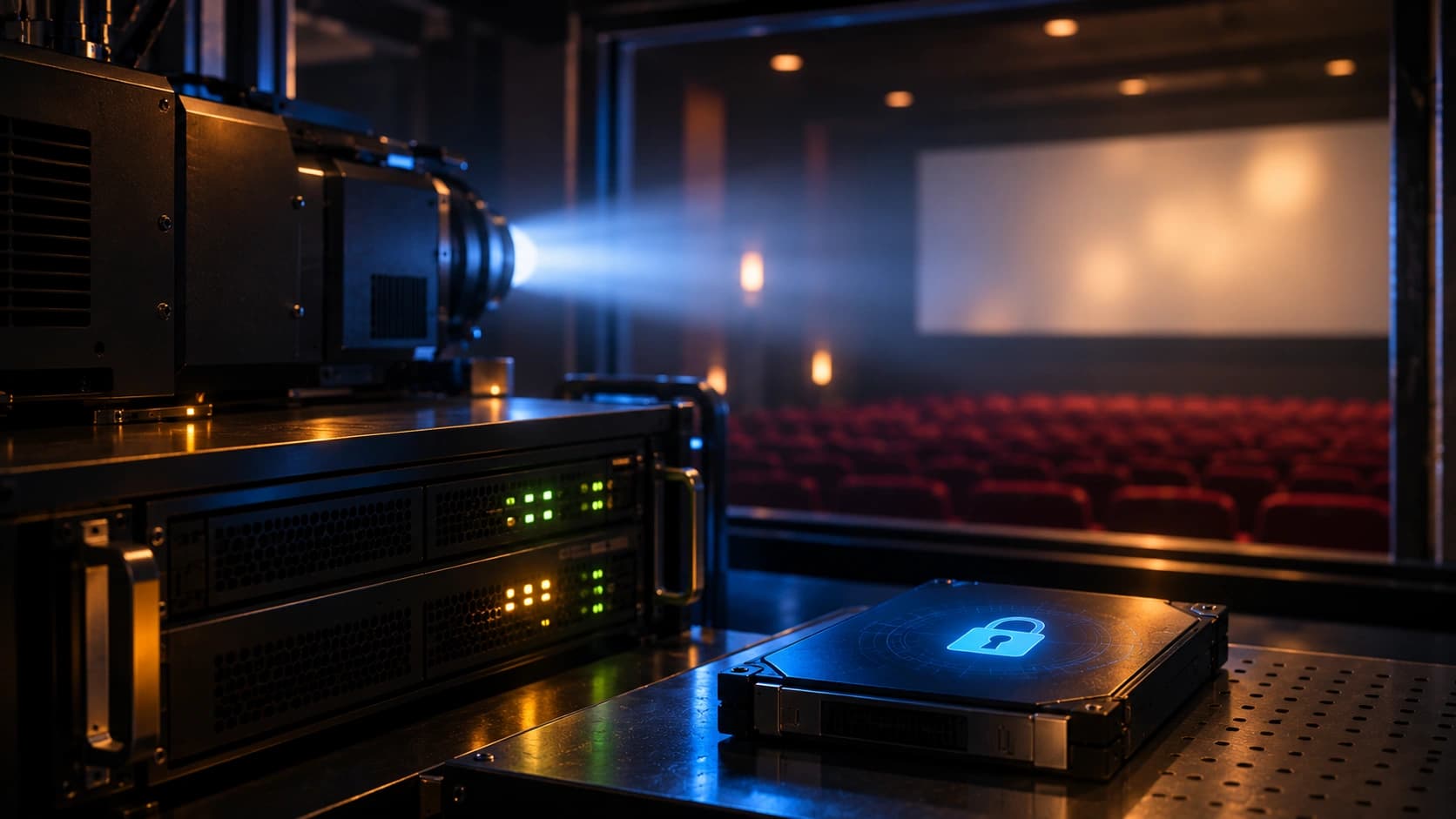
The Complaint explained how these systems worked. Before a showing, a theater received a Digital Cinema Package holding the encrypted movie. It also received a Key Delivery Message containing encrypted keys and usage rules. A media block inside the system checked those rules. It then decrypted and played the film only if the request fell within the permitted terms.
PLS accused GDC’s DCI-compliant media servers and media blocks. It also accused GDC’s screen management and theater management systems. PLS alleged that GDC infringed by designing, making, importing, selling and using these products. It also pointed to GDC’s product testing and demonstrations at U.S. trade shows, including CinemaCon 2021 and CinemaCon 2022.
Injury
PLS alleged that GDC knew about the patents and the claimed infringement for years. According to the Complaint, Intertrust sent notice letters to GDC customers in April 2018. In August 2019, Intertrust sued GDC customers, including AMC, Cinemark and Regal. PLS alleged those suits were based partly on the customers’ use of GDC products.
PLS further alleged that GDC kept selling its products after learning of these claims. It stated that neither PLS nor any prior patent owner ever licensed GDC. The Complaint alleged that PLS suffered substantial damages as a result.
Damages
The Complaint did not state a specific dollar amount. Instead, PLS sought damages of no less than a reasonable royalty. It also requested prejudgment and post-judgment interest.
In addition, PLS asked the Court to find the infringement willful and to treble damages under 35 U.S.C. § 284. It sought a declaration that the case was exceptional under 35 U.S.C. § 285. That declaration would support an award of attorneys’ fees, costs and expenses.
Key Arguments and Proceedings
Legal Representation
Plaintiff(s): PLS IV, LLC
Counsel for Plaintiff(s): Tigran Guledjian | Andrea Leigh Fair | Christopher Anthony Mathews | Claire Hausman | Claire Abernathy Henry | Garrett C. Parish | Jordan Brock Kaericher | Maggie Moriarity Miltko | Moon Hee Lee | Razmig Hagop Messerian | Scott A. Florance | Scott Liscom Watson | Valerie Anne Lozano
Defendant(s): GDC Technology Limited
Counsel for Defendant(s): Paul V. Storm | Roland Manuel Potts | Andy Tindel | Bradley D. Roush | Davis George Mosmeyer, III | Jonathan Michael Thomas | Marvin Craig Tyler | Michelle Anne Moran | Rachel Gillespie
Key Arguments or Remarks by Counsel
Claims
PLS originally asserted four patents. They were U.S. Patent Nos. 6,785,815, 7,340,602, 7,406,603 and 7,694,342. The Complaint raised one count for each patent. Each count alleged direct infringement, induced infringement and contributory infringement. Each count also alleged willful infringement.
The case later narrowed. On October 31, 2025, PLS filed an unopposed motion to dismiss its claims on the '815 and '342 patents. The Court granted that motion on November 3, 2025. The Court then held a claim construction hearing on November 10, 2025. It issued its claim construction order on November 24, 2025.
By trial, PLS asserted claims 1 and 2 of the '603 patent. It also asserted claims 25 and 26 of the '602 patent.
The '603 patent, titled “Data protection systems and methods,” covered a method for protecting media content from unauthorized use. PLS alleged that the media block’s security manager stopped playback if content was directed to an untrusted channel.
The '602 patent covered a method for encoding data with linked check values and hashes. This let a receiving system verify the data piece by piece. PLS tied this patent to security log records generated during movie showings.
Defense
GDC filed its Answer on November 18, 2024. It denied infringing any of the patents. GDC also argued that each patent had expired. It contended that PLS could not establish a right to damages before the suit.
GDC raised five affirmative defenses. These were non-infringement, invalidity, failure to mark, prosecution history estoppel and disclaimer, and license and patent exhaustion. On the invalidity defense, GDC cited 35 U.S.C. §§ 101, 102, 103 and 112. It also cited obviousness-type double patenting.
On marking, GDC alleged that licensees did not mark their products with the patent numbers. It named Intertrust, Sony, Apple, Microsoft, Dolby, AMC, Cinemark and Regal as licensees, on information and belief. GDC argued that PLS could not recover damages for conduct before GDC received actual notice.
In early 2026, GDC sought partial summary judgment of non-infringement on both remaining patents. For the '603 patent, GDC argued that the studios controlled the playback steps through the Key Delivery Messages they issued. It also argued that PLS had no evidence GDC persuaded anyone to infringe.
For the '602 patent, GDC argued that the DCI rules required only the capability to create secure log reports. GDC contended that PLS had no evidence any theater using GDC equipment ever generated and transmitted one.
GDC also argued it did not direct or control Aegisolve, an independent laboratory that tested its products. Separately, both sides moved to strike portions of the other side’s expert reports.
The Court ruled on these motions in a memorandum opinion and order signed April 17, 2026. It denied both summary judgment motions. The Court found that factual disputes remained for the jury on each patent. On the expert challenges, the Court denied two motions outright and granted the other four only in part. The Court also barred GDC from arguing that industry rules requiring DCI compliance excused any infringement.
On May 11, 2026, the Court appointed Hon. David Folsom as mediator. His July 14, 2026 report listed the mediation result as “suspended.”
Jury Verdict
Jury selection and the first day of trial took place on September 30, 2026. Trial continued on October 1, 2 and 5. The trial concluded on October 6, 2026, when the jury returned its verdict. The verdict form required unanimous answers.
The jury found that PLS proved GDC infringed claims 1 and 2 of the '603 patent. However, the jury found that PLS did not prove infringement of claims 25 and 26 of the '602 patent.
Next, the jury considered GDC’s invalidity challenge to the '603 patent. It found that GDC failed to prove, by clear and convincing evidence, that claims 1 or 2 were invalid.
The jury also found that PLS proved GDC’s infringement was willful.
Finally, the jury awarded PLS $3,075,435.00 for GDC’s infringement of the '603 patent. It left the '602 patent damages line blank, consistent with its non-infringement finding. As of November 11, 2026, neither side had filed post-trial motions.
Court Documents:
Documents are available for purchase upon request at [email protected]