Case Background
Stratasys, Inc., a 3D printing company based in Eden Prairie, Minnesota, sued the companies behind the Bambu Lab brand. It brought the case in the U.S. District Court for the Eastern District of Texas. The dispute centered on how Bambu Lab printers switch filaments, plan print paths, and sense force at the nozzle.
According to the First Amended Complaint, Stratasys was founded in 1988. It described itself as the original innovator of fused deposition modeling, also known as material extrusion 3D printing. Stratasys was an indirect, wholly owned subsidiary of Stratasys Ltd., an Israeli company traded on NASDAQ.
The Defendants were Shenzhen Tuozhu Technology Co., Ltd., Shanghai Lunkuo Technology Co., Ltd., and BambuLab Limited. Tuozhu Technology Limited and BambuLab USA, Inc. were also Defendants. The verdict form referred to them collectively as "Bambu." In their answer, the Defendants admitted that Shenzhen Tuozhu operated under the Bambu Lab brand name.
Stratasys filed suit on August 8, 2024. The Court consolidated the case with a related Stratasys suit against the same companies on October 22, 2024. Stratasys also named two Beijing companies but voluntarily dismissed them. The Court entered that dismissal on September 30, 2024.
According to the amended complaint, the Bambu companies then sued Stratasys in the Western District of Texas in December 2024. They sought a declaratory judgment that the Stratasys patents were invalid. The Western District later transferred that case to the Eastern District, where it joined the consolidated proceedings.
Cause
According to the First Amended Complaint, Bambu began making and selling Bambu Lab printers by 2022. Stratasys accused several models, including the X1-Carbon, X1E, P1S, P1P, A1, and A1 mini printers.
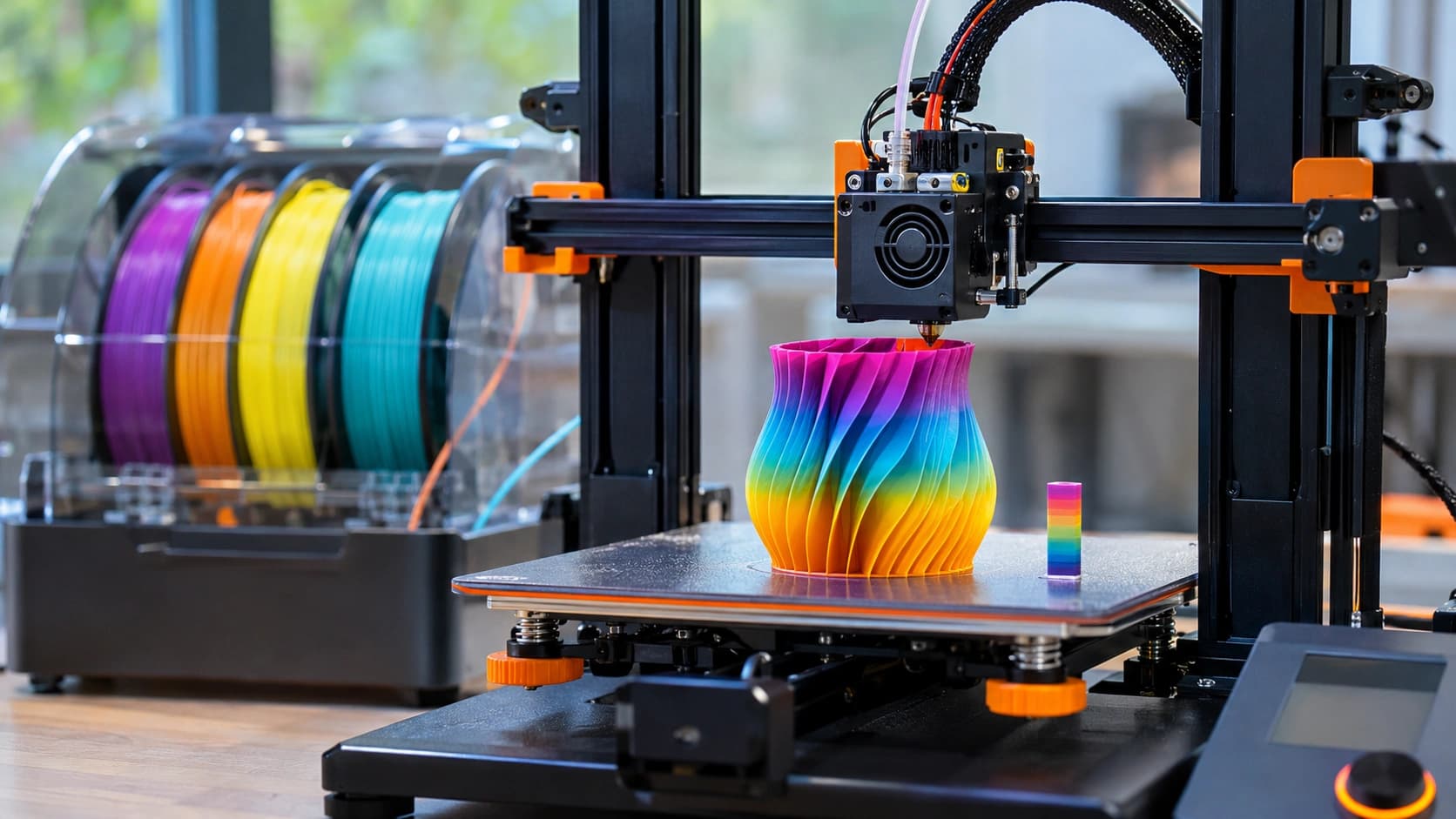
Stratasys alleged that the printers and Bambu Studio slicing software used its patented methods. For the '713 Patent, it pointed to the Automatic Material System, which feeds multiple filaments to the printer. Stratasys alleged the software directed a purge to a prime tower whenever the printer switched between part and support material.
For the '357 Patent, Stratasys alleged the printers filled gaps between walls with paths of a different width. For the '698 and '381 Patents, it targeted the force sensor in the A1 and A1 mini nozzles. Stratasys alleged that sensor detected filament clumping and stopped print jobs.
Stratasys alleged that Bambu knew of the patents at least as early as August 5, 2024, through a notice letter. It alleged that Bambu kept infringing afterward.
Injury
Stratasys alleged that Bambu's infringement had injured and damaged it and would continue to do so. It also claimed irreparable harm. Under its separate false advertising count, Stratasys alleged injury to its business, reputation, and goodwill.
Damages
Stratasys sought damages for the infringement, including enhanced damages under 35 U.S.C. § 284. It requested a permanent injunction against further infringement. It also asked the Court to declare the case exceptional and award attorneys' fees.
On the false advertising count, Stratasys sought Bambu's profits, its own damages, and the cost of corrective advertising. It also asked for increased monetary relief based on alleged willful conduct.
Key Arguments and Proceedings
Legal Representation
Plaintiff(s): Stratasys, Inc.
Counsel for Plaintiff(s): Aashish Gautam Kapadia | Adam W Burrowbridge | Andrea Leigh Fair | Brian W Oaks | Christian Taylor Tatum [Terminated: 05/14/2026] | David Joshua Tobin | Deron R Dacus | Dexter Krommes Hamilton | Douglas H Carsten | Garrett C. Parish | Ian B Brooks | Jason Kraus | Kevin James Meek | Syed Kamil Fareed
Defendant(s): Shenzhen Tuozhu Technology Co. Ltd. | Shanghai Lunkuo Technology Co. Ltd. | Bambulab Ltd. | BambuLab USA, Inc. | Tuozhu Technology Limited | Beijing Tiertime Technology Co. Ltd. [Terminated: 09/30/2024] | Beijing Yinhua Laser Rapid Prototyping and Mould Technology Co. Ltd. [Terminated: 09/30/2024]
Counsel for Defendant(s): Ruffin B Cordell | Aaron P Pirouznia | Alexander Hale Martin | Alyaman Amer | Boyd T. Cloern | Brandon Scott Avers | Brendan Frederick McLaughlin [Terminated: 05/01/2026] | Carl Edward Bruce | David M Barkan | Gregory Phillip Love | James Anthony Mullen | Jamie Lynn Lucia | Jessica Wang | Julie Metkus | Lauren A Degnan | Meghana Thadani | Menglin Sun | Michael Alden Vincent | Philip Gregory Brown | Riley James Green | Thomas Howard Reger, II
Mediator(s): Jack Wesley Hill | David Folsom
Technical Advisor: David Keyzer
Key Arguments or Remarks by Counsel
Claims
Stratasys filed its First Amended Complaint on September 17, 2025. Five counts alleged infringement of U.S. Patent Nos. 9,421,713; 9,592,660; 7,555,357; 9,168,698; and 10,556,381. Stratasys alleged direct, induced, contributory, and willful infringement.
According to the complaint, the '713 Patent related to 3D printing with purge towers. The '660 Patent was titled "Heated Build Platform And System For Three-Dimensional Printing Methods." The '357 Patent related to extrusion-based layered printing that fills void regions in a build path. The '698 and '381 Patents shared the title "Three-Dimensional Printer With Force Detection."
A sixth count alleged false advertising under the Lanham Act. Stratasys claimed Bambu’s pleadings and discovery responses denied features that its website and Wiki advertised. The parties later moved jointly to dismiss that count. The Court granted the motion on May 5, 2026.
Before trial, the Court granted Bambu’s motion for summary judgment of invalidity of Claim 7 of the ‘660 Patent. In a July 1, 2026 memorandum opinion, it found Claim 7 indefinite. The Court applied the same reasoning it had used to find Claim 1 indefinite at claim construction. That ruling found the term “thermally conductive plate” had no objective boundaries. Stratasys then filed a notice of final election of asserted claims on September 1, 2026. The ‘660 Patent did not appear on the verdict form.
Defense
In their answer to the amended complaint, the Defendants denied infringing any valid claim. They argued every asserted claim was invalid under 35 U.S.C. §§ 101, 102, 103, and 112.
The Defendants also raised prosecution history estoppel, marking and notice, and lack of standing. They cited the statutory damages limit in 35 U.S.C. § 286 and denied any willful infringement.
Another defense invoked license and patent exhaustion. Bambu asserted that open-source contributions by Stratasys or related companies may have licensed the patents. It cited the GNU Affero General Public License as one example.
Before trial, the Court granted Stratasys summary judgment on this defense for every patent except the ‘357 Patent. It found factual disputes over the ‘357 Patent precluded summary judgment.
Bambu also filed counterclaims seeking declarations of non-infringement and invalidity for all five patents. It asked the Court to find the case exceptional and award its fees.
Before trial, the Court denied Bambu's motion to dismiss for failure to join an indispensable party on May 29, 2025. On August 31, 2026, the Court granted Bambu's Daubert motion to exclude the supplemental opinions of Stratasys's experts.
Jury Verdict
Trial began on September 11, 2026, before U.S. District Judge Rodney Gilstrap. The jury returned its unanimous verdict on September 17, 2026.
The jury found that Bambu infringed all six asserted claims. These were Claims 1 and 6 of the '713 Patent and Claim 8 of the '357 Patent. They also included Claim 10 of the '698 Patent and Claims 1 and 11 of the '381 Patent.
The jury found that Bambu had not proven any asserted claim invalid by clear and convincing evidence. It also found that Bambu's infringement was willful.
The jury awarded $14.2 million for the '713 Patent and $10.6 million for the '357 Patent. It awarded $2.8 million for the '698 and '381 Patents together. The total award came to $27.6 million.
Judge Gilstrap entered final judgment on September 18, 2026. The judgment treated each award as a reasonable royalty in the form of a running royalty. The damages period began on May 31, 2022, for the '713 and '357 Patents. For the '698 and '381 Patents, it began on September 20, 2023.
The Court awarded prejudgment interest at the five-year U.S. Treasury Bill rate, compounded monthly. It also awarded post-judgment interest at the statutory rate. However, the Court denied Stratasys's request to enhance damages for willfulness. Having heard the testimony and seen the exhibits, it found no enhancement warranted. The Court named Stratasys the prevailing party and allowed it to recover costs.
Post-trial Motions
The Court ordered post-trial mediation on September 23, 2026. Stratasys filed an unopposed motion for its bill of costs on October 2, 2026. On October 16, 2026, Stratasys moved to amend the judgment. It sought supplemental damages, prejudgment and post-judgment interest, and ongoing royalties.
The same day, Bambu filed sealed motions for judgment as a matter of law and for a new trial. On October 19, 2026, Bambu filed an unopposed motion to approve an escrow deposit as security. The motion also asked the Court to stay execution of the judgment. Bambu filed a notice of receipt of the escrow deposit on October 22, 2026.
On October 31, 2026, mediator David Folsom reported the mediation as suspended. The docket showed no rulings on the post-trial motions as of November 3, 2026. No notice of appeal appeared on the docket.
Court Documents:
Documents are available for purchase upon request at [email protected]