Case Background
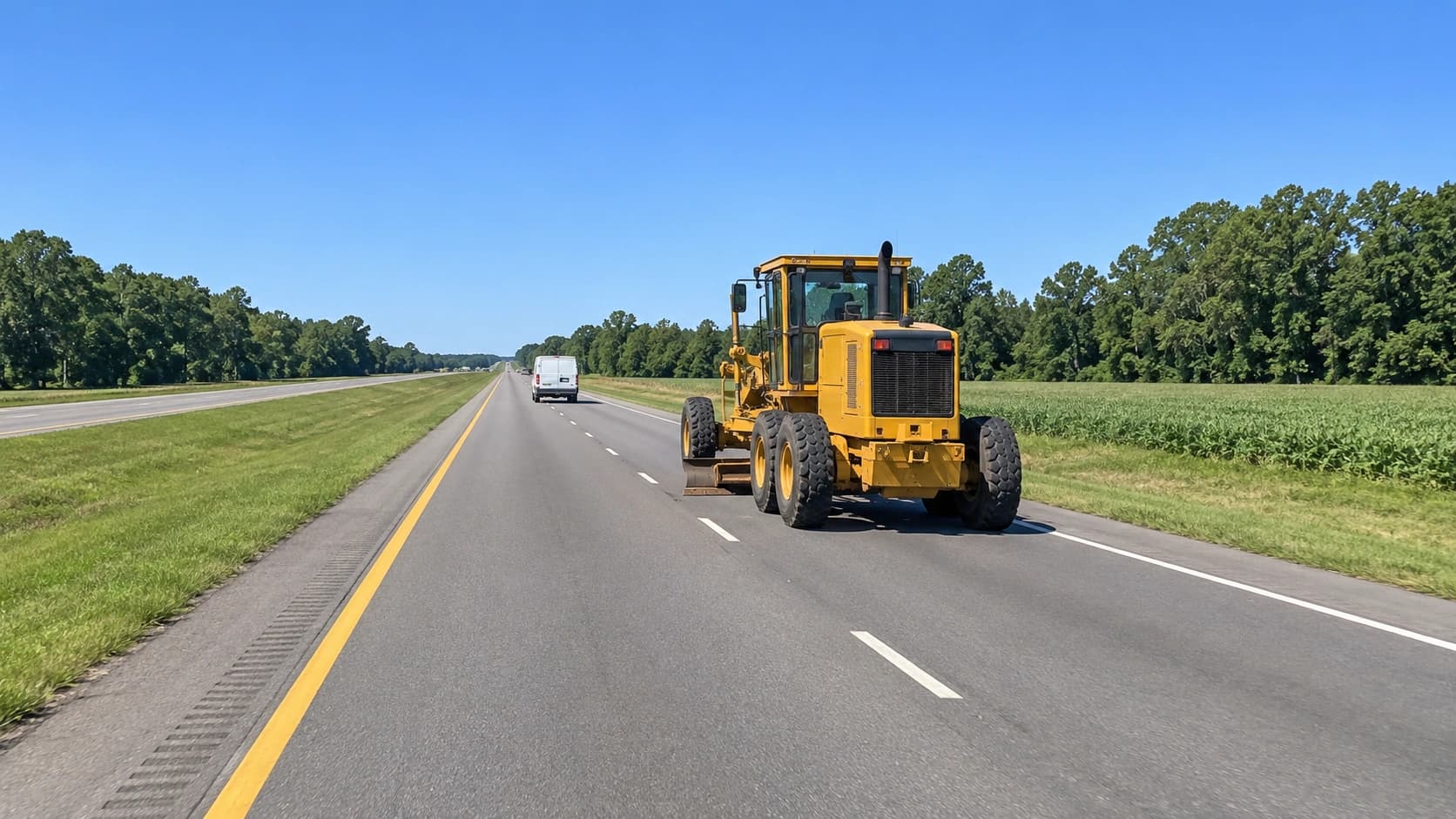
On June 6, 2023, Joseph Angelo Scalco, IV, died after his van struck the rear of a motor grader. The crash happened at about 11:03 a.m. on US Highway 17 in Pasquotank County, North Carolina. At that location, the highway was a four-lane divided road with a 70-mile-per-hour speed limit.
Carl Douglas Swain, Jr., was operating the motor grader. He served as President of R&D Excavating Co., Inc., a construction services company based in Elizabeth City. Vonda Ward Chappell, Scalco’s wife and the administrator of his estate, later sued Swain and R&D Excavating. She filed the case in the U.S. District Court for the Eastern District of North Carolina. The dispute centered on who caused the crash.
Cause
According to the First Amended Complaint, Scalco was driving his Ford Transit van in the right-hand lane. He was traveling at about 70 miles per hour. Swain was operating the motor grader ahead of him in the same direction. The Plaintiff alleged that the grader was moving at 20 to 28 miles per hour.
According to the Plaintiff’s summary judgment brief, Swain estimated his speed at 28 miles per hour during his deposition. He was driving from the Dixieland Motor Speedway to the Pasquotank Waste Facility to perform grading work. The Plaintiff alleged that Scalco could not perceive the grader’s slow speed until it was too late to avoid it.
Injury
Scalco died in the collision. According to the Defendants’ summary judgment brief, the investigating trooper examined the van after the crash. His report noted that the steering wheel was crushed into the instrument panel. Tool boxes and equipment in the cargo area had shifted forward into the cab. No barrier separated the cab from the cargo area.
Walter A. Meads, the Pasquotank County Medical Examiner, examined Scalco’s body. Meads did not perform an autopsy. According to deposition excerpts quoted by the Defendants, Meads based the probable cause of death on Scalco’s crash injuries.
Damages
The Plaintiff sought compensatory damages under the North Carolina wrongful death statute. These included medical and funeral expenses, lost income, and loss of companionship. She alleged that these damages exceeded $75,000. She also sought property damage for the van and the personal items inside it.
In addition, the Plaintiff requested punitive damages of $250,000 or three times the compensatory damages, whichever was greater. She also asked for costs, attorney fees allowed by law, and prejudgment interest.
Key Arguments and Proceedings
Legal Representation
Plaintiff(s): Vonda Ward Chappell, Administrator of the Estate of Joseph Angelo Scalco, IV
Counsel for Plaintiff(s): Fred W. DeVore, III | Amanda A. Mingo | Kathleen Clary
Defendant(s): Carl Douglas Swain, Jr. | R&D Excavating Co., Inc.
Counsel for Defendant(s): William H. Harkins, Jr. | William L. Nimick
Key Arguments or Remarks by Counsel
Claims
The First Amended Complaint asserted four counts: negligence, gross negligence, punitive damages, and property damage. Under the negligence count, the Plaintiff alleged that Swain failed to operate the grader at a safe speed. She claimed he failed to warn other drivers of the machine’s slow speed. She also alleged he drove the grader without an escort vehicle.
The Plaintiff further alleged negligence per se. She cited North Carolina speed laws, including a statute barring speeds that impede the normal movement of traffic. Her complaint also accused Swain of driving carelessly and heedlessly, in language tracking the state’s reckless driving statute.
At summary judgment, the Plaintiff argued that Swain considered the grader to be farm equipment. She contended that a farm equipment ordinance required such vehicles on Highway 17 to have a trailing escort vehicle. She also relied on testimony from Trooper Logsdon, who investigated the crash. According to her brief, he testified that the grader was not a farm vehicle and could not be registered.
The Plaintiff also argued that Swain had safer routes available, including roads with lower speed limits. In addition, she pointed to his testimony that hauling the grader on a lowboy trailer would have cost about $300.
Defense
The Defendants denied that they were negligent or breached any duty. They raised contributory negligence and gross contributory negligence as affirmative defenses. They alleged that Scalco failed to keep a proper lookout and failed to avoid the hazard. They also asserted intervening negligence, open and obvious hazard, and statutory limits on punitive damages.
In their summary judgment brief, the Defendants relied on the trooper’s collision report. Trooper Logsdon listed inattention and failure to reduce speed as contributing circumstances for Scalco. He listed no contributing circumstances for Swain and issued him no citations. The Defendants also argued that Scalco failed to secure the cargo in his van.
The Defendants further relied on the report of their accident reconstruction expert. According to their brief, the report placed the crash in daylight on a straight, flat road. It found that the unobstructed approach was over one mile long. The report also stated that Scalco was driving 65 miles per hour for at least five seconds before impact. It concluded that he made no effort to slow until less than half a second before the crash.
The Defendants also argued that the minimum speed statute applied only to passenger vehicles. They added that the slow speed statute exempted vehicles traveling at reasonable speeds for their type. Finally, they contended that the Plaintiff could not prove proximate cause without an autopsy. They noted the medical examiner’s testimony that he could not rule out a medical event before impact.
After a hearing on July 24, 2026, the Court denied both sides’ summary judgment motions on August 24. It found that genuine issues of material fact existed. In October, the Court also denied the Defendants’ motion to bifurcate punitive damages.
Jury Verdict
Trial began on October 5, 2026, before U.S. District Judge Terrence W. Boyle in Elizabeth City. Eleven jurors were selected and impaneled. On October 6, the Plaintiff rested her case. The Defendants then moved for judgment as a matter of law. The Court granted that motion on the gross negligence and punitive damages claims.
The negligence claim went to the jury the same day. The verdict sheet asked whether the Defendant was negligent in causing the collision. The jury unanimously answered “No.” As a result, the jurors did not reach the damages question. The verdict sheet did not include a separate question on property damage.
The Clerk of Court entered judgment for the Defendants on October 6, 2026. The judgment stated that Scalco’s death was not caused by the Defendants’ negligence.
Post-trial Motions
On October 19, 2026, the Plaintiff filed a motion for judgment under Rule 50(b). The Defendants filed a response on October 27. Separately, the Defendants filed an application for costs on October 20. The Rule 50(b) motion went to Judge Boyle for decision on November 13, 2026. As of the docket retrieved on November 17, 2026, the Court had not ruled on either filing.
Court Documents:
Documents are available for purchase upon request at [email protected]