

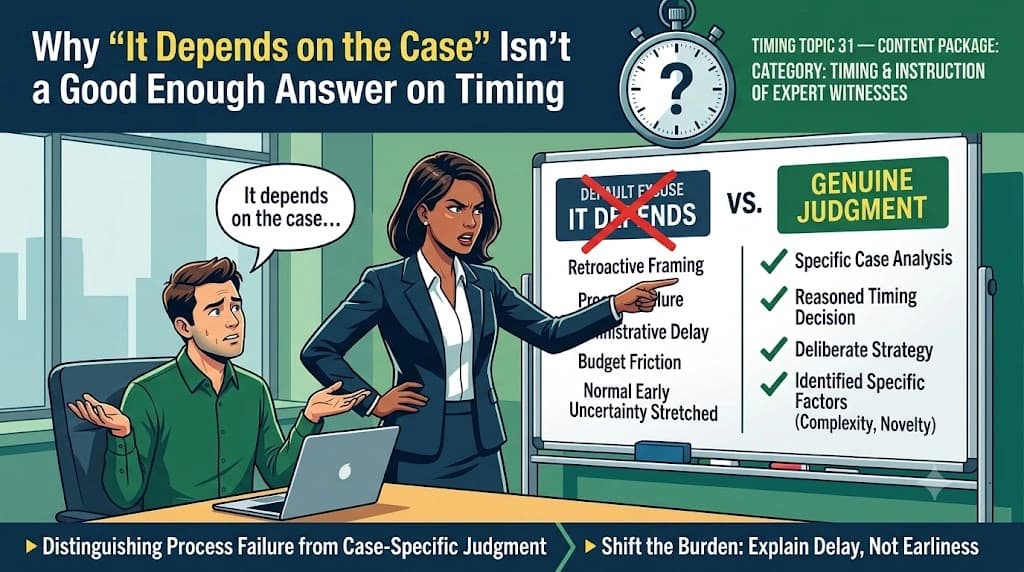
Ask a room of experienced litigators when an expert should be instructed, and someone will eventually say it: it depends on the case. The phrase is offered as though it settles the question, closing off further discussion with an appeal to the obvious variety of disputes a practice handles. It is also, in the overwhelming majority of cases where it gets used, doing very little actual analytical work. It is technically true, entirely unhelpful, and has become the default answer precisely because it requires nothing further from whoever offers it.
This matters more than it might seem, because "it depends on the case" functions less as a genuine analytical conclusion and more as a conversation-ending device, deployed at exactly the moment a more specific, more useful answer would actually require some effort to produce. Treating late expert instruction as an inevitable, case-driven outcome rather than what it usually is, a process failure that a bit more deliberate planning would have prevented, is a comfortable habit worth examining directly rather than accepting at face value.
Why "It Depends" Is Technically True and Still Not a Good Answer
There is a real sense in which the phrase is defensible. Disputes genuinely vary enormously in complexity, in how quickly the relevant facts become clear, and in how much technical uncertainty exists at the outset. A straightforward, well-precedented dispute plainly does not need the same instruction timeline as a genuinely novel, highly technical one, and anyone claiming a single fixed rule applies to every case regardless of these differences would be wrong.
The trouble is that acknowledging genuine variation is not the same as explaining why a specific instance of late instruction actually happened. "It depends on the case" is offered just as readily to explain a genuinely justified delay as it is to explain a delay that resulted from nothing more than the timing question never being raised early enough, from budget approval taking longer than it should have, or from the case team simply defaulting to habit rather than making a deliberate choice. The phrase does not distinguish between these very different situations; it treats them all as equally unavoidable, which flattens a genuinely important distinction into something that sounds sophisticated but explains nothing specific about the actual case at hand.
A genuinely useful answer to the timing question identifies the specific factors that make a particular case suited to earlier or later instruction, discussed in more detail elsewhere in this content series, factors like technical complexity, novelty, and the likelihood of proceeding to a contested hearing. "It depends on the case" gestures vaguely in this direction without actually doing the work of identifying which specific factors apply to the case at hand, which is precisely what makes it such a comfortable, low-effort answer to reach for.
There is a useful parallel here to how the phrase functions in other areas of professional judgment. A doctor who answers every question about treatment timing with "it depends on the patient" would be technically correct and professionally useless, since the actual value of clinical judgment lies precisely in identifying which specific patient characteristics justify which specific timing decision. The same standard should apply to expert instruction timing, a genuinely important strategic and financial decision that deserves the same specificity of reasoning as any other significant case management choice, rather than being treated as uniquely resistant to concrete analysis.
What "It Depends" Usually Covers For
In practice, the phrase most often gets deployed in one of three situations, and none of them reflects genuine, case-specific analysis. The first is simple absence of process: no one on the legal team raised the timing question deliberately at the outset, and by the time expert instruction became unavoidable, the timeline had already compressed considerably. "It depends on the case" retroactively frames this outcome as though it resulted from careful, case-specific judgment, when it actually resulted from the question never being asked early enough to matter.
The second situation involves budget or client-approval friction that had nothing to do with the technical merits of the timing question. A legal team that wanted to instruct an expert earlier but faced delay in securing client sign-off on the associated cost sometimes reaches for "it depends on the case" as a more comfortable explanation than the more specific and less flattering truth, that the delay was administrative rather than strategic.
This particular version of the phrase is worth naming specifically because it often reflects a genuinely solvable problem rather than an inherent feature of how cases develop. A firm that has developed a clear, pre-approved process for securing client sign-off on early, appropriately scoped expert consultation, discussed elsewhere in this content series, removes much of this specific friction in advance, converting what would otherwise become an "it depends on the case" delay into a genuinely deliberate, well-reasoned timing decision instead.
The third situation, perhaps the most common, involves genuine uncertainty about case direction being used as a justification for delay well past the point that uncertainty actually warranted. Some early uncertainty about case theory is entirely normal and does not, on its own, justify waiting to bring in an expert. Treating any degree of uncertainty as sufficient reason to delay indefinitely, rather than recognizing the specific point at which continued uncertainty starts costing more than it saves, uses "it depends on the case" to justify a delay considerably longer than the underlying uncertainty actually required.
This version of the excuse is particularly persistent because it contains a genuine kernel of truth that makes it hard to challenge directly. Nobody can credibly claim a case theory is perfectly settled from day one, which means there is always some technically accurate uncertainty available to point to as justification for further delay. The useful response is not to demand certainty before instruction, which would be an unreasonable standard, but to ask whether the specific uncertainty remaining at a given point is genuinely the kind that expert input would help resolve rather than the kind that expert input is actually needed to help resolve, a distinction that reverses the usual logic of waiting for clarity before bringing in technical help.
Distinguishing Genuine Case-Specific Variation From Process Failure
The useful distinction is between variation that reflects a deliberate, reasoned judgment about the specific case and variation that reflects the simple absence of any deliberate judgment at all. A legal team that considers the technical complexity, novelty, and likely trajectory of a specific case and concludes, explicitly, that instruction can reasonably wait until a later stage has engaged in genuine case-specific analysis, even if the eventual instruction still happens relatively late. A legal team that simply never raised the question, and only instructed an expert once external pressure made it unavoidable, has not engaged in any analysis at all, regardless of how the eventual timing is later explained or justified.
This distinction matters because only the first kind of variation is actually defensible as "depending on the case." The second kind is a process failure dressed up in language that makes it sound like considered judgment, and the two are easy to conflate precisely because both produce the same observable outcome, an expert instructed relatively late in the proceedings, even though only one of them reflects genuine, deliberate case management.
A useful diagnostic question, applicable after the fact to any specific instance of late instruction, is simply: was there ever a specific moment where someone deliberately considered instructing the expert earlier and consciously decided against it for stated, case-specific reasons? If the honest answer is no, if the timing simply happened rather than being decided, the case for "it depends on the case" as an adequate explanation collapses, regardless of how reasonable the eventual outcome happens to look in hindsight.
It is worth being fair to legal teams here: hindsight makes this distinction look easier to apply than it actually is in the moment. A busy case team managing dozens of simultaneous demands rarely experiences the absence of a timing decision as a dramatic, memorable gap; it simply feels like one more thing that did not happen this week, then next week, until enough weeks have passed that the option of early instruction has quietly closed. This is precisely why the diagnostic works better as a forward-looking discipline, a deliberate checkpoint built into case planning, than as a backward-looking exercise in reconstructing intent after the fact.
A Better Question to Ask Instead of "When Should We Instruct?"
Rather than asking the open-ended question of when an expert should be instructed, a question vague enough to invite "it depends on the case" as a satisfying-sounding non-answer, a more useful practice is to ask a specific, answerable question at the outset of every matter: given what we currently know about this case's complexity and likely trajectory, is there a case-specific reason to delay expert instruction beyond the earliest point it could reasonably occur? This reframes the default toward earlier instruction and requires an affirmative, specific justification for any delay, rather than treating delay as the unmarked default that requires no justification at all.
This reframing does real work because it shifts the burden of explanation. Under the old framing, someone has to make an active case for why an expert should be brought in early, against a comfortable default of waiting. Under the reframed question, someone has to make an active, specific case for why delay is genuinely warranted in this particular matter, against a default that assumes earlier instruction unless a specific, case-relevant reason says otherwise. The same underlying facts about a case can support either framing, but the reframed question makes the actual reasoning visible and auditable in a way "it depends on the case" never does.
This shift in default also changes who bears the cost of inaction. Under the old framing, inaction, simply not raising the timing question, costs nothing visible in the moment; the case proceeds, the expert gets instructed eventually, and the delay only becomes apparent, if ever, much later when its consequences have already materialized. Under the reframed default, inaction requires an active decision to accept the risk of delay, which surfaces the tradeoff at the moment it can still be addressed rather than only after it has already shaped the case.
What Treating Delay as a Process Failure Actually Requires
Treating late instruction as a process failure, where it genuinely is one, requires building a specific checkpoint into standard case management practice, a deliberate moment early in every matter where the timing question is explicitly raised and answered, rather than left to develop by default. This does not need to be elaborate; it can be as simple as a standing item on an early case planning checklist, discussed in more detail elsewhere in this content series regarding workflow-embedded tools, that requires an explicit, documented answer to the timing question rather than allowing it to pass by unaddressed.
It also requires a cultural shift in how late instruction gets discussed after the fact. A firm that treats every instance of late instruction as simply "how this particular case happened to unfold" never builds the institutional learning needed to actually improve its timing practices over time. A firm that asks, honestly, after any case where instruction happened late, whether that lateness reflected genuine case-specific judgment or a gap in process, builds exactly the kind of institutional awareness needed to catch and correct the pattern in future matters.
Objections to This Framing, and Responses
The most common objection to this framing is that it risks over-correcting toward reflexive early instruction in every case, incurring unnecessary cost in matters that genuinely would have benefited from a later approach. This is a fair concern, but it misunderstands the argument being made. The point is not that every case should be instructed as early as possible regardless of circumstance; it is that the decision about timing should be made deliberately and explicitly, with a specific, case-relevant reason given for whatever timing is chosen, rather than defaulting to delay without any deliberate reasoning behind it at all.
A second objection holds that requiring explicit justification for every timing decision adds administrative burden to already busy case teams. This is true but modest in scale relative to the benefit; the process described above requires a single, specific question asked and answered early in a matter, not an elaborate new bureaucratic process. The administrative cost of asking one deliberate question at the outset of a case is considerably smaller than the cost, discussed elsewhere in this content series, of a compressed, late-instructed engagement that a bit more upfront deliberation would have avoided.
What This Means for Firms and Individual Practitioners
For firms, the implication is to build an explicit timing checkpoint into standard case management practice, treating an unexplained instance of late instruction as a genuine process gap worth investigating rather than an inevitable byproduct of case variation that requires no further examination.
For individual practitioners, the implication is to treat "it depends on the case" as a prompt for further explanation rather than a satisfying answer in itself, whether offered by a colleague, a client, or one's own internal reasoning, and to press for the specific case-relevant factors that actually justify a given timing decision before accepting it as adequately reasoned.
Frequently Asked Questions
Does this mean every case should be instructed as early as theoretically possible? No. The argument is for deliberate, explicit reasoning about timing in every case, not for a uniform, reflexively early approach regardless of the specific case's genuine characteristics.
How can a firm tell whether a specific instance of late instruction reflected genuine judgment or process failure? Asking whether there was ever a specific, documented moment where the timing question was deliberately considered and a case-relevant reason given for the eventual timing is a reliable diagnostic, applicable after the fact to almost any matter.
Isn't some genuine uncertainty about case direction always present early in a matter? Yes, but genuine uncertainty and indefinite deferral are not the same thing. The relevant question is whether the specific level of uncertainty present in a given case actually warrants continued delay, evaluated explicitly, rather than treated as automatic justification for waiting without further examination.
What is the simplest first step a firm can take to address this? Adding a single, explicit checklist item requiring a documented answer to the timing question at the outset of every matter is a low-cost, high-leverage first step that does much of the work described throughout this piece.
Conclusion
"It depends on the case" is true often enough to feel like a satisfying answer and vague enough to explain almost nothing about why a specific instance of late instruction actually happened. Some of the variation it gestures toward is genuine and defensible; a considerable amount of it is process failure wearing the language of considered judgment. Treating every instance of late instruction as equally unavoidable forecloses the institutional learning needed to actually improve timing practices over time, while treating delay as something requiring an affirmative, case-specific justification, rather than the unmarked default, makes the real reasoning behind any given timing decision visible, auditable, and considerably more likely to actually reflect the case's genuine characteristics rather than simple institutional habit.
Key Takeaways
● "It depends on the case" is technically defensible but frequently used to explain delays that actually resulted from process gaps rather than genuine case-specific reasoning.
● The useful distinction is between timing decisions that reflect deliberate, documented judgment and those that simply happened by default, with no specific reasoning behind them at all.
● Reframing the default question from "when should we instruct" to "is there a specific reason to delay beyond the earliest reasonable point" shifts the burden of justification toward explaining delay rather than explaining earliness.
● A single, explicit checkpoint requiring a documented answer to the timing question at the outset of every matter is a low-cost, high-leverage way to convert vague case variation into genuine, auditable reasoning.
Position yourself where the legal industry looks for expertise - sign up on exlitem.com to get discovered by leading lawyers and high-value clients.