

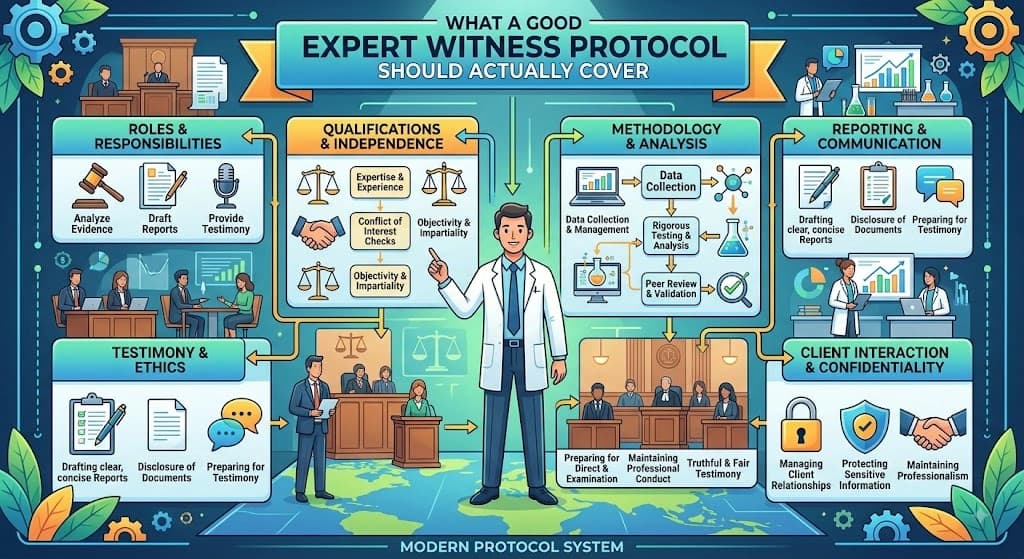
Most expert witness protocols read the same way: a set of general principles about independence, objectivity, and professional conduct, stated in language broad enough to apply to virtually any case and specific enough to guide almost none of them. Independence matters. Experts should not act as advocates. Communication should be professional and appropriate. All true, all reasonable, and all nearly useless at the exact moment a junior associate is deciding whether a specific comment on a draft joint statement crosses a line. A protocol that only states principles is not really a protocol in any functional sense. It is a values statement, and values statements, however sincere, rarely change behavior on their own.
A genuinely useful protocol does something different. It takes the recurring, specific decision points where practice actually goes wrong, the ones examined throughout this content series, and gives practitioners something concrete to consult at exactly those moments, rather than a general principle they have to translate into specific guidance themselves, under time pressure, without much support. Building a protocol this way is more work upfront, but it is the difference between a document that sits in a drawer and one that actually gets used.
What Most Protocols Get Wrong
The most common failure is generality masquerading as comprehensiveness. A protocol that states, at length, that experts must remain independent and that counsel should not improperly influence an expert's opinion covers an enormous amount of conceptual ground while providing almost no specific guidance about what independence actually requires in the moment a specific email is being drafted, a specific joint statement comment is being considered, or a specific pre-conference conversation is happening. Breadth of principle is not the same as depth of usefulness, and protocols that mistake one for the other end up technically comprehensive and practically empty.
A second common failure is treating the protocol as a static document rather than a living reference tied to actual workflow. A protocol filed away after an initial training session, never referenced again during the life of an actual case, competes poorly against the specific pressures and habits discussed elsewhere in this content series that shape real behavior. The most thoughtfully drafted protocol in the world does no work if it is not actually consulted at the moments that matter.
A third failure, less obvious but genuinely significant, is protocols that address only the counsel side of the relationship without corresponding, equally specific guidance for the experts themselves. Independence and appropriate communication are a shared responsibility, and a protocol that instructs counsel extensively while leaving experts to infer their own side of the boundary from context produces an asymmetric, incomplete framework that neither party can rely on with real confidence.
A fourth failure worth naming is protocols written entirely in the abstract, without reference to any of the specific scenarios where things actually go wrong in practice. A protocol that includes even a small number of brief, concrete illustrations, this kind of comment on a draft joint statement is acceptable, this kind is not, tends to be considerably more usable than one relying purely on general language, since it gives practitioners an actual reference point to compare their own situation against rather than requiring them to translate an abstract principle into a judgment call entirely on their own.
Scope and Instruction: What the Protocol Should Specify
A useful protocol addresses, specifically, how an expert's mandate should be defined and documented at the outset of an engagement. This means more than a general statement that scope should be clear; it means specifying that the mandate should identify, in writing, the precise technical questions the expert is being asked to address, the relevant time period or valuation date if applicable, and an explicit statement of which underlying legal or factual premises are being provided as assumptions rather than left to the expert's independent determination, an issue examined in detail elsewhere in this content series.
The protocol should also specify how instruction should evolve as a case develops, since mandates frequently need updating as new evidence emerges or the legal theory of the case shifts. Rather than leaving this to informal, ad hoc communication, an effective protocol specifies that any material change to an expert's instructions should be documented in writing, with a brief note explaining what changed and why, creating a clear record that protects both the expert's credibility and the integrity of the eventual report if the instruction history is later questioned.
A further specific element worth including is guidance on how draft reports should be reviewed by counsel before finalization. The protocol should distinguish explicitly between legitimate review, checking for accuracy, ensuring the report addresses the agreed scope, flagging any factual error, and illegitimate review, suggesting changes to conclusions, softening or strengthening specific findings, or reframing language to be more favorable, with concrete examples of each to make the distinction usable rather than purely conceptual.
It is also worth the protocol addressing what happens when an expert's draft report identifies an issue counsel had not anticipated, since this is a genuinely common occurrence that can create real pressure if not addressed in advance. A protocol that specifies, clearly, that an expert's independent identification of a new issue should be treated as valuable information to be assessed on its merits, rather than as a problem to be managed or minimized, sets an important tone that shapes how these moments actually unfold in practice.
Communication Boundaries: What the Protocol Should Specify
An effective protocol specifies, concretely, what topics are appropriate for pre-engagement and ongoing conversation between counsel and expert, and what topics are not. Discussing the scope of the mandate, the timeline, logistics, and the general nature of the dispute is appropriate. Discussing which specific conclusion would be most helpful to the case, or what outcome the client is hoping for, is not, and a good protocol states this distinction in concrete, example-driven terms rather than relying on the word "appropriate" to do all the work on its own.
The protocol should specify clear rules around joint expert conferences specifically, given how central this process is to the overall credibility of expert evidence, discussed at length elsewhere in this content series. This means specifying explicitly that counsel should not be present during the substantive conference, that pre-conference conversations should be limited to logistics and confirmed scope rather than strategy or preferred outcomes, and that post-conference review of any draft joint statement should be limited strictly to factual accuracy, with a specific process for how any factual correction should be raised and documented.
Guidance on communication frequency and format also belongs in a well-constructed protocol. This includes specifying who within a legal team is the designated point of contact for expert communications, reducing the risk discussed elsewhere in this content series of inconsistent guidance reaching an expert through multiple, uncoordinated channels, and specifying whether and how communications with the expert should be documented, particularly for anything touching on scope, assumptions, or instructions that might later need to be reconstructed or defended.
A well-constructed protocol also addresses the specific question of email and informal messaging, since much of the ambiguity discussed elsewhere in this content series around subtle, cumulative influence tends to develop through exactly this kind of informal, seemingly low-stakes communication rather than through any single formal instruction. Specifying that any communication touching on scope, assumptions, or the expert's technical approach should go through the designated point of contact and be captured in a form that could later be reviewed, rather than happening through ad hoc messages from multiple team members, closes off much of the space where this kind of gradual influence tends to accumulate unnoticed.
Joint Conferencing and Reporting: What the Protocol Should Specify
Beyond the boundaries already discussed, a comprehensive protocol addresses the practical mechanics of how joint conferences and subsequent reporting should actually run. This includes specifying an expected format for the resulting joint statement, since a template or clear structural expectation reduces the risk of the sprawling, unfocused documents discussed elsewhere in this content series, and specifying that the statement should identify clearly not just where the experts agree and disagree but, where relevant, whether any disagreement traces back to differing underlying instructions or assumptions rather than genuine differences in technical judgment.
The protocol should also address the question of frequency directly, specifying whether the case anticipates a single, traditional end-stage conference or a structured series of conferences tied to case milestones, an approach discussed in more detail elsewhere in this content series as often better suited to complex, evolving disputes. Leaving this undecided by default tends to produce the traditional single-conference approach by inertia rather than by deliberate choice, even in cases where a more structured, multi-stage approach would clearly serve the process better.
A well-constructed protocol also specifies, in advance, what should happen if the two experts cannot reach agreement on a specific point during a conference, since ambiguity here often leads to unproductive extended sessions or, conversely, to premature abandonment of a discussion that might have benefited from more time. Specifying a default process, recording the disagreement clearly with each expert's specific reasoning, and flagging whether either expert believes further discussion would be productive, gives both experts and the tribunal a clear, consistent way to handle this common outcome rather than improvising a response each time it arises.
Enforcement and Consequences: What the Protocol Should Specify
A protocol without any specified consequence for departure is, as discussed elsewhere in this content series, considerably weaker than one that attaches at least some concrete mechanism to its provisions. This does not require harsh or punitive language; it can be as straightforward as specifying that any communication inconsistent with the protocol should be disclosed to the tribunal or opposing party, creating a meaningful incentive to comply that does not depend purely on individual practitioners' voluntary good judgment.
An effective protocol also specifies who is responsible for monitoring adherence within a legal team or institution, rather than leaving compliance to the general good intentions of whoever happens to be handling a particular matter. Designating a specific individual or role responsible for confirming the protocol has been followed at key stages, mandate documentation, pre-conference briefing, post-conference review, closes much of the enforcement gap discussed elsewhere in this content series far more effectively than a protocol that exists purely as a passive reference document.
For institutional protocols specifically, tying adherence directly to the tribunal's own procedural directions, rather than leaving the protocol as a separate, voluntary reference, produces the strongest enforcement available. A tribunal that explicitly incorporates key elements of the protocol into its own case management order, rather than simply recommending the parties follow published best-practice guidance, gives the protocol the same institutional weight discussed elsewhere in this content series that distinguishes binding procedural requirements from voluntary codes.
Making the Protocol Usable, Not Just Comprehensive
A protocol's usefulness depends heavily on its format, not just its content. A dense, lengthy document is considerably less likely to be consulted at the specific moment it would matter than a short, well-organized checklist covering the same substantive ground, broken into clear stages, initial instruction, pre-conference, post-conference, final report review, with specific, concrete guidance at each stage rather than general principle spread evenly across a long narrative document.
Embedding the protocol directly into existing workflow tools, standard engagement letter templates, case management checklists, calendar reminders tied to key stages of an expert engagement, does more to ensure actual use than any amount of additional detail added to a standalone document. The goal is for the protocol to intersect with a practitioner's actual working process at the moments that matter, rather than existing as a separate resource someone has to remember to consult on their own initiative.
Who Should Own and Maintain the Protocol
A protocol that is drafted once and never revisited tends to drift out of alignment with actual practice over time, as new patterns of difficulty emerge and older provisions become less relevant. An effective protocol has a clearly designated owner, whether an individual, a practice group, or an institutional committee, responsible for periodically reviewing and updating it based on real experience from cases where the protocol was actually used, rather than treating the initial drafting as a one-time exercise.
This ownership role also matters for the training and onboarding process discussed elsewhere in this content series. A protocol with a clear, engaged owner is far more likely to be actively taught to new practitioners as part of standard onboarding than one that exists as an unowned document somewhere in a shared drive, referenced occasionally but not actively championed by anyone with a specific stake in its continued relevance and use.
Building a short feedback mechanism directly into the protocol itself, a simple way for practitioners to flag a specific scenario the protocol did not clearly address, turns the document into something that improves through actual use rather than remaining static until the next scheduled review. Over time, a protocol maintained this way tends to become considerably more specific and more genuinely useful than one drafted once, comprehensively, in the abstract, since it accumulates real-world detail from exactly the situations practitioners actually encounter.
Frequently Asked Questions
Should a protocol be the same length and level of detail for every case, or tailored to specific matters? A core protocol covering the fundamentals should be consistent, but the most effective versions allow for a short, case-specific addendum addressing anything unusual about a particular matter's scope, timeline, or technical complexity.
Who should be involved in drafting a firm or institutional protocol? Input from practicing experts, not just lawyers, tends to produce a considerably more practical and usable document, since experts are often better positioned to identify exactly where ambiguity in communication actually causes problems in practice.
How often should a protocol be reviewed and updated? At minimum annually, though protocols benefit considerably from being revisited after any case where a genuine ambiguity or gap in the existing guidance became apparent, rather than waiting for a fixed review cycle to address a known issue.
Does a detailed protocol slow down the early stages of a case? Marginally, but the time invested upfront in clear scoping and instruction typically saves considerably more time later by avoiding the kind of mismatched reports, supplemental filings, and credibility challenges discussed throughout this content series.
Should a small firm without significant institutional resources bother building a formal protocol? Yes, and arguably it matters more for smaller teams, since a formal reference reduces reliance on informal, senior-colleague-modeled practice that may be inconsistent or, if a key person departs, lost entirely from the firm's institutional knowledge.
Conclusion
A good expert witness protocol is not a restatement of general principle; it is a practical, specific reference tied directly to the actual decision points where practice most often goes wrong. It specifies concretely how mandates should be defined and documented, what communication is and is not appropriate at each stage of an engagement, how joint conferences should be structured and reviewed, and what happens when the protocol is not followed. Built this way, and maintained by someone with a genuine stake in its continued relevance, a protocol becomes a working part of how a firm or institution actually operates rather than a document produced once and quietly forgotten.
Key Takeaways
● A useful protocol translates general principles like independence and objectivity into specific, concrete guidance tied to the actual decision points where practice tends to go wrong.
● Protocols should address both sides of the expert-counsel relationship with equal specificity, rather than instructing counsel extensively while leaving experts to infer their own boundaries.
● Enforcement mechanisms, even modest ones like a disclosure requirement for departures, make a meaningful difference in how consistently a protocol is actually followed.
● A protocol's format matters as much as its content; a short, workflow-embedded checklist tends to see far more actual use than a long, comprehensive narrative document.
Position yourself where the legal industry looks for expertise - sign up on exlitem.com to get discovered by leading lawyers and high-value clients.