

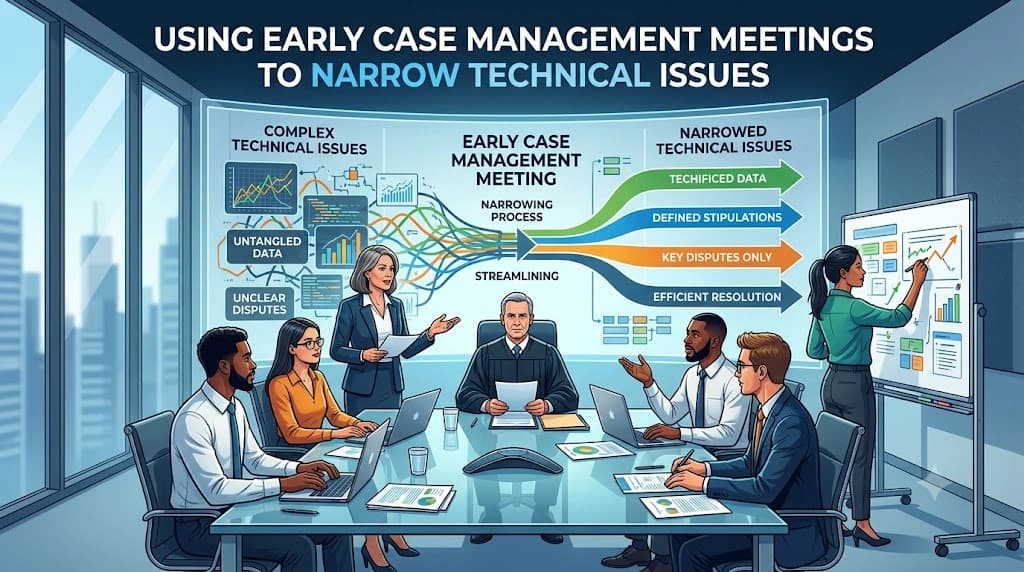
By the time most expert reports are filed, a great deal of avoidable work has already happened. Experts have analyzed questions that turned out not to matter, built calculations around scenarios the tribunal was never actually going to need resolved, and produced reports considerably longer and more expensive than the case required, simply because nobody sat down early enough to ask a basic question: what, specifically, do the experts actually need to address here? An early case management meeting, held well before either expert starts drafting, is one of the least glamorous and most consistently underused tools available for avoiding this waste.
The idea is not complicated. Bring the key participants together early, identify the technical questions genuinely in dispute, and let that identification shape the experts' work from the outset rather than letting each expert guess independently at what the case requires. What makes this harder in practice than it sounds is that early meetings compete for attention against every other early-stage priority in a case, and their value is easiest to see in hindsight, after a report has already gone sideways, rather than in advance, when the benefit is still hypothetical.
What Early Case Management Meetings Are Actually For
An early case management meeting focused on expert issues serves a narrow, specific function that is easy to conflate with broader case management but shouldn't be. Its purpose is to identify, as precisely as the case allows at that stage, which technical questions the experts will actually need to address, separate from the full universe of questions that could theoretically be relevant to the dispute. This distinction matters because parties and their experts, left without this kind of early guidance, tend to err toward comprehensiveness, addressing every issue that might conceivably matter rather than the narrower set that will actually determine the outcome.
This is not the same exercise as agreeing on the ultimate merits of the case, and meetings that drift into merits discussion tend to become unproductive quickly, since neither side has any incentive to concede ground on the substance this early. The more useful frame is procedural: what questions, if answered by the experts, would actually move the case forward, and what questions, however interesting, are unlikely to affect the outcome regardless of how they are resolved.
A secondary but genuinely valuable function of these meetings is calibration. Two experts working independently, without any early guidance on scope, sometimes produce reports that address overlapping questions using different frameworks, or that address entirely non-overlapping sets of questions because each expert reasonably interpreted an ambiguous mandate differently. An early meeting that clarifies scope reduces both risks considerably, giving each expert a shared reference point for what "the case" actually requires them to analyze.
Why Waiting Until Reports Are Filed Costs More Than It Saves
The most obvious cost of skipping this step is duplicated or wasted expert work, but the less obvious costs tend to be larger. When two expert reports address the dispute using different scopes or frameworks because no early clarification occurred, the parties are often left needing a second round of supplemental reports simply to make the first round comparable, adding an entire additional stage of expense and delay to a process that could have been avoided with a single meeting held months earlier.
There is also a strategic cost that falls disproportionately on the side less prepared to absorb it. A party whose expert has produced an overly broad, unfocused report because scope was never clarified early has effectively spent client resources analyzing questions that add little value, resources that could have gone toward developing the strongest possible analysis on the questions that actually matter. This is rarely visible as a single dramatic failure; it shows up instead as reports that feel padded, unfocused, or oddly proportioned relative to what the case actually turns on.
There is a related cost to the tribunal's own time and attention that is easy to overlook because it is diffuse rather than concentrated. A tribunal working through an unfocused report has to spend time identifying which of its many sections actually bear on the outcome, effectively doing scoping work after the fact that the parties could have done far more efficiently before the report was ever drafted. Multiplied across several witnesses and a lengthy hearing, this diffuse cost in reading and deliberation time can be substantial, even though no single moment of it looks like an obvious inefficiency.
Compressed hearing schedules compound this problem further. A tribunal or court with limited hearing time available cannot productively engage with an expert report addressing fifteen technical questions when the case realistically turns on four or five of them. Some of that excess simply goes unaddressed at the hearing, meaning the resources spent developing it were effectively wasted, a outcome an early scoping meeting would very likely have prevented.
There is also a credibility cost worth naming, distinct from the purely financial one. A report that visibly spends as much attention on peripheral questions as on central ones can leave a tribunal with the impression that the expert, or the legal team instructing them, either misunderstood what the case actually required or was padding the analysis for tactical reasons. Neither impression helps the party that commissioned the report, and both are considerably more avoidable than they might first appear, since they trace back to a scoping problem rather than to any flaw in the expert's actual technical competence.
What Gets Decided in a Well-Run Early Meeting
A productive early meeting typically produces a written record, even an informal one, addressing several specific questions. First, what are the technical issues the case actually depends on, stated as precisely as the parties' current understanding allows this early in proceedings. Second, are there any issues that appear technical on the surface but actually turn on a disputed legal or factual premise that needs to be resolved, or at least clearly flagged, before an expert can meaningfully address them, a problem discussed in more detail elsewhere in this content series.
Third, is there a shared understanding of the relevant time period, valuation date, or other framing parameters the experts will need to work from, since divergence on these basic parameters, left unaddressed, produces exactly the kind of comparability problems that make two independently sound expert reports difficult to evaluate side by side. Fourth, what data or documents will the experts need access to in order to address the identified issues, and is there a plan for making sure that access happens early enough that data availability does not become a bottleneck later in the process.
A well-run meeting resists the temptation to over-specify. Its goal is to narrow the field of inquiry, not to dictate the experts' conclusions or methodology, and meetings that drift toward the latter risk compromising the independence the entire expert evidence process depends on. The output should read like a scope document, not an instruction manual.
It is worth being specific about the difference between narrowing and dictating, since the line can blur in practice. Agreeing that valuation should be assessed as of a particular date is narrowing; agreeing what the valuation should conclude, or which methodology must produce the most favorable result, is dictating, and belongs nowhere near this meeting. A useful discipline for anyone chairing the discussion is to ask, before finalizing any point on the scope document, whether it constrains what question the expert answers or how the expert must answer it. Only the former belongs in a scoping document.
Who Should Be in the Room, and Who Shouldn't
The core participants in a productive early meeting are the case manager or tribunal, counsel for both sides, and, in many cases, the experts themselves or at least their designated technical leads. Including the experts directly, rather than relying entirely on counsel to relay technical scope questions secondhand, tends to produce a sharper, more accurate scoping discussion, since the experts are best positioned to flag genuinely open technical questions that lawyers might not think to raise.
Including the experts does raise a fair question about independence, addressed more fully elsewhere in this series: an expert present at an early scoping meeting should be there to clarify what questions require technical analysis, not to signal what conclusions would be favorable. Meetings that stay disciplined about this distinction, keeping the conversation focused on scope rather than substance, generally avoid the independence concerns that might otherwise arise from involving the experts this early.
What typically does not belong in this meeting is a broader group of case witnesses, junior team members without direct responsibility for the technical scope, or observers whose presence adds little beyond diluting a discussion that works best when kept focused and relatively small. Efficiency here is not a minor consideration; a scoping meeting that sprawls into a dozen participants tends to produce vague, consensus-driven conclusions rather than the sharp, specific scope document the exercise is meant to generate.
A Practical Structure for Running the Meeting
Meetings that work well tend to follow a similar, relatively simple structure. They begin with each side briefly stating, in plain terms, what it believes the case turns on technically, without yet debating whose framing is correct. This step alone is often revealing, since it is not uncommon for the two sides to discover, at this early stage, that they have somewhat different understandings of what the technical dispute actually is.
From there, the discussion moves to identifying overlap and divergence between the two framings, with the case manager or tribunal member present helping to draw out a working list of issues that both sides agree the experts will need to address, separate from issues where the parties disagree about relevance and will need a ruling or further discussion to resolve. This step benefits from being led firmly, since left unmanaged, it can easily slide into a substantive argument about the merits rather than a scoping exercise.
The meeting typically closes with a short, written summary, circulated promptly afterward, capturing the agreed scope and any open questions still requiring resolution. This document becomes a genuinely useful reference point later in the case, both for the experts drafting their reports and for the tribunal evaluating, much later, whether the eventual reports actually addressed what the case required.
Common Reasons These Meetings Get Skipped or Rushed
Despite the clear value on paper, early scoping meetings are frequently skipped, folded into a longer procedural conference where they receive only a few minutes of attention, or scheduled too late to actually influence how the experts approach their work. The most common reason is simple scheduling pressure: early in a case, everyone is managing a long list of competing priorities, and a meeting whose benefit is preventive rather than immediately visible tends to lose out to items with harder deadlines attached.
A second reason is a mistaken assumption that the pleadings or statement of claim already define the technical scope clearly enough that a separate meeting is unnecessary. In practice, pleadings are drafted for legal rather than technical purposes, and the technical questions an expert actually needs to resolve are often only loosely mapped onto the legal claims as pleaded, which is precisely why a dedicated conversation, focused specifically on technical scope, tends to surface gaps that the pleadings alone do not reveal.
A third reason, less often acknowledged, is that one side sometimes has a tactical interest in keeping scope ambiguous for as long as possible, particularly if ambiguity favors a broader, more resource-intensive expert process that the other side is less able to fund. Tribunals and case managers aware of this dynamic are generally well placed to insist on an early scoping meeting regardless of any party's informal preference to skip it, since the tool exists precisely to prevent this kind of asymmetric advantage from shaping how expert evidence develops.
A fourth, more mundane reason is simply unfamiliarity with the practice. In jurisdictions or institutional settings where early technical scoping meetings are not yet a standard part of procedure, neither counsel nor the tribunal may think to propose one, not out of any strategic calculation but because it has not become part of the default toolkit they reach for automatically. This is changing gradually as more tribunals and case managers see the benefit demonstrated in practice, but it remains a meaningful reason the step gets missed in matters where no one on the case happens to have used the technique before.
What This Means for Tribunals, Counsel, and Experts
For tribunals and case managers, the implication is to build an early technical scoping meeting into the standard procedural timetable as a default step, rather than leaving it to the parties to request, since the parties' incentives to raise it voluntarily are often mismatched with its actual value to the process as a whole.
For counsel, the implication is to treat this meeting as a genuine opportunity rather than a procedural formality to move through quickly. A well-prepared position on technical scope, brought into the meeting with real thought behind it, shapes the entire trajectory of the expert evidence that follows, at a stage when doing so is far cheaper than correcting course later.
For experts, the implication is that early involvement in scoping, kept carefully within the bounds of clarifying technical questions rather than signaling preferred outcomes, produces a mandate considerably easier to work from than one pieced together later from an ambiguous pleading and inconsistent instructions. Experts who have worked under both conditions, a clearly scoped mandate versus one assembled piecemeal over the course of drafting, consistently report that the former produces not just a more efficient process but a more confident, better-supported final opinion, since the analysis is built on a settled understanding of what actually needs answering rather than a moving target.
Frequently Asked Questions
How early should this kind of meeting happen in a case? As early as the parties have enough understanding of the dispute to identify likely technical issues, often shortly after the statement of claim and defense have been exchanged, well before either expert begins substantive work.
Does involving experts in early scoping discussions compromise their independence? Not if the discussion stays disciplined and focused on identifying technical questions rather than preferred conclusions. Experts should clarify what needs analysis, not signal what the analysis should find.
What happens if the parties cannot agree on scope during the meeting? Genuine disagreement about scope is itself useful information for the tribunal, which can then rule on or narrow the disputed points directly, rather than leaving the ambiguity to surface later in two mismatched expert reports.
Is a formal written record of the meeting necessary? A written summary, even an informal one circulated promptly afterward, is strongly advisable, since it becomes the reference point both experts and the tribunal can return to later if a report's scope is later questioned.
Can this kind of meeting be repeated later in the case if new technical issues emerge? Yes, and it often should be. Cases evolve, and a follow-up scoping conversation once new evidence or a new legal theory has surfaced is generally far more efficient than trying to fold that adjustment into an expert report already substantially drafted.
Conclusion
Early case management meetings focused on technical scope are inexpensive relative to the waste they prevent, yet they are consistently among the first things to be skipped or rushed under the pressure of early-case scheduling demands. The cost of skipping this step rarely shows up immediately; it shows up later, in reports that talk past each other, in supplemental filings needed to fix comparability problems that could have been avoided, and in hearing time spent on issues that never needed to be developed in the first place. A short, well-run meeting held early enough to actually shape the experts' work is one of the highest-leverage, lowest-cost interventions available in the entire lifecycle of a technical dispute.
Key Takeaways
● Early case management meetings focused specifically on technical scope prevent expert reports from addressing different, poorly overlapping sets of issues.
● The most productive meetings stay disciplined about scope rather than drifting into the merits of the dispute, which tends to make them unproductive and contentious.
● Including experts directly in early scoping discussions, kept carefully limited to clarifying questions rather than signaling conclusions, produces a sharper result than relying on counsel alone.
● Skipping this step rarely causes visible damage immediately; the cost shows up later as mismatched reports, supplemental filings, and hearing time spent on issues that never needed developing.
Position yourself where the legal industry looks for expertise - sign up on exlitem.com to get discovered by leading lawyers and high-value clients.