
Case Facts
Riddle Aggregates, LLC, Ornstein-Schuler, LLC, Tax Matters Partner v. Commissioner of Internal Revenue, Docket No. 31104-21, went to trial on March 18, 2026, before Judge Kathleen Kerrigan in the United States Tax Court in Atlanta. The dispute centers on the valuation of a conservation easement under section 170 of the Internal Revenue Code. Petitioner offered valuation testimony from experts Kyle Catlett and Barry Shea; Respondent, the Commissioner, offered real estate appraiser Leslie Sellers - who holds the MAI, SRA, and AI-GRS appraisal designations and has appraised property since 1976 - as a rebuttal witness. The parties stipulated to Sellers’s qualification as an expert in real property appraisal. Sellers testified that he had prepared two rebuttal reports responding to Catlett and Shea, lodged with the court on January 23, 2026 under its standing pretrial order and later marked as Exhibits 9006-R (rebutting Catlett) and 9007-R (rebutting Shea).
The Setup
On voir dire, Petitioner’s counsel, Daniel Rosen, questioned Sellers about his use of generative AI. Sellers testified that he regularly used Grammarly “for years” and had used both ChatGPT and Gemini, for which he held paid accounts. He described drafting by dictation and then running the text through Grammarly “to give me ideas about restructuring of sentences,” and said he sometimes queried AI tools for background research “the same as I would with Google.” Asked whether he was familiar with AI “hallucinations,” he first misheard the term but then said he had heard of the concept, though he testified he could not recall an AI tool ever returning a hallucination to him personally.
Rosen then turned to specific footnoted citations in the two reports. A block-quoted passage in the Catlett rebuttal was footnoted to page 357 of “Appraisal of Real Estate,” 15th edition, which Sellers agreed was meant to convey a verbatim quotation. The same report also cited section 1.5.2.3 and pages 27 and 36 through 38 of the “Yellow Book” - the Uniform Appraisal Standards for Federal Land Acquisitions - for the proposition that “the value of the business conducted on the property is not a proper element of compensation.” Paging through those sections on the stand, Sellers agreed that they instead addressed the sales-comparison adjustment process, capitalization methods, and reconciliation, and said nothing resembling what his report attributed to them. The Shea rebuttal separately cited Yellow Book “section 4.4.4.2” at pages 135 through 137 for the claim that the income capitalization approach is “generally not recommended for undeveloped mineral properties” - a section number Sellers agreed, page by page, does not appear anywhere in that range.
The Failure
Sellers had already filed two errata sheets - Exhibits 9008-R and 9009-R - correcting a number of citations, but not until February 27, 2026, roughly two weeks before trial and more than a month after the reports were originally lodged. Under cross-examination, Sellers acknowledged more than 20 separate errors on the Catlett errata sheet alone, plus four more on the Shea errata sheet. Asked to account for the discrepancies, he pointed to Grammarly, testifying that the program sometimes restructured wording he had dictated and that this “possibly could happen” to language he had intended as a direct quotation.
The Ruling
Rosen moved to exclude both exhibits under Tax Court Rule 143(g), arguing that Sellers had “clearly, by his testimony, used artificial intelligence in the preparation of his reports” and that the resulting errors were not typographical fixes but hallucinated citations that left the reports “inherently unreliable,” with “[q]uotes seemingly attributed to the Yellow Book [that] do not exist.” He argued Petitioner had been forced, on the eve of trial, “to pick apart the entirety of every citation and quotation” to determine “what was real and what was hallucinated.” Respondent’s counsel, Christopher Pavilonis, countered that the problems went to the weight of the reports rather than their admissibility, and that the errata sheets had already corrected “almost all the errors.”
Judge Kerrigan did not treat it as a routine errata dispute. She told the parties she was “very concerned about what happened here this morning” and said Rule 143(g)’s exclusion standard did not “fit as squarely” a report that was, in her words, “full of mistakes” that were “not just typographical errors.” She added that she was “not clear exactly from the witness’ answers what he used to write this,” and that opposing counsel could not “use any of the [Yellow Book] cites without double-checking everything.” After a brief recess, she noted - without treating it as controlling - that another Tax Court order had previously touched on parties’ use of AI in a different context, and made clear that if the reports were admitted, she had “grave concerns” she intended to weigh heavily in evaluating them.
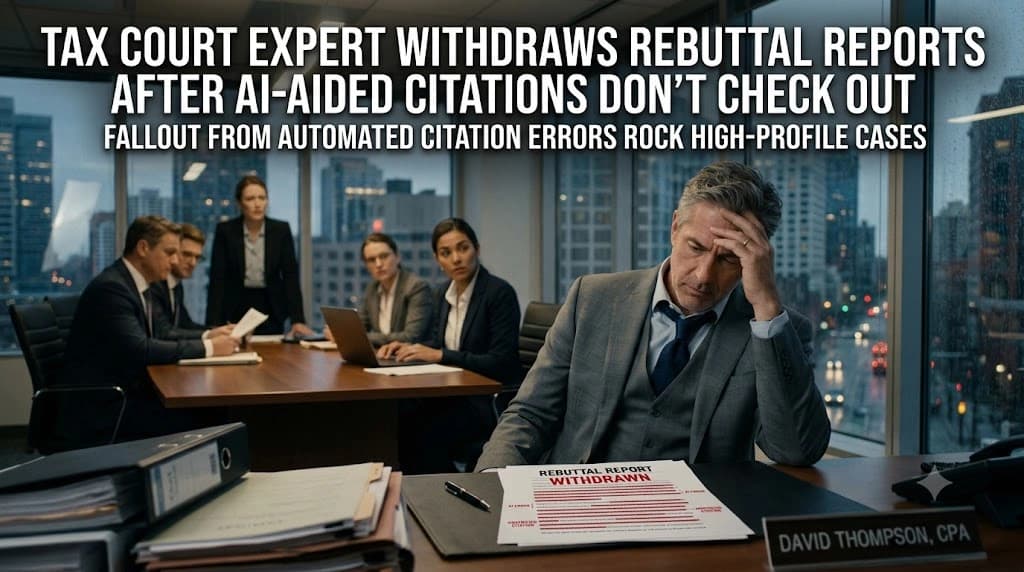
Rather than proceed on that footing, Pavilonis withdrew both exhibits: “Respondent believes the best path forward is going to be to withdraw Exhibits 9006-R and 9007-R in light of the Court’s comments.” Sellers was excused from the stand, and the reports never became part of the trial record - an outcome the court reached without a written exclusion order, but arrived at all the same once it signaled from the bench that admission would not spare the reports serious scrutiny.
The Kicker
Sellers had spent much of the morning describing decades of continuing education, peer-reviewed appraisal standards, and a professional discipline built on catching other appraisers’ errors - testimony offered, in part, to establish that he was qualified to review other experts’ work for exactly this kind of mistake.
Failure Points
→ Sellers drafted both rebuttal reports using a dictation-and-Grammarly workflow, and disclosed separate use of ChatGPT and Gemini, without cross-checking the resulting citations against the sources they purported to quote.
→ Citations attributing specific statements and a specific section number to the Yellow Book did not match the actual text at the cited pages, in both the Catlett rebuttal and the Shea rebuttal.
→ Neither Sellers nor Respondent’s counsel caught the errors before the reports were lodged as his sworn direct testimony; two errata sheets filed weeks later still left more than 20 errors across the two reports.
→ Once the court signaled it would weigh the reports harshly if admitted, Respondent withdrew both exhibits rather than proceed to a ruling on exclusion.
The Lesson
A court does not need to formally exclude an unreliable expert report to keep it out of the record. A judge’s stated intent to discount a report can accomplish the same result, often faster, by giving the offering party a reason to withdraw the evidence before a ruling is even made. The episode is also a reminder that a rebuttal expert retained specifically to critique another expert’s citations is held to the standard he was hired to enforce.
Takeaways
If you’re retaining experts:
Ask directly whether AI drafting or editing tools were used in preparing a report, and build in time to verify every citation against its original source before the report is lodged as direct testimony. A court that catches one hallucinated quote will assume the rest need checking too.
If you’re an expert witness:
Treat AI writing aids, grammar checkers included, as tools that can silently alter quoted language, not just prose style. Verify block quotes against the actual page you are citing before certifying a report under oath, especially when the citation is doing the work of establishing a rule or standard.