

Case Facts
Joseph Ferlito bought a splitting maul - an axe built for splitting wood - from Harbor Freight Tools in 2017. Several months later, while he was hanging the maul to store it, the head detached and struck him, injuring his nose and left eye. Ferlito sued in 2020, alleging the maul was defectively designed; Harbor Freight countered that the tool failed because Ferlito misused it, pointing to a large crack in the handle. To support his design-defect claim, Ferlito offered testimony from Mark Lehnert, a consultant who described himself as having "extensive knowledge and experience in manufacturing and assembly, [and] mechanical and electrical engineering management." Lehnert holds no engineering degrees, but reported decades of experience designing and manufacturing power tools, more than a dozen patents, and management roles in engineering departments at several corporations.
The Setup
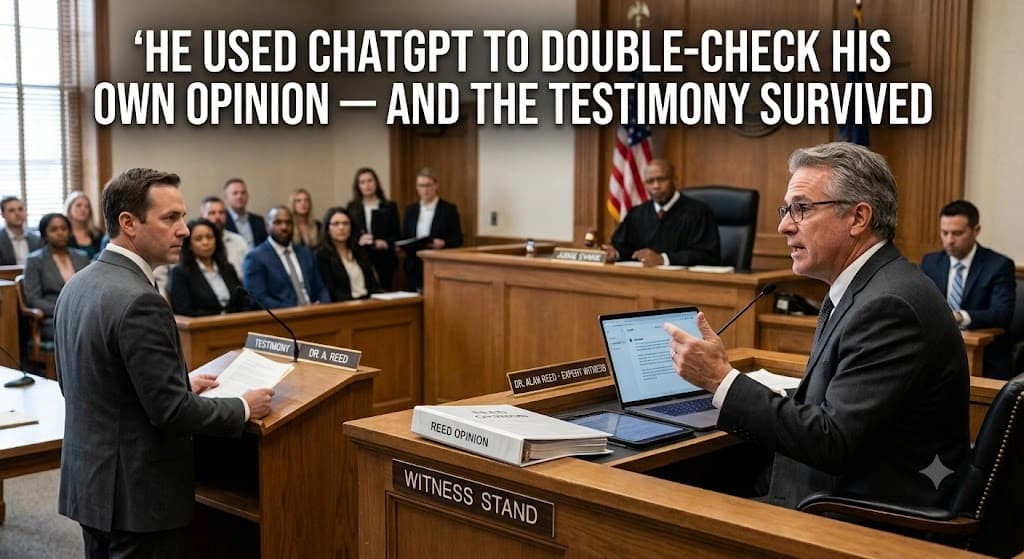
Lehnert's report concluded that the maul's handle and head were defectively joined with adhesive alone, and proposed an alternative: drilling a small hole through the head and handle and securing them with an aluminum pin, a design he noted was already used in other splitting mauls on the market. Harbor Freight moved to exclude his testimony under Federal Rule of Evidence 702, arguing on three grounds: that Lehnert wasn't qualified because he lacked engineering credentials and his experience was limited to power tools rather than manual ones; that his opinion was unreliable because he cited no scientific, technical, or trade literature; and that after finishing his report, he had entered a query into ChatGPT asking the best way to secure a hammer head to a handle - a query that returned an answer consistent with his own conclusion. The court held a Daubert hearing on February 27, 2025, where Lehnert testified.
The Challenge
On the stand, Lehnert explained his qualifications this way: "my experience here is in the cojoining of dissimilar materials. When you put two things together, you either have to connect them mechanically, glue them with some type of material that forms a cohesive joint... this is an assembly issue, which is my specialty, assembly process engineering." On the ChatGPT question, the record showed he had run the query only after his report was already written, testifying he used it "to confirm his findings" and that he was "quite amazed" the search "confirmed what he had already opined." On re-direct, he was asked directly whether ChatGPT was among the things he relied on in reaching his conclusions, and answered: "Correct" - meaning he had not.
The Ruling
The court found Lehnert qualified, holding that his lack of an engineering degree went to the weight of his testimony rather than its admissibility, and that his experience joining dissimilar materials in power tools was transferable to a simpler manual tool. It found his opinion reliable as well: because other mauls on the market already used the pin design he proposed, independent testing wasn't required to establish feasibility, and the absence of peer-reviewed sources was again a weight issue for cross-examination, not a bar to admission.
On the AI question, the court surveyed how other courts have handled expert and attorney use of generative AI, citing Kohls v. Ellison, where an expert's declaration was excluded after it cited "fake, AI-generated sources" that "shatter[ed] his credibility," and separate cases sanctioning attorneys for filing briefs built on ChatGPT-fabricated citations. The court read that line of cases as drawing a line at reliance: Daubert problems arise, in the court's words, "when attorneys and experts abdicate their independent judgment and critical thinking skills in favor of ready-made AI-generated answers" - not from the mere fact that AI was consulted.
Applying that standard, the court found no issue with Lehnert's ChatGPT use: he had reached his conclusions first, based on his own stated experience, and only afterward ran a query to see whether it lined up with what he'd already written. "There is no indication that Lehnert used ChatGPT to generate a report with false authority or that his use of AI would render his testimony less reliable." The court did separately flag that Lehnert had "a troubling propensity for hyperbole" at the hearing - defense counsel called one exchange "the classic example of ipse dixit," and the court agreed - but found that alone insufficient to exclude him, while cautioning Ferlito's counsel to rein in overstatement before trial. Harbor Freight's motion to exclude was denied.
The Kicker
The court opened its opinion with an aphorism it took pains to note is "incorrectly attributed to Abraham Lincoln" - about spending the first two hours of a four-hour job sharpening the axe. Here, the axe survived scrutiny not because the expert avoided ChatGPT, but because he'd already done the sharpening himself before he ever asked it a question.
How the AI Question Was Resolved
→ Ferlito's expert, Mark Lehnert, concluded the maul was defectively designed and proposed securing the head to the handle with a metal pin, citing other mauls already built that way.
→ Harbor Freight moved to exclude Lehnert's testimony, arguing he was unqualified, cited no technical literature, and had used ChatGPT to check a conclusion he'd already reached.
→ At a February 27, 2025 Daubert hearing, Lehnert testified he ran the ChatGPT query only after finishing his report, to confirm findings based on his own experience.
→ On re-direct, Lehnert confirmed ChatGPT was not among the things he relied on in reaching his conclusions.
→ The court surveyed cases excluding experts and sanctioning attorneys over AI-fabricated citations, and framed the line as reliance versus confirmation.
→ Finding Lehnert had formed his opinion independently and merely checked it against ChatGPT afterward, the court found no reliability problem with his AI use.
→ The court denied Harbor Freight's motion to exclude Lehnert's testimony in full.
The Lesson
The court's own framing supplies the throughline: the problem in the cases it cited was reliance - an expert or lawyer treating AI output as a finished answer, without independently verifying what it produced. Lehnert's report and opinion were already complete, grounded in his account of decades joining dissimilar materials, before ChatGPT entered the picture at all. The court's inquiry wasn't whether AI was used, but when, and for what - a query run afterward to check an existing conclusion sits in a different category than a declaration built from AI-generated citations nobody checked.
Takeaways
If you're retaining experts:
An expert who wants to sanity-check a finished opinion against an AI tool isn't automatically creating a Daubert problem - but the sequence matters, and it should be documented. Lehnert's testimony that he ran the query after writing his report, and his direct concession on re-direct that he hadn't relied on it, are what let the court draw that line clearly.
If you're an expert witness:
Be prepared to testify precisely about when you used an AI tool and what role it played. The distinction the court drew - confirmation after independent analysis, versus reliance in place of it - is one you may have to establish through your own testimony, not just your report.
If you're opposing counsel:
Flagging an expert's AI use is worth raising, but courts are drawing real distinctions rather than treating any AI contact as disqualifying. Here the same motion also raised the expert's lack of credentials and absence of literature citations - neither on its own, nor combined with the ChatGPT query, was enough without evidence the AI output was actually relied upon.