
Case Facts
Dr. Michael Khoury brought this False Claims Act qui tam suit against Mountain West Anesthesia, LLC and five named anesthesiologists, alleging that data pulled from the defendants' personal electronic devices showed them tending to other business - DJ gigs, a ketamine clinic, stock trading, party and graduation planning - while billing Medicare and Medicaid for anesthesia care during complex surgeries. To testify about the Medicare and Medicaid conditions of payment those claims were supposed to satisfy, and about CMS's related processes, Dr. Khoury's counsel retained Thomas Dawson, an expert whose résumé listed more than twenty-three years in healthcare policy, a law degree from George Washington University, and a stint as Health Care Counsel to the U.S. House of Representatives Committee on Small Business. Counsel intended Dawson's testimony as a substitute for calling a CMS witness at trial, after the court had narrowed the scope of a second CMS deposition.
The Setup
Dawson billed more than 165 hours - in excess of $91,000 - conducting what his invoices described as independent research and drafting between March and May 2025, including more than twenty-seven hours of "independent regulatory/legal research" and over twenty-three hours of "editing and revis[ing]" his draft, part of it billed specifically for "citation insertions" and "documentation language," plus seven and a half hours billed for "QA." He submitted his final twenty-five-page report on May 12, 2025, after narrowing it down from nearly fifty pages, and voluntarily attached an "Expert Declaration" certifying "under penalty of perjury under the laws of the United States of America that the foregoing report is true and correct to the best of my knowledge." Dr. Khoury's counsel has said it reviewed drafts of the report for clarity and readability but, consistent with the rule against attorneys shaping an expert's substance, did not probe the underlying research.
The Failure
At his deposition on July 21, 2025, Dawson volunteered that he had used artificial intelligence while preparing the report. Asked why he hadn't told Dr. Khoury's counsel, he testified, "I didn't think to" tell them about his ChatGPT use, and separately acknowledged, "I certainly used the ChatGPT to help me pull my documents together." The report he had certified under penalty of perjury turned out to contain fabricated testimony attributed to a CMS deposition witness and a fabricated joint policy statement purportedly issued by two real organizations. Dr. Khoury's counsel later described why neither had raised a flag during their own review: the invented CMS testimony was "a substantively correct statement and as such it never jumped out as being a fabrication," and the fabricated policy statement "was similar to other statements the groups had made."
"ChatGPT is a technology designed to create content that appears to be plausible - content that looks, sounds, and 'feels' genuine - but that is, in fact, entirely made up."
Dr. Khoury's own filing put it more bluntly still: "one of Dr. Khoury's expert witnesses prepared a report containing errors, likely caused by generative artificial intelligence (AI) that fabricated plausible but fictitious misstatements."
The Ruling
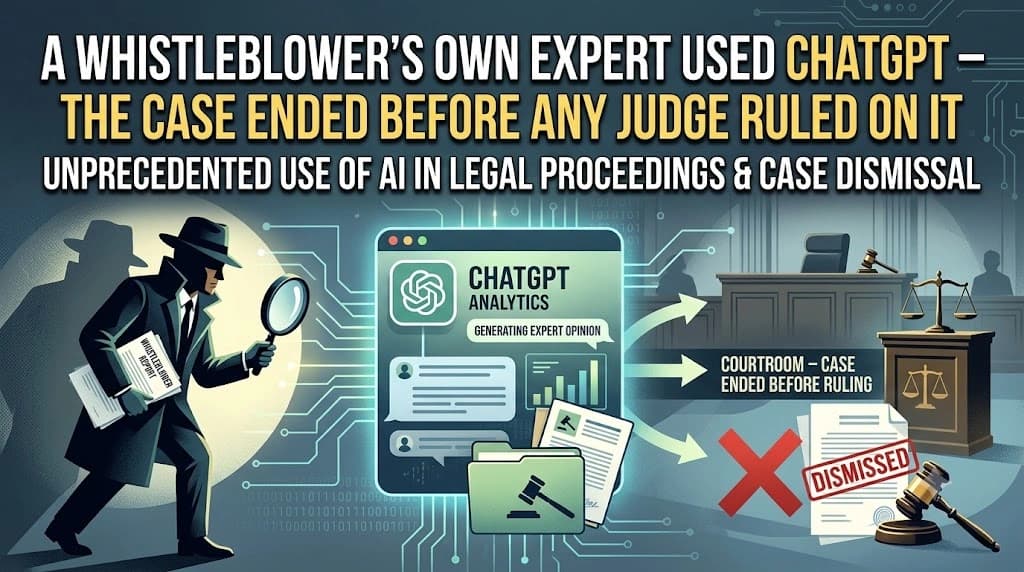
Defendants moved to exclude Dawson as a witness. Dr. Khoury's counsel withdrew him voluntarily and offered to reimburse Defendants for the costs of reviewing his report and taking his deposition - an offer Defendants rejected. Instead of accepting the withdrawal, Defendants moved to sanction Dr. Khoury's counsel and to disqualify them from the case entirely, a request Dr. Khoury's counsel opposed as untimely and disproportionate, noting that Defendants had waited roughly three months after first suspecting AI use in the report before filing the motion, and that they never identified a specific ethical rule counsel had violated. That sanctions and disqualification fight was still unresolved when the United States exercised its own authority as a qui tam plaintiff to intervene and move to dismiss the case outright. On September 30, 2025, Judge Tena Campbell granted that unopposed motion in a one-paragraph order: the action was "dismissed with prejudice as to Relator and without prejudice as to the United States." Neither the dismissal order nor the accompanying judgment mentions Dawson, ChatGPT, or the sanctions dispute - the case ended before any court ruled on what Dawson's undisclosed AI use should cost anyone.
The Kicker
A qui tam relator's own expert put a ChatGPT-assisted fabrication under his signature and penalty of perjury, and the resulting fight over sanctions and disqualification never got a verdict - not because a judge decided it didn't matter, but because the lawsuit itself ran out of time first.
How the AI Issue Unfolded
→ Dr. Khoury's counsel retained Thomas Dawson to testify about Medicare and Medicaid conditions of payment, in place of calling a CMS witness at trial.
→ Dawson billed more than 165 hours, over $91,000, researching and drafting his report between March and May 2025, and submitted it May 12, 2025 with a voluntary sworn declaration.
→ At his July 21, 2025 deposition, Dawson volunteered that he had used ChatGPT while preparing the report and had never disclosed that to Dr. Khoury's counsel.
→ The report contained fabricated testimony attributed to a CMS witness and a fabricated joint policy statement attributed to two real organizations.
→ Defendants moved to exclude Dawson; Dr. Khoury's counsel withdrew him and offered to cover Defendants' related costs, which Defendants refused.
→ Defendants moved instead to sanction and disqualify Dr. Khoury's counsel, arguing for disqualification without identifying a specific ethical rule violated.
→ Before the court ruled on the sanctions and disqualification motion, the United States moved to intervene and dismiss the case; Judge Campbell granted that motion September 30, 2025, without addressing the AI issue.
The Lesson
This case shows an AI-hallucination dispute running its full course through the parties' own briefing - discovery of the problem at deposition, a voluntary withdrawal, a rejected offer to pay costs, an escalated motion for sanctions and disqualification - without ever reaching a judge. Dr. Khoury's counsel argued they had no way to catch the fabrications because Dawson's invoices never suggested AI use and the fabricated material read as plausible on its face; Defendants argued that was beside the point once Dawson himself had certified the report under penalty of perjury. Which side had the better argument was never decided. The government's intervention and dismissal, filed on its own timeline for reasons its motion doesn't state, overtook the sanctions fight before the court reached it.
Takeaways
If you're retaining experts:
An expert's invoices and a plausible-sounding report aren't a substitute for asking directly, in writing, whether any AI tool touched the drafting. Dawson's billing entries described every task as his own personal work, and nothing in them signaled AI involvement - the disclosure only came out, unprompted, at deposition.
If you're an expert witness:
Attaching a voluntary sworn declaration to a report raises the stakes of anything in it you can't stand behind. Dawson's declaration certified the report was "true and correct" under penalty of perjury; his own deposition testimony is what unraveled that certification.
If you're opposing counsel:
A well-documented AI-hallucination record doesn't guarantee a ruling. Here, the losing side of a sanctions and disqualification fight it had strong grounds to bring never found out how a court would have resolved it, because the case ended on unrelated grounds first.