

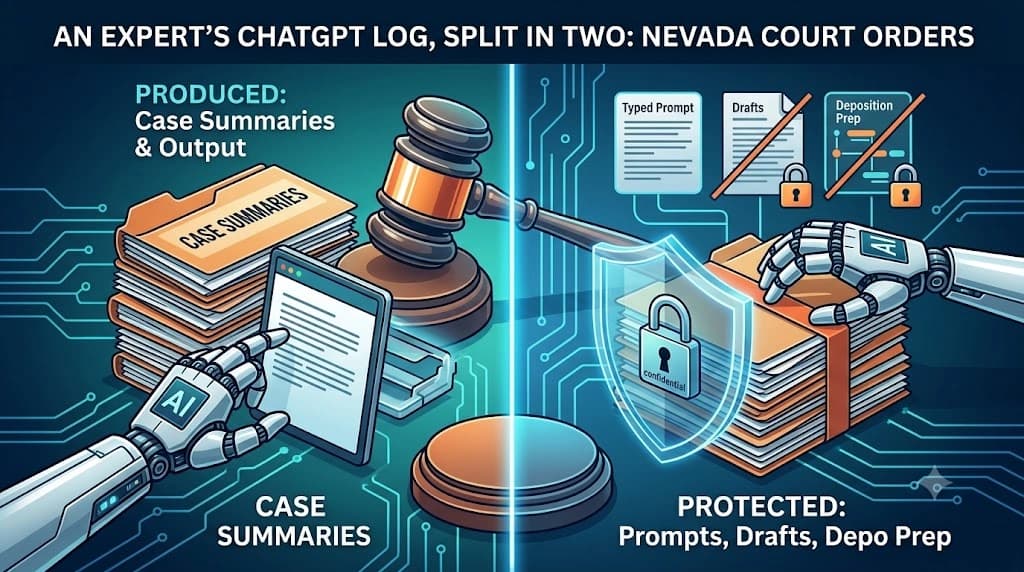
Jose Villanueva v. Las Vegas Metropolitan Police Department, et al. | Case No. 2:24-cv-00125-ART-DJA | U.S. District Court for the District of Nevada | Hon. Anne R. Traum, U.S. District Judge | Order on ECF Nos. 70, 71, 72 | Decided September 29, 2026 | 2026 WL 2942348
Case Facts
Jose Villanueva sued the Las Vegas Metropolitan Police Department (LVMPD) and corrections officer Francis Soriano over what happened to him at the Clark County Detention Center (CCDC) in October 2023. According to the First Amended Complaint, as the court recounted it in its February 17, 2026 order, Villanueva was arrested on October 9, 2023, and taken to CCDC. Four days later, Soriano escorted him to be fingerprinted. After a verbal exchange, Villanueva told Soriano he would be filing a Citizen Review Board complaint against him. Soriano, he alleges, answered with increasingly offensive remarks and a threat, and when they reached the booking area told the other officers, “We have one here, another one that needs ‘The Treatment.’” Villanueva understood that to mean use of force. (ECF No. 31 ¶¶ 12–15.)
Back at his module, Soriano told Villanueva he had a “24” — a punishment that restricts an inmate to his quarters for 24 hours — “For not following orders.” Villanueva denied it and demanded a supervisor so he could lodge a verbal complaint and have the cameras reviewed. Soriano then, as alleged, grabbed him, “threw him against the wall, and then tripped/threw [him] headfirst into the concrete floor in a bodyslam type manner.” At the hospital, Villanueva was found to have orbital bone fractures, along with vision and concussion symptoms. (Id. ¶¶ 16–19.)
Villanueva filed the case on January 18, 2024, initially without a lawyer. Judge Traum’s December 30, 2024 screening order let First Amendment retaliation and Eighth Amendment excessive-force claims proceed against Soriano, allowed a Monell claim against LVMPD and supervisory claims against unnamed Doe supervisors, let several state-law claims go forward against Soriano, and dismissed Clark County with prejudice. After counsel appeared, Magistrate Judge Daniel J. Albregts granted leave to amend on July 15, 2025. (ECF No. 25.) On February 17, 2026, Judge Traum granted in part and denied in part Defendants’ motion to dismiss the amended complaint (ECF No. 76): she dismissed the Fourth Amendment theory with leave to replead under the Fourteenth Amendment’s Due Process Clause, declined to dismiss the “cruel and unusual punishment” claim under Article I, Section 6 of the Nevada Constitution, held that the alleged shared understanding of “the Treatment” among officers was enough to plead a Monell custom, and dismissed a negligence per se claim built on NRS 171.1455.
Experts were already a point of friction. On August 4, 2026, Judge Albregts ruled on the deposition fee for Defendants’ expert, Dr. Richard Allen, who had disclosed a rate of $1,100 per hour with a three-hour minimum retainer, or $3,300. Villanueva intended to depose him for about an hour and did not dispute the hourly rate. The court held that Villanueva “shall only pay Dr. Allen for the time actually spent in his deposition.” The same order deemed Defendants’ summary judgment motions (ECF Nos. 95, 96), filed July 16, 2026, timely. Those motions remain pending.
The September 29, 2026 order resolves three objections Villanueva filed against discovery rulings Judge Albregts made from the bench on December 23, 2025 (transcript at ECF No. 69). Two of them have nothing to do with artificial intelligence. The third — ECF No. 70 — concerns the ChatGPT history of Villanueva’s own expert witness.
The Setup
Villanueva’s expert witness, Tom Melton, sat for deposition on October 1, 2025. According to the order, he testified there that he “relied upon ChatGPT, an artificial intelligence program, to assist him with researching and drafting his expert report.” (ECF No. 44 at 5–6.) He also testified to sometimes copying and pasting ChatGPT’s outputs into his own report. (Id. at 6.)
None of that had surfaced earlier. Before the deposition, Defendants had subpoenaed “all data, documents, and other information considered by expert witness in forming the expert’s opinions,” and Villanueva’s response did not disclose Melton’s use of AI. (Id. at 4–5.) When Defendants asked for the ChatGPT history log after the deposition, Villanueva declined and listed it on his privilege log as “Attorney/Expert Work Product; Trial Preparation: Materials.” (ECF No. 44-9 at 16.)
The log runs 40 pages. Villanueva’s own description of what is in it — the description the magistrate judge later relied on — sorted it into three categories:
“(a) Much of the material asks for a case summary of certain controlling court cases on excessive force, in other words legal research conducted by the expert, (b) some inquiries ask ChatGPT to create a deposition outline for an excessive force case, which apparently the expert used to predict likely questions at deposition (classic trial/litigation preparation work), (c) prompts to analyze and create what could be used as portions of a draft report as to certain issues, such as qualifications of the opposing expert or analysis of the opposing expert’s report (classic protected draft report information).” (ECF No. 51 at 4.)
The Dispute
Defendants moved to compel production of the log. (ECF No. 44.) Villanueva opposed (ECF No. 51), and Defendants replied (ECF No. 63). Their reason for wanting it was specific: as the court put it, the log “is the only place where Defendant can review alleged ‘hallucinated case citations...quotes...and references to broad legal standards’ that Melton relied upon, or at least considered, to reach his opinion.” (ECF No. 74 at 2.)
That is an allegation, not a finding. The September 29 order does not determine that Melton’s report or his ChatGPT log contains any fabricated citation or quotation. What it decides is how much of the log the other side gets to see.
At the December 23, 2025 hearing, Judge Albregts granted the motion in full from the bench. He held that the log should have been disclosed under Federal Rules of Civil Procedure 26(a)(2)(B)(ii) and (iii) “because Melton considered it in forming and supporting his opinions.” (ECF No. 69 at 26.) He found it was not work product because it was not a draft report — the log was neither created by Melton nor itself a draft of the entire report — and that attorney-client privilege did not protect it either; it should have been disclosed like other materials an expert “would have relied upon in forming his opinion.” (Id. at 26–27.) He did not review the log in camera, relying instead on Villanueva’s three-category description.
Villanueva objected. (ECF No. 70.) He argued that Melton’s prompts would reveal his “mental impressions or strategy...as to what issues he found of particular importance” and his theory of the case (ECF No. 70 at 2), that skipping in camera review was clear error, and that nothing about Melton’s use of ChatGPT waived any privilege. Defendants responded in support of the order. (ECF No. 74.)
The Ruling
Because the magistrate judge’s ruling was non-dispositive, Judge Traum reviewed it under 28 U.S.C. § 636(b)(1)(A) and Rule 72(a), deferring unless it was “clearly erroneous or contrary to law.” She found that standard met — but only in part. In her words, “the order granting disclosure of the entirety of Melton’s ChatGPT history log was ‘clearly erroneous or contrary to law.’” The objection was granted in part and overruled in part.
The analysis turned on two pieces of Rule 26. Rule 26(a)(2)(B)(ii) requires an expert report to include “the facts or data considered by the witness in forming” the opinions — language narrowed in 2010 from “data or other information,” which the order notes many courts had read to require disclosure of all attorney-expert communications and draft reports. Reading the rule broadly, the court explained that it reaches “any material considered by the expert, from whatever source, that contains factual ingredients” — material the expert considered, not only material relied upon. On the other side of the line, Rule 26(b)(4)(B) protects drafts of an expert’s report or disclosure “regardless of the form in which the draft is recorded,” and Rule 26(b)(3)(B) bars disclosure of the “mental impressions, conclusions, opinions, or legal theories of a party’s attorney or other representative.”
Rather than treat the log as one document, the court took it apart category by category.
What must be produced: ChatGPT’s case-law summaries
The case summaries ChatGPT generated for Melton are discoverable. “Because Melton generated case summaries and ‘consulted’ them to reach his expert opinion on excessive force, the ChatGPT-generated case summaries constitute ‘facts or data’ that are subject to disclosure under Rule 26.” The court framed this as material that “must be disclosed as part of his expert report,” and held that “disclosure under Rule 26 requires the disclosure of all case summary responses supplied by ChatGPT.”
The court expressly credited Defendants’ reason for wanting them: “As Defendant correctly contends,” the log is the only place they can review the alleged hallucinated citations, quotes, and legal standards Melton relied on or considered. The objection was overruled as to this portion of the log.
What stays protected: prompts, deposition prep, and draft-report work
The other three components of the log are shielded, and ordering them produced was “clearly erroneous or contrary to law.”
Melton’s questions and prompts. The court held that a prompt is not “facts or data” at all: “a question is not something that an expert can ‘consider’ or ‘rely’ upon as ‘facts or data’ in reaching their opinion, just as an expert would not ‘consider’ or ‘rely’ upon their online research queries.” Whether treated as part of a draft report under Rule 26(b)(4)(B) or as trial-preparation material under Rule 26(b)(3)(A), the court said, “discovery into Melton’s questions to ChatGPT would be impermissible.” It agreed with Villanueva that the prompts would reveal Melton’s mental impressions and his theory of the case, noting that protecting opinion work product was the driving purpose of the 2010 amendments.
The deposition outline. Melton’s use of ChatGPT to build a deposition outline was a different use from research. “Instead of using ChatGPT’s outputs to inform his expert opinion, Melton used ChatGPT’s responses to structure his preparation for his deposition and trial.” A deposition outline is not “facts or data,” and even assuming no privilege applied, the court held production barred by Rule 26(b)(3)(B), because such an outline “would reveal Melton’s focus, priorities, or areas of concern to address in the deposition and at trial.”
Draft-report output. Prompts asking ChatGPT to analyze “certain issues, such as qualifications of the opposing expert or analysis of the opposing expert’s report” fall, the court held, “squarely within the protections of an expert’s draft reports.” Defendants argued that ChatGPT’s responses are not Melton’s “own generation of a report” and so cannot be his draft. (ECF No. 44 at 12–13.) The court disagreed, and the deciding fact was Melton’s own testimony: “Melton’s creation of a draft report on ChatGPT is protected as a draft report, because Melton testified that some of this information was directly incorporated into his own written report.” In the alternative, the outputs would still be protected mental impressions under Rule 26(b)(3)(B).
In camera review and waiver
Judge Traum looked at the log herself. “Having conducted an in camera review of the history log, the Court finds that Judge Albregts did not clearly err in relying upon Plaintiff’s good-faith representation of the history logs.”
On waiver — an issue the order says Judge Albregts appears not to have reached — the court ruled for Villanueva: “Because ChatGPT is not a person, but was an application used in this instance as a research, drafting, and editing program, the Court finds that any privileged information is not waived by Melton’s use of the program.”
The court closed the ChatGPT section by pointing Defendants toward trial rather than discovery: “many of Defendant’s concerns about Melton’s methodology and reliance on ChatGPT are appropriate to address at trial as matters of impeachment.”
The other two objections
Both of Villanueva’s non-AI objections were overruled. Judge Traum upheld the deferral of discovery into Soriano’s personal finances for punitive damages until dispositive motions addressing qualified immunity are resolved, noting that the order “did not deny all discovery into punitive damages but instead shifted the window of time” for it. (ECF No. 71.) She also upheld the denial of a protective order against 131 requests for admission — 49 from LVMPD and 82 from Soriano — observing that the Federal Rules set no numerical limit on requests for admission and that, under the local rules, Villanueva had to file individualized objections or responses rather than a blanket objection. (ECF No. 72.)
The Kicker
The detail most likely to worry a reader about Melton — that he copied and pasted ChatGPT’s output into his expert report — is the very fact the court relied on to keep that output out of Defendants’ hands. Pasted text became draft text, and draft text is protected. What Defendants do get is the part of the log where any hallucination would most likely live: ChatGPT’s summaries of the case law. They will see the answers. They will not see the questions.
What Was Sought vs. What the Court Ordered
→ The whole log: Defendants asked for all 40 pages; the magistrate judge ordered all of it produced. The district judge held that ordering the entire log was clearly erroneous or contrary to law.
→ ChatGPT case-law summaries: Produced. They are “facts or data” Melton considered and must be disclosed as part of his expert report.
→ Melton’s prompts and questions: Protected. A question is not “facts or data,” and the prompts reveal his mental impressions.
→ ChatGPT deposition outline: Protected. It structured deposition and trial preparation rather than informing his opinion.
→ Draft-report output: Protected as a draft under Rule 26(b)(4)(B), because Melton incorporated some of it into his report — and alternatively as mental impressions.
→ Waiver through using ChatGPT: None. ChatGPT “is not a person.”
→ The alleged hallucinations: Not decided. Concerns about Melton’s methodology and reliance on ChatGPT are left for impeachment at trial.
→ The earlier disclosure: Melton’s AI use was not disclosed in response to the pre-deposition subpoena and came out only when he testified. The case summaries, the court held, belong in his Rule 26 disclosure.
The Lesson
The ruling refuses an all-or-nothing answer to the question every litigator with an AI-using expert will eventually face: is the chat log discoverable? Judge Traum’s answer is that a ChatGPT history is not one thing. Outputs the expert consulted as research are “facts or data” and go to the other side. The expert’s own inputs reveal how he thinks about the case and stay with him. Outputs used to rehearse for a deposition are trial preparation. Outputs that made their way into the report are drafts, whatever software produced them. And a tool is a tool — feeding privileged material to an application that “is not a person” waives nothing.
The practical effect is to move the AI fight from discovery to the witness stand. Defendants did not get everything they asked for, but they got the portion that matters most to an accuracy challenge, and the court told them where the rest of their concerns belong: cross-examination. This is a district court ruling on objections to a magistrate judge’s non-dispositive order, reviewed under a deferential standard, so its weight elsewhere will be persuasive rather than binding. But its framework — sort the log by what the expert actually did with each output — is one other courts can apply line by line.
Takeaways
If you’re retaining experts:
Ask at the outset whether your expert uses generative AI, and for what. Here the answer came out for the first time at deposition, after a subpoena for everything the expert “considered” had already been answered.
Treat AI-generated research — case summaries, literature summaries, factual digests — as “facts or data” the expert considered, and disclose it with the report. Under this ruling, that material belongs in the Rule 26 disclosure.
If you withhold any part of a chat log, log it by category. The court’s analysis worked component by component — prompts, research outputs, deposition prep, draft language — and a privilege position built the same way is far easier to defend than a blanket designation.
Have someone check every case an AI tool summarized for your expert before the report goes out. Those summaries are the part of the log the other side is most likely to get.
If you’re an expert:
Verify anything an AI tool tells you about the law or the literature against the source itself. Your research outputs can be produced and compared, line by line, to the real cases.
Keep research, drafting, and deposition-preparation sessions separate. The court’s protection followed what each output was used for; mixing them in one conversation makes that line harder to draw.
Be ready to explain on the record exactly how you used the tool. The court left concerns about an expert’s methodology and reliance on ChatGPT for impeachment at trial — which means you will be asked.
If you’re opposing counsel:
Ask every expert directly, at deposition, whether and how they used AI. Deposition testimony is how the issue surfaced in this case.
Aim discovery at the outputs that served as research inputs to the opinion. Under this reasoning, prompts, deposition outlines, and draft-report output are likely to be protected.
Build your cross around the produced summaries: compare what the AI said each case held with what the case actually says.