

Case Facts
Conservation Law Foundation, Inc. v. Equilon Enterprises LLC d/b/a Shell Oil Products US, Inc., Triton Terminaling LLC, and Motiva Enterprises LLC is pending in the District of Connecticut under Civil Action No. 3:21-cv-00933-VDO. On December 23, 2025, the defendants moved to compel Conservation Law Foundation (CLF) to produce reliance materials tied to its expert Dr. Naomi Oreskes’s use of artificial intelligence in preparing her report, or in the alternative for sanctions over unpreserved evidence (ECF No. 941). Under a standing discovery-referral order (ECF No. 473), the parties presented the dispute through simultaneous letter briefs (ECF Nos. 940, 941), then met and conferred at the court’s direction (ECF No. 961). They resolved every issue except one: “their dispute concerning Defendants’ request for the prompts Dr. Oreskes used in conducting her AI analysis and outputs” (ECF No. 963). The court held a hearing on that remaining dispute on May 14, 2026, and Judge Thomas O. Farrish granted the motion to compel in an order entered May 18, 2026.
The AI Workflow
Dr. Oreskes used artificial intelligence to help form the opinions in her expert report on the history of climate science and Shell’s internal knowledge. According to the underlying motion, she testified that she and her research assistant, Dr. Alexander “Sasha” Kaurov, jointly developed the prompts used to analyze the defendants’ document production; Kaurov “ran the analysis,” and Oreskes then reviewed the documents the AI identified. She described the tool as a “sieve to identify all the documents that could be relevant.” She also acknowledged she never checked the AI’s output against the full set of produced documents to see what might have been missed, excluded, or misread. At one point she testified she believed the tool had searched “through all of the documents provided by the Defendants” - the entire production - and when defense counsel questioned whether that was technically feasible, she said her assistant had a “particular toolkit.”
The Discovery Fight
CLF initially told the defendants that no documents had been “ingested” by any AI tool, then acknowledged in a November 21, 2025 meet-and-confer that documents had in fact been uploaded. The defendants asked for the Bates numbers of everything fed to the AI model; CLF never produced that list. Separately, the defendants sought the prompts and outputs themselves, a request CLF resisted for months - at one point stating the AI had not “generate[d] any reports or print outs” and that “no experimental prompts were stored.” On December 19, 2025, CLF produced a declaration from Kaurov acknowledging that he “did not export or preserve a complete native ‘prompt/output log’” on his personal systems or in any cloud environment. The parties declared an impasse three days later, and the motion to compel followed.
The Ruling
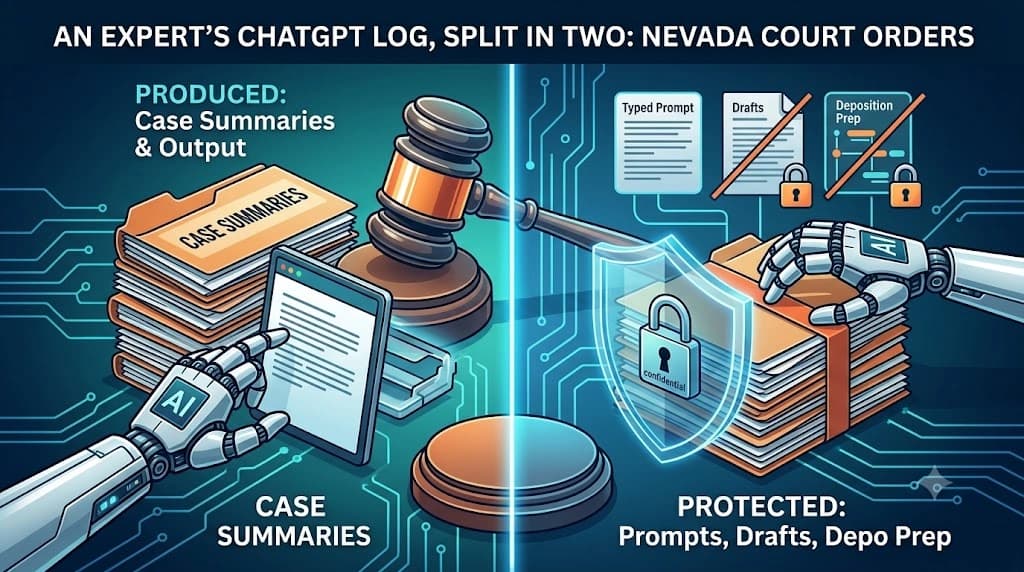
The court rejected CLF’s arguments one at a time. First, CLF argued that AI prompts fall outside the scope of discovery under Rule 26(b). The court disagreed, holding that “an expert witness’s methodology is fair ground for discovery” and that, on these facts, “the process by which Dr. Oreskes culled down the defendants’ document production into a subset to be worked with is an aspect of that methodology.”
Second, CLF argued the prompts were shielded by a Rule 29 discovery agreement covering “expert notes, drafts, or communications needed by, and made during, the report drafting process,” and contended at oral argument that the AI prompts qualified as “notes.” The court disagreed again. Before a Rule 29 agreement can block otherwise-discoverable material, the agreement “must be quite clear” - and CLF’s reading of “notes” to reach AI prompts was not so obvious as to be “quite clear.”
Third, CLF argued there was nothing left to produce, since Oreskes had used “search terms,” not “prompts,” and all search terms had already been turned over. The court noted that a party’s good-faith statement that responsive material does not exist ordinarily ends the inquiry - unless the requesting party has an evidence-backed reason to doubt it. Here, the defendants had one: Kaurov’s own declaration referred to a “prompt.” The court ordered CLF to revise its interrogatory and document-request responses to cover any AI prompts or queries used by Oreskes or her team, due June 1, 2026, and warned that Rule 37(b) sanctions could follow if CLF’s eventual representation that nothing further exists later proves untrue.
The Kicker
A tool built to speed up document review now comes with its own discovery obligations - the search became part of the record it was meant to search through.
Where CLF’s Answers Shifted
→ CLF first said no documents had been uploaded to an AI tool, then acknowledged in a November 2025 meet-and-confer that documents had been ingested
→ CLF said the AI generated no outputs and stored no “experimental” prompts, then produced a declaration acknowledging prompts existed but were not preserved
→ CLF argued its Rule 29 agreement covered AI prompts as “notes” - a reading the court found was not “quite clear” enough to withstand discovery
The Lesson
The order treats an expert’s AI prompts the way courts have long treated any other input behind an opinion: as part of the reasoning the opposing side is entitled to test. Calling the AI a “toolkit” or its prompts “search terms” didn’t change that analysis, and neither did a confidentiality agreement written with a pre-AI idea of what counts as an expert’s “notes.”
Takeaways
If you’re retaining experts:
Build AI use into the record from the start. Prompts and outputs can be treated as core reliance material under Rule 26, the same as annotated documents or calculation worksheets - and they should be preserved accordingly, not treated as disposable scratch work.
If you’re an expert:
A research assistant’s AI queries don’t fall outside what you may have to produce just because you didn’t type them yourself. Be ready to explain, on the record, whether and how you validated an AI tool’s output against the underlying documents.
If you’re negotiating a Rule 29 agreement:
Language written to cover “notes” or “drafts” may not extend to AI prompts unless the agreement says so in terms specific enough to meet a “quite clear” standard.