
Case Facts
Minnesota law prohibits, under certain circumstances, disseminating “deepfakes” with intent to injure a political candidate or influence an election. Plaintiffs Christopher Kohls and Mary Franson challenged that law on First Amendment grounds and moved for a preliminary injunction against its enforcement. In opposition, Attorney General Keith Ellison submitted two expert declarations: one from Jevin West, a University of Washington professor and Director of the Center for an Informed Public, and one from Jeff Hancock, a Professor of Communication at Stanford University and Director of the Stanford Social Media Lab. Both declarations offered background on artificial intelligence, deepfakes, and the dangers deepfakes pose to free speech and democracy. Plaintiffs moved to exclude both declarations as conclusory and contradicted by the experts’ own prior writings, and separately alleged that the Hancock declaration contained fabricated material.
The Setup
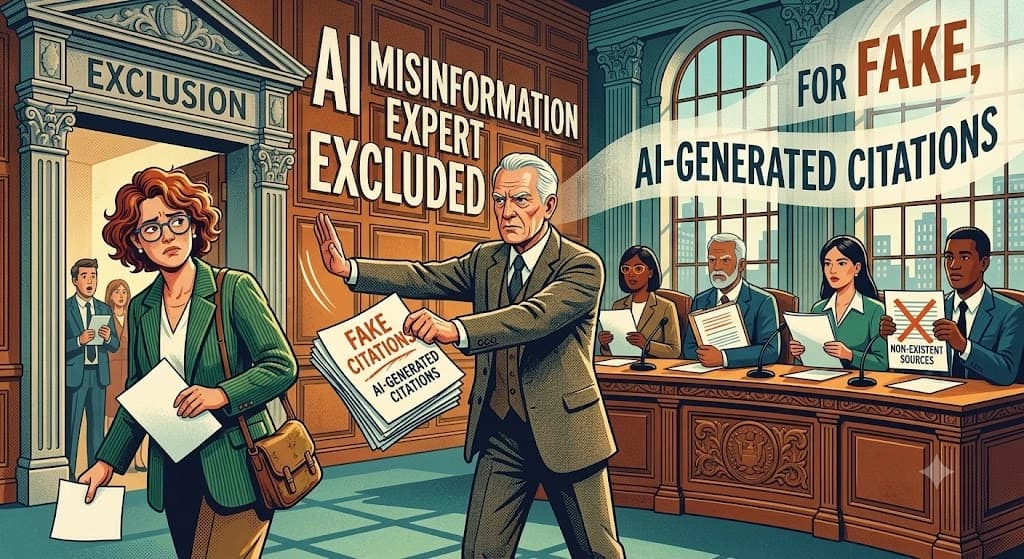
After Plaintiffs raised the fabrication allegation, the Attorney General’s office contacted Professor Hancock, who admitted that his declaration “inadvertently included citations to two non-existent academic articles, and incorrectly cited the authors of a third article.” The errors traced back to Hancock’s use of GPT-4o while drafting the declaration: the tool generated fake citations to academic articles, and Hancock failed to verify them before submitting the declaration under penalty of perjury. The Attorney General’s office said it had no idea the declaration contained AI-generated fake citations, and - because the deadline for its preliminary-injunction response had already passed - moved for leave to file a corrected version, citing excusable neglect.
The Failure
The court did not mince words:
“The irony. Professor Hancock, a credentialed expert on the dangers of AI and misinformation, has fallen victim to the siren call of relying too heavily on AI—in a case that revolves around the dangers of AI, no less.”
Hancock gave the court a detailed account of how the errors happened and told the court he stood by the substantive propositions in his declaration even where the citations supporting them were fake. The court found that beside the point: “even if the errors were an innocent mistake, and even if the propositions are substantively accurate, the fact remains that Professor Hancock submitted a declaration made under penalty of perjury with fake citations.” The court also noted that Hancock routinely runs his citations through reference-checking software when writing academic articles, but skipped that step here. “One would expect that greater attention would be paid to a document submitted under penalty of perjury than academic articles,” the court wrote. “Indeed, the Court would expect greater diligence from attorneys, let alone an expert in AI misinformation at one of the country’s most renowned academic institutions.”
The Ruling
The court was careful to separate AI use itself from what happened here: “the Court does not fault Professor Hancock for using AI for research purposes. AI, in many ways, has the potential to revolutionize legal practice for the better.” But, it added, “when attorneys and experts abdicate their independent judgment and critical thinking skills in favor of ready-made, AI-generated answers, the quality of our legal profession and the Court’s decisional process suffer.”
At the preliminary-injunction stage, the court did not apply a full Daubert analysis, evaluating instead the “competence, personal knowledge and credibility” of the declarations - but found that standard for expert reliability applied regardless of procedural posture. The fake citations, the court held, “shatters his credibility with this Court,” and a declaration signed under penalty of perjury demands more than an after-the-fact explanation, however “helpful, thorough, and plausible.” The court excluded Professor Hancock’s declaration in its entirety from consideration on the preliminary-injunction motion and denied the Attorney General’s request to substitute a corrected version as moot. The West declaration, by contrast, drew no similar reliability problem and was admitted; the court found it offered proper general background testimony and rejected Plaintiffs’ separate arguments that it was conclusory or improperly contradicted by Professor West’s earlier writing. The court also suggested that a reasonable pre-filing inquiry may now require attorneys to ask their witnesses whether they used AI in drafting a declaration, and what they did to verify the results.
The Kicker
The same order that let one expert’s testimony on the dangers of AI stand excluded the other expert’s testimony on the dangers of AI - because of AI.
How the AI Issue Unfolded
→ Attorney General Ellison submitted declarations from two experts, Hancock and West, opposing a preliminary injunction against Minnesota’s deepfakes law.
→ Plaintiffs alleged the Hancock declaration contained fabricated material; the Attorney General’s office investigated and confirmed it.
→ Hancock admitted he used GPT-4o to help draft his declaration and did not catch the fake citations it generated.
→ The Attorney General moved to substitute a corrected declaration, citing excusable neglect for the late request.
→ The court rejected that request and excluded the Hancock declaration in its entirety, finding the fake citations “shatters his credibility.”
→ The unrelated West declaration was admitted, with the court finding no comparable reliability problem.
The Lesson
This order is a stark example of an expert’s own subject-matter expertise offering no protection against unverified AI output - Hancock studies misinformation for a living, and the fake citations still made it into a declaration signed under penalty of perjury. The court’s framing is notable for what it didn’t do: it didn’t treat AI use itself as disqualifying, and it credited the explanation Hancock gave as sincere. What it wouldn’t do is treat “I didn’t mean to” as a substitute for verification once a filing carries a perjury attestation. The distinction the court draws - between using AI as a research aid and outsourcing verification to it - is the throughline of the ruling.
Takeaways
If you’re retaining experts:
Build AI-verification into your intake process for any declaration or report, not just as a courtesy but as something you can represent to the court you did. A late-discovered fabrication, however innocent, can cost you the witness entirely - this order excluded a well-qualified expert’s testimony wholesale rather than allowing a corrected version.
If you’re an expert witness:
Whatever process you use to check citations in your academic work, use at least that much rigor - and ideally more - for anything you sign under penalty of perjury. Being a recognized authority on misinformation didn’t change how a court weighed unverified, AI-generated citations in your own filing; it arguably raised the bar.
If you’re opposing counsel:
Check citations for existence and accuracy, not just relevance, especially in supporting declarations filed on a compressed schedule. Flagging a fabricated citation early, as Plaintiffs did here, can be dispositive even against a well-credentialed expert.