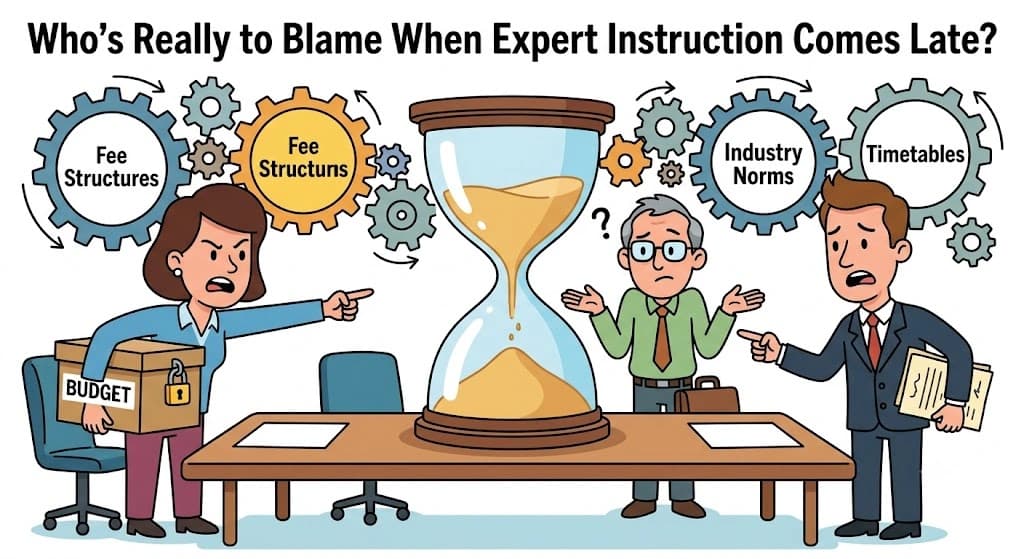

The most consequential decisions in a technical dispute are often made not by the tribunal, but by whichever party moves first and most confidently to shape how the expert evidence will unfold. That is not how case management is supposed to work, and it is worth asking directly why so many tribunals continue to treat early, active engagement with the expert process as optional rather than as core case management. The honest answer is that most tribunals believe restraint at this stage is the more principled choice. This piece argues that belief, while understandable, is usually mistaken, and that early, active, and appropriately bounded case management of the expert process produces better evidence, lower costs, and no meaningful sacrifice of the neutrality tribunals are rightly protective of.
This is not an argument for tribunals to start directing the substance of technical disputes before the evidence is in. It is an argument that the current default, treating expert process management as something to specify minimally and leave largely to the parties, gets the balance wrong, and that a more active posture on process, sequencing, and structure serves every legitimate interest a cautious tribunal is trying to protect.
It is worth being explicit about the burden of proof this argument accepts. The claim here is not that active management is risk-free, every procedural choice carries some risk of being read as favoring one party over another. The claim is narrower and more defensible: that the risk of active, disciplined process management is smaller than the cost of passive management's default failures, and that the current balance in most tribunals' practice sits too far toward passivity relative to where that comparison actually points.
The Case for Earlier, More Active Management
The strongest argument for active early management is straightforward: the parties do not have symmetric incentives to make the expert process work well. Each side is optimizing for its own case, not for the overall efficiency or clarity of the proceeding, and a tribunal that leaves process design entirely to negotiation between two parties with different incentives should not be surprised when the result is slower, more contentious, and less useful than a tribunal-led process would have been.
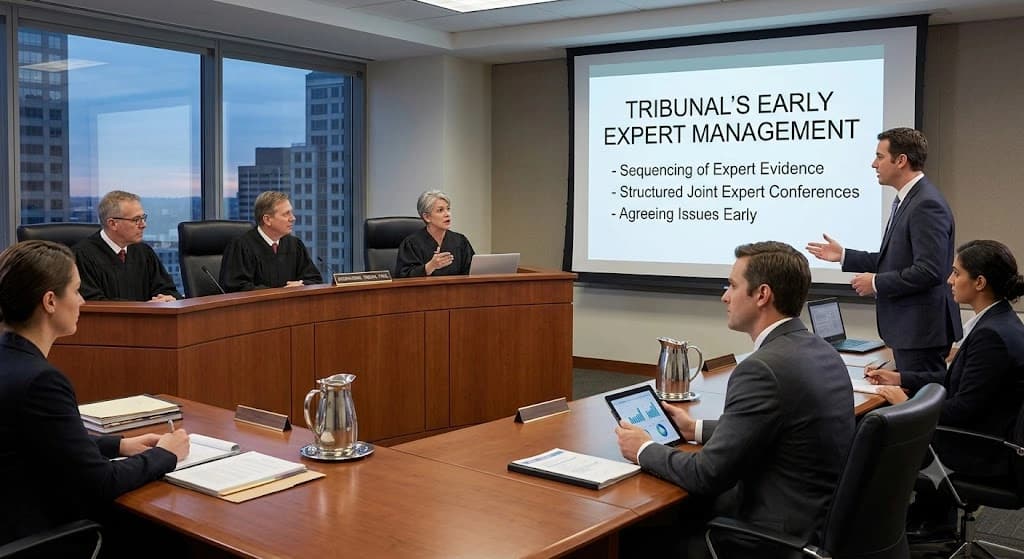
Active early management also compounds in value precisely because expert evidence is sequential. A well-structured issues list, agreed early, narrows what both experts need to address before either has drafted a full report, saving analysis time on both sides. A clearly defined joint expert process, specified before the individual reports are even filed, prevents the ambiguity that otherwise gets resolved, expensively, through a procedural dispute much later in the case. None of these interventions require the tribunal to engage with which technical position is correct. They require only that the tribunal treats the shape of the process as something worth specifying deliberately rather than leaving to drift.
There is also a quality argument, not just an efficiency one. Tribunals that engage early with the expert process, asking what the case will actually require of its experts before defaulting to a standard template, tend to receive evidence that is better matched to the dispute's real complexity. A tribunal that waits passively receives whatever process the parties happen to construct, which may or may not resemble what the case genuinely needed.
There is a fourth, more subtle benefit worth naming: active early management shortens the distance between when a process problem becomes visible and when it gets addressed. A tribunal engaged early with the shape of the expert process is positioned to notice a sequencing problem or an ambiguous joint statement requirement while it is still cheap to fix, days of correspondence rather than a contested application. A tribunal that only engages once a problem has already escalated into a formal dispute has lost the option of a cheap, early fix entirely, and is left choosing among more expensive, more adversarial remedies.
Why Tribunals Hesitate
The hesitation is not baseless, and taking it seriously matters for the credibility of this argument. Tribunals are rightly concerned that engaging early with expert issues risks the appearance, or the reality, of prejudging a question that the adversarial or inquisitorial process is meant to test on the merits. A tribunal that appears to have formed a view on a technical question before either party has fully presented its case undermines confidence in the proceeding regardless of how the case ultimately resolves.
There is also a genuine bandwidth constraint. A tribunal or judge managing a full caseload cannot engage deeply with the substantive technical detail of every matter at the level an expert steeped in a single case for months would consider ideal, and defaulting to a solid procedural framework while trusting the parties to raise substantive issues as they arise is often the only realistic way to manage a docket responsibly.
A third, less discussed hesitation is habit reinforced by institutional culture. Tribunals trained and experienced primarily in a more passive case management tradition reasonably default to what has worked adequately across many previous matters, and departing from that default requires a deliberate choice that carries some perceived risk with comparatively little visible reward, since the benefits of active management show up as an absence of problems rather than a visible achievement.
This asymmetry, visible cost against invisible benefit, is worth naming directly because it explains why the hesitation persists even among tribunals who would readily agree, in the abstract, that active management sounds sensible. A tribunal that actively manages the expert process well produces a case with fewer procedural disputes, which is to say a case that looks, from the outside, unremarkable. A tribunal that manages passively and the case runs into predictable trouble anyway has at least followed familiar, defensible practice. The incentive structure quietly rewards passivity even when active management would have produced the better outcome, because the better outcome is largely invisible while the risk of departing from convention is not.
What Active Management Doesn't Require
The case for more active management rests on a distinction that deserves to be stated precisely, because conflating it with something more aggressive is exactly what produces the hesitation described above. Active management of the expert process is not the same as active engagement with the substance of a technical disagreement. A tribunal can specify, in detail, how many sessions a joint expert conference should involve, what a joint statement needs to document, and when clarifying questions will be invited, without expressing any view whatsoever on which side's technical position is more likely correct.
This distinction is the entire basis on which active early management can be pursued without compromising neutrality. Defining process is not the same as directing outcome. A tribunal that asks, early, what technical questions the case is actually likely to turn on is not prejudging those questions, it is scoping the process needed to test them properly. A tribunal that specifies exactly how a joint expert process should run is not favoring either party's substantive position, it is ensuring both experts operate under the same clear expectations rather than guessing independently at what the tribunal wants.
Where this distinction genuinely gets tested is around tribunal-posed questions once initial reports are filed. Even here, questions framed as requests for clarification, why was this data set used rather than an alternative, what would change under a different assumption, remain squarely on the process side of the line, because they invite the expert to explain their own reasoning rather than asking the tribunal to weigh in on which reasoning is correct.
A useful test for any tribunal uncertain whether a given intervention crosses from process into substance is to ask whether the same question or direction could be given regardless of which way the underlying technical dispute is likely to resolve. Specifying that a joint statement must document reasons for disagreement passes this test easily, it would be given in any case regardless of which expert's position ultimately proves stronger. A direction that implicitly assumes one interpretation of contested data over another fails it, and that failure is the actual marker of impermissible substantive engagement, not the mere fact that the tribunal said something before a hearing concluded.
The Cost of Waiting
The default of passive, minimal process specification is not a neutral choice with no downside. It has a cost, visible in the pattern of problems that recur across cases where a tribunal has left the expert process largely undefined: joint expert conferences that produce vague, unhelpful statements because nobody specified what the statement needed to cover, sequencing disputes between multiple experts that surface only once the schedule is already unworkable, and hearing time consumed clarifying process questions that a few sentences of early direction would have resolved in writing.
This cost lands unevenly. Well-resourced parties with experienced counsel are generally better equipped to fill the gaps a passive tribunal leaves, proposing their own detailed process suggestions, anticipating sequencing problems before they occur, negotiating workable joint expert protocols directly with opposing counsel. Less experienced counsel or less well-resourced parties are correspondingly more exposed when a tribunal declines to specify process actively, which means passive case management, whatever its intentions, does not actually produce a level playing field. It produces an advantage for whichever party is better resourced to compensate for the tribunal's restraint.
This unevenness is, on its own, a strong argument for active management that has nothing to do with efficiency at all. A tribunal genuinely committed to a fair proceeding between parties of unequal resources has a reason, independent of cost or delay, to prefer a process where the tribunal itself supplies the structure that would otherwise only be available to whichever party can afford to construct it privately.
A Practical Model for Early, Active Case Management
A tribunal genuinely persuaded by this argument does not need to overhaul its entire approach to adopt it. A small number of concrete practices capture most of the available benefit. Asking, at the first case management conference, a direct question about what the dispute's genuine technical complexity requires, rather than defaulting immediately to a standard procedural template, costs little time and immediately calibrates the process to the case.
Specifying the joint expert process in detail, how many sessions, what format, what a resulting statement needs to document, closes one of the most consistently cited sources of confusion without requiring any substantive engagement with the disputed technical questions themselves. Building in an explicit, early window for tribunal-posed clarifying questions once initial reports are filed signals genuine engagement and often surfaces ambiguities early enough to resolve efficiently, well before they can harden into a procedural dispute at the hearing.
Revisiting the procedural timetable actively as a case develops, rather than treating the first case management order as fixed once issued, allows a tribunal to respond to genuine complexity that only becomes apparent once expert work is underway, without requiring omniscience about the case's technical difficulty at the very first conference.
None of these four practices requires substantial additional time investment relative to what most tribunals already spend on case management generally. What they require is redirecting a portion of that existing effort from purely procedural scaffolding, dates, deadlines, page limits, toward the specific structural choices that determine whether the expert process actually functions well once those dates arrive.
Addressing the Objections Directly
The strongest remaining objection is that even process-level engagement carries some risk of appearing to favor one party, since procedural choices are rarely perfectly neutral in their practical effect. This is true, and worth taking seriously rather than dismissing. The answer is not to avoid process engagement altogether but to ground it in transparent, consistently applied reasoning available to both parties, explaining why a particular sequencing or format was chosen, rather than issuing directions without visible rationale. Transparency about the reasoning behind a procedural choice does more to protect perceived neutrality than avoiding the choice altogether, which simply shifts the practical advantage to whichever party is better positioned to fill the resulting gap.
A second objection holds that bandwidth constraints make this level of engagement unrealistic across a full caseload. This is a fair practical limit, but it argues for triaging active management toward the cases that genuinely need it, technically complex, multi-expert, high-value disputes, rather than abandoning the practice altogether. Not every matter requires the same intensity of early engagement, and a tribunal does not need to apply this approach uniformly to capture most of its benefit.
A third objection, raised less often but worth addressing, holds that parties themselves sometimes prefer maximum procedural flexibility and would resist a tribunal specifying process details they would rather negotiate directly between counsel. This preference is legitimate and easily accommodated: active management does not require imposing a rigid process over party objection, it requires offering a structured default that parties can adopt, modify, or decline by agreement, which preserves party autonomy while still closing the gap for parties who would otherwise be left with no structure at all.
What This Means for Tribunals, Counsel, and Institutions
For tribunals, the practical takeaway is that active early management of the expert process is available without compromising the legitimate neutrality concerns that make many tribunals cautious, provided the engagement stays disciplined to process rather than substance and is grounded in transparent reasoning.
For counsel, the takeaway is to actively invite this kind of engagement rather than assuming a tribunal's silence reflects a deliberate choice not to provide it. Raising specific process questions early, proposing a structured joint expert protocol for the tribunal's consideration, often prompts exactly the kind of active management this piece argues for, from tribunals who simply had not been asked.
For institutions developing procedural rules and model clauses, the takeaway is to build optional, adaptable frameworks for early expert process management directly into standard case management guidance, lowering the effort required for any individual tribunal to adopt this approach case by case.
Frequently Asked Questions
Does active early case management of experts risk making a tribunal appear biased? Not when the engagement is disciplined to process rather than substance and grounded in transparent, consistently explained reasoning. The risk comes from unexplained or substantively engaged intervention, not from active process management itself.
Should every case receive this level of active early management? Not necessarily. Triaging active management toward technically complex, multi-expert, or high-value disputes captures most of the benefit without requiring the same intensity across an entire caseload.
What is the clearest example of process management that does not cross into substantive engagement? Specifying the structure and required content of a joint expert statement, how many sessions, what needs to be documented, is a clear example: it shapes how the experts interact without expressing any view on which expert's position is correct.
How should counsel respond if a tribunal seems reluctant to engage actively with the expert process? Raising specific, concrete process proposals for the tribunal's consideration, rather than a general request for more engagement, tends to be more effective, since it gives a cautious tribunal something specific and low-risk to adopt.
Is there a simple test for whether a tribunal's intervention has crossed from process into substance? A useful check is whether the same direction could be given regardless of which party's technical position ultimately proves correct. Directions that pass this test, like specifying what a joint statement must document, sit safely on the process side of the line.
Conclusion
Tribunals default to restraint on expert process management out of genuine, defensible caution, but that caution, applied indiscriminately to process as well as substance, produces real costs that fall unevenly across better- and less-resourced parties. Active, early, disciplined process management, distinct from substantive engagement with disputed technical questions, addresses those costs without sacrificing the neutrality tribunals are rightly protective of. The tribunals that adopt this approach are not taking on more risk than passive case management already carries. They are simply choosing to manage that risk deliberately rather than by default, and shifting the burden of constructing a workable process away from whichever party happens to be best resourced to build one privately.
Key Takeaways
● Passive case management of the expert process is not a neutral default; it produces real costs that fall unevenly, favoring parties with the resources to compensate for a tribunal's restraint.
● Active management of process, sequencing, structure, joint expert protocols, is distinct from substantive engagement with disputed technical questions and does not compromise tribunal neutrality when disciplined and transparently reasoned.
● A small number of concrete practices, early scoping questions, detailed joint expert specifications, and windows for clarifying questions, capture most of the available benefit without requiring a wholesale change in approach.
● Counsel can actively invite more engagement by proposing specific, concrete process suggestions rather than assuming a tribunal's restraint is a fixed, unchangeable position.
Position yourself where the legal industry looks for expertise - sign up on exlitem.com to get discovered by leading lawyers and high-value clients.