

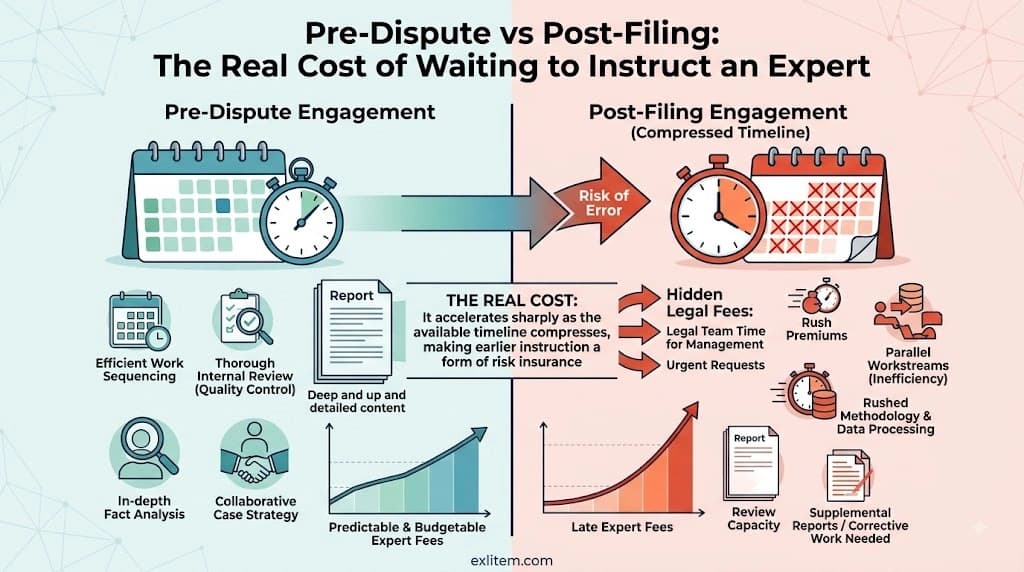
Two versions of the same dispute unfold differently depending on a single variable: when the expert gets involved. In one version, the expert is consulted before formal proceedings begin, working alongside the legal team as the case theory takes shape, with time to explore the technical questions properly before any deadline forces a conclusion. In the other, the same expert is engaged only after pleadings have closed, with a report due in a matter of weeks and a body of evidence, assumptions, and procedural commitments already locked in place by decisions made without their input. The technical questions in both versions are identical. The cost of answering them well is not, and the difference is larger and more predictable than most fee estimates account for.
This piece looks specifically at the cost mechanics behind that difference, separate from the broader strategic case for early instruction discussed elsewhere in this content series. Understanding exactly why and how compression drives cost up, not just that it does, gives legal teams and clients a more concrete basis for weighing the upfront expense of earlier engagement against the costs, both financial and otherwise, that compressed timelines reliably generate later.
Why Compressed Timelines Inflate Fees Directly
The most straightforward driver of cost inflation under compression is simple capacity economics. An expert working to a comfortable timeline can plan their analysis efficiently, sequencing work in the order that makes the most technical sense and avoiding the inefficiency of jumping between tasks out of order to meet an artificial deadline. An expert working under severe time pressure often has to run multiple workstreams in parallel that would ideally happen sequentially, frequently requiring additional staff, expedited data processing, or work performed outside normal hours, all of which typically carry a cost premium over the same work performed at a reasonable pace.
There is also a review and quality-control cost that compression tends to compress out of the process, even though the underlying need for it does not disappear. A well-run technical analysis normally includes time for internal review, a second set of eyes checking calculations and reasoning before a report is finalized. Under severe time pressure, this review step is often either shortened considerably or, in the worst cases, skipped entirely, not because it stopped mattering but because the calendar no longer accommodates it. The immediate cost saving from skipping thorough review is real, but it is a savings borrowed against risk rather than a genuine efficiency, a distinction discussed further below.
A further, less visible cost driver involves the expert's own risk pricing. An expert asked to produce a rigorous, defensible analysis on a compressed timeline is being asked to accept a higher risk of error, or at minimum a higher risk of being challenged effectively on a rushed methodology, and experienced experts price that additional risk into their fee structure for compressed engagements, whether through an explicit rush premium or simply a higher baseline rate reflecting the added professional exposure of working under those conditions.
Data and document processing costs also tend to scale unfavorably under compression. Much of the underlying work in a technical expert analysis involves gathering, organizing, and processing large volumes of data or documents, work that can often be done efficiently and at lower cost when spread over a reasonable timeline but that frequently requires additional staff, expedited third-party processing services, or premium-rate overtime when compressed into a shorter window. This category of cost is easy to overlook when estimating the impact of a compressed timeline, since it sits upstream of the expert's own analytical work but still flows directly from the same timing decision.
The Hidden Costs Compression Creates Beyond the Expert's Own Invoice
The expert's fee is only part of the cost picture, and often not the larger part. A compressed engagement frequently generates costs elsewhere in the case that never appear on the expert's own invoice but trace directly back to the timing decision. Legal team time spent managing a compressed expert engagement, more frequent check-ins, urgent document requests, expedited review of draft materials, adds meaningfully to overall case cost even though it shows up as legal fees rather than expert fees.
Compressed timelines also increase the likelihood of needing supplemental work later, whether a follow-up report addressing a point the original rushed analysis did not have time to develop fully, or a more disruptive correction if a compressed analysis turns out to contain a genuine error or gap discovered only during cross-examination preparation or, worse, during the hearing itself. This kind of downstream correction is considerably more expensive than getting the analysis right the first time, both in direct cost and in the less quantifiable cost of diminished credibility with the tribunal.
There is also a scheduling cost worth naming specifically. A compressed engagement often has to compete for the same expert's limited capacity against other client commitments, and an expert unable to prioritize a specific matter within an unreasonably short window may decline the engagement entirely, forcing the legal team to search for an available expert under even greater time pressure, sometimes settling for someone less well matched to the specific technical question than the originally preferred expert would have been.
There is also an opportunity cost specific to compressed timelines that rarely gets accounted for explicitly: the loss of the strategic collaboration discussed elsewhere in this content series as one of the central benefits of early instruction. An expert working under severe time pressure has little capacity to engage in genuine back-and-forth about how the technical findings might shape case strategy; the compressed timeline forces a narrower, more purely executional relationship, which means the case loses access to exactly the kind of insight that could, in a less compressed engagement, meaningfully improve the strategy itself rather than simply validate a strategy already fixed.
How Compression Elevates the Risk of Errors and Omissions
Time pressure is one of the most well-established drivers of error in any complex technical work, and expert analysis is no exception. An analyst working through a complex methodology at a sustainable pace has natural opportunities to notice when an intermediate result looks unexpected or inconsistent with other parts of the analysis, prompting a closer look that often catches an error before it reaches the final report. Compression compresses out exactly this kind of natural error-catching opportunity, since there is simply less time available to notice and investigate anomalies that a more leisurely process would have surfaced organically.
Compression also increases the risk of scope-related errors, not just calculation errors. An expert working under severe time pressure has less opportunity to fully absorb the nuances of a complex fact pattern, increasing the risk of a report that technically addresses the assigned mandate but misses an important contextual factor that a more thorough, less rushed engagement would have caught. This kind of error is often more damaging than a straightforward calculation mistake, since it can undermine confidence in the entire analytical approach rather than requiring only a narrow, isolated correction.
A further risk specific to compression involves the joint conferencing and cross-examination preparation processes discussed at length elsewhere in this content series. An expert who has not had adequate time to fully test their own analysis against likely challenges arrives at these later stages considerably less prepared than one who has had the benefit of a more comfortable timeline, and the resulting performance gap can materially affect how the tribunal weighs the eventual evidence, independent of the underlying technical merit of the analysis itself.
Compression can also affect how thoroughly an expert is able to document their own reasoning and methodology within the report itself, which matters considerably beyond the immediate hearing. A report produced under severe time pressure often explains its conclusions more tersely than one produced at a sustainable pace, not because the underlying analysis was necessarily weaker but because there was simply less time available to write a fully developed explanation. This can leave a technically sound analysis more vulnerable to challenge than its actual substance would otherwise warrant, purely as a function of how much time was available for the writing and documentation stage rather than the underlying calculation itself.
The Quality-Time Tradeoff That Compression Forces
It helps to think about this tradeoff explicitly rather than treating "the expert will manage" as a sufficient response to a compressed timeline. Every technical analysis has some minimum amount of time genuinely required to produce a rigorous, well-tested result at a given level of complexity. Compressing the available time below that minimum does not simply produce the same quality of work faster; it forces a set of specific, identifiable tradeoffs, less thorough review, narrower exploration of alternative approaches, less time to absorb complex factual context, each of which carries a real, if hard to quantify precisely, cost in terms of the eventual report's rigor and defensibility.
This framing matters because it shifts the conversation away from a vague sense that rushed work is "riskier" toward a more specific, actionable question: which particular tradeoffs is this specific compressed timeline forcing, and how much does each of those tradeoffs actually matter given the specific technical and legal stakes of this particular case. A compressed timeline on a relatively straightforward, low-complexity technical question may force tradeoffs that matter relatively little. The same compression applied to a genuinely novel, high-stakes, high-complexity question forces tradeoffs that can matter enormously, which is precisely why the cost of waiting scales with complexity rather than remaining constant across every kind of dispute.
This also suggests a practical diagnostic worth applying to any specific engagement: asking explicitly, before finalizing a compressed timeline, exactly which of the standard steps in a thorough analysis, internal review, exploration of alternative methodologies, full documentation of reasoning, will need to be shortened or skipped to meet the deadline. Naming these specific tradeoffs out loud, rather than leaving them implicit, gives the legal team and client a genuinely informed basis for deciding whether the compression is acceptable for this specific matter or whether it is worth pushing for additional time, even at some cost to other aspects of the case schedule.
A Conceptual Framework for Weighing the Tradeoff
A useful way to frame the actual decision is to compare two cost curves rather than two single numbers. The cost of earlier instruction rises gradually and predictably as engagement begins sooner, reflecting straightforward, budgetable expert time. The cost of later instruction, by contrast, tends to rise non-linearly as the available timeline compresses past a certain point, since the specific cost drivers discussed above, rush premiums, reduced review, elevated error risk, do not scale gently; they tend to accelerate sharply once a timeline drops below whatever threshold the specific analysis genuinely requires to be done properly.
This means the real comparison is rarely between a fixed early cost and a fixed late cost; it is between a predictable, budgetable early cost and a considerably less predictable, potentially much larger late cost that depends heavily on exactly how compressed the eventual timeline turns out to be and how badly that compression happens to intersect with the specific complexity of the case at hand. Framed this way, earlier instruction functions less like an optional expense and more like a form of cost and risk insurance, purchased at a modest, predictable price against a real possibility of a considerably larger, less predictable cost later.
What Pre-Dispute Instruction Specifically Buys, in Cost Terms
Pre-dispute instruction specifically buys the ability to sequence work efficiently, at a sustainable pace, with adequate time for internal review built into the process as a matter of course rather than sacrificed under pressure. It buys the expert time to genuinely absorb the complexity of an unfamiliar or novel fact pattern before having to commit conclusions to paper, reducing the specific scope-related error risk discussed above.
It also buys something considerably harder to price directly but genuinely valuable: the opportunity for the kind of collaborative strategic engagement discussed elsewhere in this content series, which can improve the underlying case theory itself rather than merely validate whatever theory happened to be in place by the time the expert was finally brought in. This benefit does not show up as a specific line item on any invoice, but its absence, in a compressed, late-instructed engagement, represents a real and sometimes significant lost opportunity.
What This Means for Budgeting and Client Communication
For legal teams, the implication is to present the cost comparison to clients explicitly in these terms, not as a simple choice between spending money now versus later, but as a choice between a predictable, budgetable cost and a considerably less predictable one that tends to scale sharply with how compressed the eventual timeline turns out to be.
For clients, the implication is to treat early expert budget not as a discretionary early expense to defer wherever possible, but as a specific, quantifiable form of risk management against the real, well-understood cost dynamics of compressed technical work, discussed throughout this piece.
It also helps for clients to understand that the cost comparison is not static across the life of a matter. A case that looks likely to settle early may reasonably justify a more conservative, later-instruction approach, while a case that shows early signs of proceeding to a full hearing shifts the calculation meaningfully toward earlier instruction, since the probability-weighted expected cost of compression rises as the likelihood of the matter actually reaching a contested hearing increases.
Frequently Asked Questions
Is it always cheaper, in total, to instruct an expert early rather than late? Not in every single case, since some disputes resolve quickly enough that a full early engagement turns out, in hindsight, to have been unnecessary. But across a portfolio of matters, the aggregate cost comparison, considered honestly, tends to favor earlier instruction more often than case-by-case cost-minimization instincts suggest.
How can a legal team estimate whether a specific timeline is genuinely compressed for a given engagement? A useful signal is asking the expert directly, early, what timeline they would consider comfortable for the specific complexity of the mandate, and treating any gap between that estimate and the actual available time as a specific, quantifiable compression the team should account for explicitly.
Does a rush premium fully compensate for the risks of compression? No. A rush premium compensates the expert for accepting additional professional risk and working under difficult conditions; it does not eliminate the underlying quality and error risks discussed throughout this piece, which remain the client's and the case's risk regardless of what fee arrangement is in place.
Can a limited early consultation reduce the cost impact of eventual compression, even if a full engagement happens later? Yes, meaningfully. A limited early consultation, discussed in more detail elsewhere in this content series, can identify major technical risks and scope issues well in advance, reducing the amount of genuinely urgent, compressed work the full engagement later has to absorb.
Conclusion
The cost of waiting to instruct an expert is not a fixed, easily estimated number; it is a variable cost that tends to rise sharply, not gradually, once a case's available timeline compresses past whatever threshold the specific technical analysis genuinely requires. Understanding the specific mechanisms behind that cost, capacity economics, reduced review, elevated error risk, and lost strategic value, gives legal teams and clients a considerably more concrete basis for weighing early expert investment against the real, well-understood costs that compressed timelines predictably generate later. Framed correctly, early instruction is not simply an upfront expense to minimize; it is a comparatively cheap, predictable form of insurance against a considerably larger and less predictable cost down the line.
Key Takeaways
● Compressed timelines inflate expert costs directly through rush premiums, reduced capacity for internal review, and the added risk pricing experienced experts build into compressed engagements.
● Much of the real cost of late instruction shows up outside the expert's own invoice, in additional legal team time, supplemental corrective work, and lost strategic value from a purely executional rather than collaborative engagement.
● The cost of late instruction tends to rise non-linearly as a timeline compresses, making the real comparison one between a predictable early cost and a considerably less predictable, potentially much larger late one.
● Early instruction functions less like a discretionary expense and more like a comparatively cheap, predictable form of risk management against the well-understood cost dynamics of compressed technical work.
Position yourself where the legal industry looks for expertise - sign up on exlitem.com to get discovered by leading lawyers and high-value clients.