

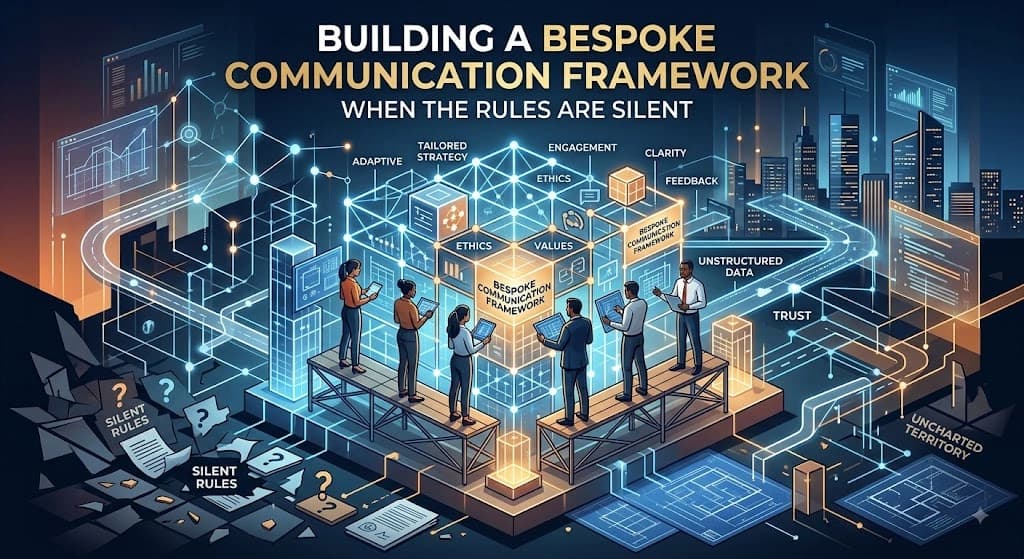
An expert is engaged on a matter where the applicable institutional rules say very little about how communication with counsel should actually work. There is general language about independence and objectivity, the kind of broad principle discussed elsewhere in this content series, but nothing addressing the specific questions that actually arise in practice: how often should the expert and counsel speak during the drafting process, what happens if a document surfaces mid-report that changes a key assumption, who is the point of contact if the instructing partner is unavailable. The tribunal has not issued detailed procedural directions on any of this, and no institutional protocol fills the gap. Everyone involved is left to improvise, case by case, without a shared framework.
This situation is far more common than it might seem. Formal guidance and procedural rules, however good, cannot anticipate every specific communication scenario a given case will produce, and many jurisdictions and institutions still operate with relatively general expert evidence rules that leave considerable room for the specifics to be worked out by the parties involved. Rather than treating this silence as a problem to be tolerated or an opportunity to be quietly exploited, the more productive response is to build a specific, agreed communication framework for the case at hand, deliberately and early, rather than letting practice develop by accident through whatever pattern happens to emerge.
Why Silence Is More Common Than It Seems
It is tempting to assume that well-established institutional rules and jurisdictional procedure cover the ground comprehensively, leaving little genuine ambiguity in practice. The reality is considerably messier. Even sophisticated institutional frameworks tend to address the major structural questions, when reports are due, how joint conferences should generally be conducted, what the expert's overriding duty is, while leaving the operational specifics of day-to-day communication largely unaddressed, on the reasonable assumption that experienced practitioners will handle these details sensibly on their own.
This gap tends to widen further in certain kinds of matters: disputes involving parties or counsel from multiple jurisdictions with different professional conventions around expert communication, cases where the expert has limited or no prior experience working within the specific procedural tradition governing the case, or matters proceeding under ad hoc rules rather than a well-developed institutional framework with years of accumulated practice and precedent behind it. In any of these situations, the general guidance that does exist may simply not map cleanly onto the specific communication questions the case actually generates.
The gap also widens over the life of a lengthy or complex case, since even well-drafted initial guidance rarely anticipates every specific development that might arise. A significant new document surfacing mid-engagement, an unexpected change in the legal team, a shift in the technical scope of the mandate, each of these can create a communication scenario the original guidance, however thorough, never specifically addressed.
Multi-party disputes add a further layer of complexity worth naming specifically. A case involving several claimants or respondents, each represented by separate counsel but relying on a shared or coordinated set of experts, generates communication questions that most standard institutional guidance, written with a simpler two-party structure in mind, simply does not anticipate. Who among several instructing lawyers is the expert's primary point of contact, and how communications should be coordinated across multiple legal teams representing aligned but formally distinct parties, are exactly the kind of practical questions a bespoke framework is well suited to resolve.
The Risk of Leaving Gaps Unaddressed
Unaddressed gaps do not stay neutral; they tend to get filled by default, usually by whichever party or individual is most comfortable taking the initiative, and not always in a way that serves the process well. Left without an agreed framework, communication patterns often develop through simple habit and convenience rather than deliberate design, and habits that develop this way carry no particular guarantee of protecting the expert's independence or the eventual credibility of the evidence produced.
There is also a specific risk of asymmetric default patterns emerging between the two sides of a dispute. Absent a shared framework, one legal team might adopt a more hands-off communication style with its expert simply as a matter of that team's general working culture, while the opposing team adopts a considerably more involved style for the same reason, producing two experts operating under meaningfully different, entirely unplanned communication conditions on the same case. This asymmetry can itself become a source of comparability problems in the eventual expert evidence, distinct from but related to the conflicting-instruction issues discussed elsewhere in this content series.
This asymmetry is particularly likely to develop unnoticed because neither legal team necessarily has visibility into how the other side is actually communicating with its own expert. A team operating within entirely reasonable internal norms has no natural occasion to compare those norms against the opposing team's practice, which means an asymmetric, unplanned divergence can persist through an entire case without either side recognizing it has occurred, surfacing only if it becomes visible later through cross-examination or an unusually candid joint conference.
A further risk involves disputes that arise later about what was actually appropriate, absent any documented, agreed baseline to measure against. An expert accused, whether fairly or not, of having received improper guidance has a considerably weaker position defending their conduct if no clear, agreed framework existed to demonstrate what appropriate communication was understood to look like at the time, compared with an expert who can point to a specific, documented agreement establishing the ground rules from the outset.
This risk is not merely theoretical or reputational; it can have direct evidentiary consequences. A tribunal weighing whether a specific communication crossed an appropriate line has to evaluate that communication against some standard, and in the absence of a documented, case-specific agreement, the tribunal is left applying only the general institutional guidance, which, as discussed above, frequently does not address the specific scenario in dispute with much precision. A documented bespoke framework gives the tribunal a considerably more precise, case-specific standard to apply, one both parties agreed to at the time, rather than a general principle requiring interpretation after the fact.
Who Should Initiate Filling the Gap
Either the expert or counsel can reasonably initiate the conversation about building a bespoke framework, and waiting for the other side to raise it first tends to simply delay a conversation that benefits both. Experts, given their professional stake in demonstrable independence, often have the clearer individual incentive to raise the topic proactively, particularly experts who have worked across multiple jurisdictions or institutional settings and have direct experience with how much communication practice can vary even within cases that appear, on paper, to be governed by similar rules.
Raising the topic is generally well received when framed constructively, as a practical step to avoid ambiguity later rather than as an implicit accusation that the other side might behave improperly without it. Something as simple as proposing, at the outset of an engagement, a short conversation to agree on communication logistics, points of contact, expected frequency, how urgent issues should be raised, tends to be read as exactly the kind of professional diligence discussed elsewhere in this content series as a positive signal rather than an awkward or confrontational request.
Where neither the expert nor counsel raises the issue proactively, a tribunal or case manager aware of the gap can also usefully prompt the parties to establish their own framework as part of early case management, discussed in more detail elsewhere in this content series, rather than leaving the matter entirely to informal development over the course of the case.
What a Bespoke Framework Should Cover at Minimum
A useful bespoke framework does not need to be lengthy or formal to be effective; it needs to address the specific questions most likely to arise in the specific case at hand. At minimum, this typically includes identifying a single, designated point of contact on the legal team for the expert's questions, reducing the risk of inconsistent guidance reaching the expert through multiple, uncoordinated channels, an issue discussed at length elsewhere in this content series.
The framework should also address expected communication frequency and format, whether regular check-ins are anticipated, how urgent issues should be flagged and by what channel, and whether communications touching on scope or assumptions should be documented in a specific way. It should specify, plainly, how new developments, an unexpected document, a shift in legal theory, should be communicated to the expert and how the expert should raise any resulting need to revisit assumptions or scope.
A well-constructed bespoke framework also benefits from explicitly addressing the boundary questions discussed at length elsewhere in this content series, even briefly: confirming that pre-conference conversations will be limited to logistics, that post-report review will be limited to factual accuracy, and that the expert should feel free to raise, without friction, any request that seems to cross those boundaries. Stating this explicitly, even in a case where no formal institutional protocol requires it, creates the same practical benefit a formal protocol provides, tailored specifically to the case at hand.
It is also worth the framework specifying, briefly, what should happen if the expert and the designated point of contact disagree about whether a specific request falls within or outside the agreed boundaries. Rather than leaving this ambiguous, agreeing in advance that either party can raise the question with a more senior member of the legal team, or flag it for the tribunal's guidance if genuinely unresolved, gives both sides a clear, low-friction path for handling exactly the kind of edge case that a framework, however carefully drafted, cannot fully anticipate in advance.
How to Reach Agreement Without It Becoming a Negotiation Over Advantage
The framework-building conversation works best when both sides approach it as jointly solving a shared logistical problem rather than as a negotiation where each side is trying to secure more favorable terms. This distinction matters because a framework built through genuine collaboration tends to produce rules both sides actually follow, while one built through a more adversarial negotiation, where each side is angling for slightly more latitude, tends to produce a framework that is technically agreed but not genuinely internalized by either side.
A useful practical discipline is to start the conversation from the specific communication problems both sides are trying to avoid, delay, miscommunication, ambiguity about who to contact, rather than from an abstract discussion of rights and permissions. Framing the conversation around shared goals, both sides want the eventual expert evidence to be credible and efficiently produced, tends to produce more genuine agreement than framing it around what each side is or is not allowed to do.
Where genuine disagreement arises about a specific element of the proposed framework, defaulting toward the more conservative, more clearly independence-protective option is generally the safer choice, since the cost of slightly more conservative communication practice is almost always lower than the cost of a framework that later appears, in hindsight, to have permitted too much latitude.
It also helps to have this conversation early, before either side has developed strong habits or expectations around how the engagement will actually run. A framework proposed and agreed in the first week of an engagement is considerably easier to establish cleanly than one proposed after several months of informal, unplanned communication have already set an implicit pattern that any new framework would then have to visibly override, a transition that can itself create unnecessary friction or the appearance that something specific prompted the change.
Documenting and Revisiting the Framework
A bespoke framework agreed only verbally carries real risk of being remembered differently by different participants, particularly over the life of a lengthy case with turnover among the individuals involved. A brief written record, even an informal email summarizing the agreed points, circulated to everyone involved shortly after the framework is discussed, protects against this risk considerably and gives the framework the same kind of documented reference point discussed elsewhere in this content series as valuable for a formal institutional protocol.
The framework should also be revisited if the case changes meaningfully, a significant new development, a change in legal team, a shift in the technical scope of the engagement, rather than treated as fixed once agreed. A brief, five-minute check-in confirming the original framework still fits the case as it now stands is a low-cost way to ensure the agreed rules remain genuinely useful rather than quietly becoming outdated as the matter evolves.
For lengthy or multi-year engagements specifically, it is worth building a periodic review of the framework into the case calendar itself, rather than relying on someone remembering to raise it only when a specific triggering event occurs. A brief, scheduled check-in, perhaps tied to a major procedural milestone already on the case timetable, ensures the framework gets revisited even in the absence of any obvious prompting event, catching the kind of gradual, cumulative drift that no single triggering development would clearly flag on its own.
What This Means for Experts and Counsel
For experts, the implication is to treat proposing a bespoke communication framework as a normal, professional part of accepting any engagement where the applicable rules leave meaningful gaps, rather than waiting to see how communication develops informally and hoping it develops well.
For counsel, the implication is to welcome this kind of proposal when it comes from an expert, and to consider raising it proactively when it does not, recognizing that a clear, agreed framework protects the credibility of the eventual evidence and, by extension, the client's own interest in that evidence being taken seriously.
Frequently Asked Questions
Is a bespoke communication framework necessary even when institutional rules exist? It can still add value, since even thorough institutional rules rarely address every specific operational detail a particular case generates, and a brief, case-specific supplement fills gaps without conflicting with the broader institutional framework.
Should the tribunal be informed of a bespoke framework agreed between the parties? This is not always necessary, but sharing a copy of the agreed framework with the tribunal, particularly in cases with genuinely unusual communication needs, can be a useful way to demonstrate transparency and good process to the tribunal proactively.
What if the two sides cannot agree on a specific element of the framework? Genuine, good-faith disagreement about a specific point is itself useful information, and can be raised with the tribunal or case manager for guidance rather than left unresolved or resolved informally in a way that favors whichever side pushed harder.
How detailed does a bespoke framework need to be to be useful? Detailed enough to address the specific communication scenarios likely to arise in that particular case, generally a short document covering point of contact, frequency, escalation process, and confirmation of the standard boundary principles, rather than an exhaustive document attempting to anticipate every conceivable scenario.
Conclusion
Silence in the applicable rules is not an invitation to improvise communication practice case by case and hope it develops well; it is an opportunity, and arguably a responsibility, for experts and counsel to build their own clear, agreed framework tailored to the specific case at hand. Done early, collaboratively, and documented briefly, this kind of bespoke framework closes exactly the gap that, left unaddressed, tends to be filled by default habit rather than deliberate design, and it gives both sides a clear, shared reference point that protects the credibility of the eventual expert evidence considerably more reliably than hoping good practice simply emerges on its own.
Key Takeaways
● Institutional rules and procedural guidance, however thorough, rarely address every specific operational communication question a given case generates, leaving genuine gaps more often than practitioners typically assume.
● Gaps left unaddressed tend to get filled by default habit rather than deliberate design, and can produce asymmetric communication practices between opposing sides of the same dispute.
● Either the expert or counsel can reasonably initiate a conversation about building a bespoke framework, and framing it as solving a shared logistical problem produces more durable agreement than framing it as a negotiation.
● A brief written record of the agreed framework, revisited if the case changes meaningfully, protects against later disputes about what was actually understood and agreed.
Position yourself where the legal industry looks for expertise - sign up on exlitem.com to get discovered by leading lawyers and high-value clients.