
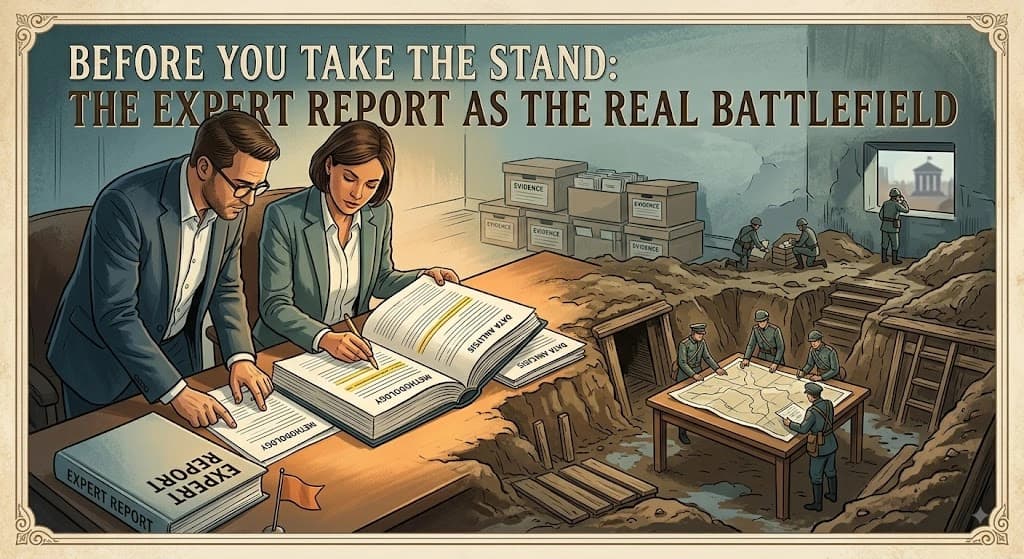
Most people picture expert witness work as a courtroom drama: a tense cross-examination, a sharp question that makes a witness pause, a jury leaning forward to catch the answer. In reality, the outcome of most cases involving expert testimony is decided months earlier, in a much quieter setting, by a document almost no juror will ever read in full. The expert report is where an opinion first takes permanent form, where every word can be quoted back verbatim years later, and where a single missed citation, an overreaching sentence, or a sloppy methodology section can end a case before a jury is ever seated. Depositions are dangerous. Trial testimony is stressful. But the report is where the real fight happens, because the report is the only part of an expert's work that exists in writing, under oath, before anyone has had the chance to see how the other side will attack it.
That is a hard lesson for many experts to learn, and it is usually learned the hard way - in a deposition, staring at a page they wrote months earlier and no longer remember precisely, while opposing counsel reads a sentence back to them with a raised eyebrow. The report does not just record an opinion. It sets the outer boundary of what that opinion can become. Nothing said on the stand can exceed what was disclosed on the page, and every weakness left in the page becomes a weapon in someone else's hands.
This article draws on conversations from On The Stand with Ashish Arun, featuring a corporate and securities law expert witness with over fifty years of experience, a forensic accounting expert, a pediatric emergency medicine physician, a medical librarian who audits the literature cited in expert reports, a materials science and patent litigation expert, and a historian whose reports have been cited directly by federal courts and the U.S. Supreme Court. Across radically different fields, their accounts converge on the same conclusion: before an expert ever takes the stand, the real battle has already been fought and largely decided, on the page. None of them share a courtroom, a case type, or even a professional vocabulary. But strip away the specifics of securities fraud, forensic accounting standards, pediatric sepsis, patent claims, and tribal water rights, and the same underlying discipline appears again and again: a report is only as strong as the process that produced it, and that process is largely invisible to everyone except the expert who lived through it and the opposing counsel determined to find its cracks.
The Report Is the Case, Long Before Trial
Few stories illustrate how much weight a report can carry better than one from Richard Leisner, who has spent more than fifty years working as a transactional lawyer and, for decades now, as an expert witness in complex business litigation. In one federal securities case, the presiding judge wrote in her opinion that the court had "paid no attention at all" to Leisner's report. She then went on to rule in favor of the SEC on every point his report had argued. "I felt pretty bad," Leisner says of reading that line, before drawing the obvious lesson: "You never know what's going to happen in trial. You hardly know what's going to happen in depositions." The report had done its work regardless of whether the judge admitted to relying on it, because the analysis it contained had already shaped how the case was understood.
That same weight is written directly into the rules governing how a report must be built. Michael G. Kaplan explains that under Federal Rule of Civil Procedure 26(a)(2)(B), an expert's report has to include the complete basis for every opinion the expert intends to offer at trial - not a summary, the actual substance. That report becomes the document a judge examines when deciding whether to let the expert testify at all. "In our reports, when we draft the report... in that portion of the report, basis and reasons for opinions, there needs to be a logical explanation," Kaplan says, describing what a judge now expects to see connecting an expert's methodology to their conclusions. If that explanation is not on the page, no amount of eloquence on the stand can retroactively supply it.
Leisner has also watched what happens when a report never gets written at all. He recounts a minor traffic-light collision that dragged through three years of discovery before ending in a $1.6 million verdict, after the defendant chose not to retain a damages expert because, in his view, the injury was obviously minor - "I've had bigger bumps and bruises at football practice," was how one early assessment put it. Without an expert to establish what a reasonably competent lawyer would have argued, the court found the defense case inadequate on its own terms. The defendant then sued his own lawyer for malpractice over the result. "He lost with an expert, he lost without an expert," Leisner says, "and I feel very badly for him." The moral he draws is not subtle: whether a report exists at all is sometimes the whole case, long before anyone debates what it should say.
Getting the timing right matters just as much as getting the content right. Leisner says the single most important question an expert can ask retaining counsel has nothing to do with the substance of the case at all: "What does the case management order say about when I have to put in my report?" Attorneys, he has found, do not always volunteer that document, and deadlines can be brutal by design - he recalls one matter where the expert report, the disclosure of experts, and the rebuttal report were all due on the very same day. Experts who do not ask this question early can find themselves trying to produce careful analysis in a fraction of the time the case actually allows.
The New Gatekeeping Standard: What a Report Must Now Prove
For decades, the gap between the legal theory of expert scrutiny and the reality of how judges actually behaved was wide. Leisner watched it happen from the earliest days of the Daubert standard, which handed trial judges a formal gatekeeping role over what counted as reliable expert opinion. "You would have expected that there would have been a snowstorm of expert reports [that] didn't get in," he says. "It didn't happen." Judges, he found, routinely punted the hard analytical work to the jury instead, reasoning that a shaky opinion should affect its weight rather than its admissibility. That informal practice persisted for years, weakening the actual bite of Rule 702 in daily practice. Kaplan describes the formal mechanism this way: once an expert's report is challenged, courts have the option to hold a hearing, outside the presence of the jury, at which the expert can be questioned specifically about whether their work meets the standard - but for years, he says, "often, probably more often than not," judges would look at the motion to exclude, deny it, and reason that if the testimony makes sense to the jury, the jury can decide how much weight to give it.
Federal Rule 702 was amended effective December 1, 2023, specifically to correct that drift, and Kaplan describes exactly what changed for experts sitting down to write. Before the amendment, an expert could often get by with methodology that existed in name only. Now, he explains, "the judges are really going to take a harder look at the work that we did." The rule change puts the burden squarely on the party offering the expert to prove, by a preponderance of the evidence, that the testimony reflects a reliable application of principles and methods to the facts of the case - not merely that a recognized methodology exists somewhere in the expert's field. Leisner, watching the amendment take effect from his own practice, remains skeptical that it will transform outcomes as dramatically as some predicted. "I wouldn't not gonna change how I write my report," he says. "It's the engaging counsel's job to worry about admissibility. I'm just an advocate for my opinions." Whether or not the amendment reshapes outcomes at the margins, both experts agree on the underlying mechanism: the report itself, not the witness's presence or credentials, is what a judge now has to scrutinize line by line before a jury hears a word.
Know Your Report Better Than Opposing Counsel Does
If the report is the battlefield, then knowing its terrain better than the opposing side is the single most decisive advantage an expert can hold. Leisner offers a story that makes the point vividly. Cross-examining him in federal court, an opposing attorney tried to pin him to a damaging statement, insisting he had said something in his report that was harmful to his own side. Leisner simply asked to be shown where in the report that statement appeared. The young lawyer had not flagged the page in advance, could not locate it, and, in Leisner's telling, "that derailed his testimony" - the cross-examiner's, not the witness's.
That kind of command over a document does not happen by accident, and it depends heavily on who actually wrote it. "I write my own reports," Leisner says, describing what he considers standard, responsible practice - as opposed to what he calls the alternative found at some larger operations, where "29 people have their hands on the report." An expert whose name is on a document they did not draft is vulnerable in a way that a hands-on author is not, because true command of a document's contents cannot be delegated. Leisner is candid that this command fades with time if it is not deliberately maintained. Because months, sometimes years, can pass between the day a report is filed and the day of a deposition or trial, he insists that experts must "reacquaint" themselves with their own report well before either - not a single read-through, but real re-immersion, precisely because a hesitant, unprepared answer during that gap is often the first sign to opposing counsel that a witness does not actually know their own work anymore.
Ian Smith approaches the same discipline from the opposite direction - not defending a finished report under cross-examination, but deliberately stress-testing it before it is ever filed. As the principal historian at Historical Research Associates, Smith has authored reports that were cited directly by federal courts and that helped shape the U.S. Supreme Court's landmark decision in Herrera v. Wyoming, along with rulings recognizing tribal water and river-bed rights. His method for avoiding surprises later is to look for the evidence that undermines his own conclusion before opposing counsel does. "You want to know both what the good evidence is that supports your legal theory," he says, "but you also want to know about the potential challenging evidence... so that you're prepared for it well in advance of deposition or trial." That discipline - actively hunting for the weaknesses in your own report rather than waiting for someone else to find them - is what separates a report built to survive scrutiny from one that merely states a conclusion. It carries through to how he testifies about that report once a deposition begins. Asked for the best advice he has ever received about testifying, Smith does not hesitate: "Sometimes less is more. If you can answer with a yes or no, that sometimes is the best answer in deposition." A report that has already been pressure-tested for its weak points does not need to be re-argued or elaborated on the fly - the expert can answer narrowly, precisely, and let the document that took months to prepare do the work it was built to do.
The Formula Behind a Defensible Opinion
Every solid expert report ultimately has to answer the same underlying question: why should anyone believe this conclusion? Dr. Robert Belfer, who has practiced pediatric emergency medicine for more than three decades, has arrived at what amounts to a formula. The final paragraph of nearly every report he writes rests on three pillars: his clinical experience, his education, and his interpretation of the evidence-based literature. "You can absolutely use decades of clinical experience to determine what the standards of care are in our field," he says, while acknowledging that the weight given to each pillar shifts case by case - sometimes experience carries the argument, sometimes the published literature does the heavier lifting.
That literature has to hold up, which is where a less visible figure in the reporting process becomes essential. Michael Graham, who has spent two decades meeting the research needs of clinicians, pharmacists, and nurses before moving into litigation support, is exactly the kind of resource Belfer relies on when a report needs to withstand scrutiny. Belfer notes that opposing counsel will frequently test an expert's citations directly: "Once I start stating journal articles or textbooks, the response from the lawyer is, do you consider that the standard?" A citation that cannot answer that follow-up question convincingly is a liability rather than an asset, which is precisely why systematic, neutral literature review - the kind Graham performs for the experts and legal nurse consultants he supports - has become as much a part of report preparation as the clinical opinion itself. A report's authority rests on the weakest citation in it as much as the strongest one. Leisner has seen the same scrutiny work in reverse, when he has served as a rebuttal expert reviewing an opposing report. In at least one case, he tracked down a witness's prior publications and found the expert had said something materially different there than what appeared in the current report about industry practices - a contradiction the retaining attorneys had not thought to look for themselves. "I have not" seen that kind of opposition research happen as often as it should, Leisner says, which means a report's citations and prior public statements are frequently more exposed than the expert who wrote them realizes.
AI Has Entered the Battlefield
The newest and most volatile front in report writing is artificial intelligence, and Dr. Seth Miller, a PhD chemist who has built complex technical reports running into the thousands of pages for patent litigation, has watched the risks materialize in real cases. He describes a case involving deepfake technology in which the expert - someone who specialized in the subject and certainly understood its risks - ended up citing a hallucinated, nonexistent article directly in an expert report. "Maybe they were not paying attention," Miller says, "but experts who don't understand the risks" of generative AI are exposing themselves and their clients to exactly this kind of failure.
That volume is not hypothetical. Miller has led the production of a single patent report running past two thousand pages across a main report and its appendices, covering a dozen accused products with structurally similar but individually documented infringement claims. Producing analysis at that scale without technological help is no longer realistic for most experts, which is exactly why the tools carry both promise and risk in equal measure.
Miller's own approach is not to avoid the tools but to treat them as a first draft that requires the same scrutiny an expert would apply to any junior colleague's work. He uses AI to help structure technical summaries and check for gaps in his reasoning, but insists on verifying every citation independently before anything is filed. His guiding principle, borrowed from the discipline good scientists already apply to their own work: "if you have found one cockroach, the odds are that there are others hiding nearby." A single hallucinated citation is rarely an isolated error; it is usually a sign that a report was not checked carefully enough throughout. Miller's advice to experts tempted to treat AI-generated text as finished work is blunt: "check it before the other side checks it" - because opposing counsel, backed by rooms of associates with the same tools, are increasingly the ones finding these errors, often after a report has already been filed and the damage to an expert's credibility is done.
Conclusion
Every expert featured here arrived at some version of the same conclusion from a completely different direction: a case involving securities fraud, patent infringement, tribal water rights, or a pediatric malpractice claim ultimately turns on the same document. The report is where methodology has to survive a gatekeeping judge, where every citation has to survive a cross-examiner's follow-up question, and where an expert's command of their own analysis is tested months after the writing is done. Depositions and trials get the attention, the anecdotes, and the courtroom drama. But by the time an expert is sworn in, the outcome has usually already been shaped by a document written, revised, and - for the experts who take it seriously - stress-tested long before anyone raised their right hand. For attorneys retaining experts and for the experts themselves, the practical implication is the same: the hours spent drafting, citing, revising, and interrogating a report before it is ever served are not preparation for the real work. They are the real work.
Experts Featured in This Article
Richard Leisner - Season 2, Episode 11 | Corporate & Securities Law Expert Witness
Michael G. Kaplan - Season 1, Episode 3 | Forensic Accounting Expert
Ian Smith - Season 3, Episode 15 | Historian & Native American Land and Water Rights Expert
Dr. Robert Belfer - Season 3, Episode 5 | Pediatric Emergency Medicine Physician
Michael Graham - Season 3, Episode 4 | Medical Librarian
Dr. Seth Miller - Season 3, Episode 7 | Materials Science & Patent Litigation Expert