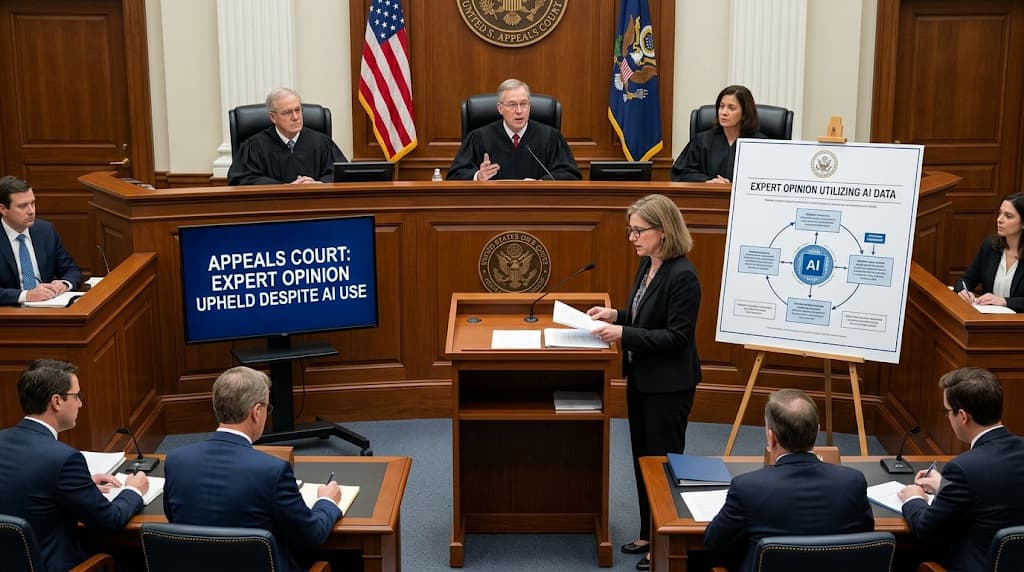
Gillespie v. Superior Court
Cal. Ct. App., Fourth District, Division One · Case No. D088222 (Super. Ct. No. SCD307508) · Not Certified for Publication · Opinion by Do, J. (McConnell, P.J., Rubin, J., concurring) · Filed November 4, 2026
Case Facts
Crystal Gillespie petitioned the California Court of Appeal for a writ of mandate directing the San Diego County Superior Court to vacate its order denying her pretrial mental health diversion under Penal Code section 1001.36. Gillespie was charged with grand theft, acting in concert with two or more people, after she and two others spent roughly 50 minutes loading merchandise from a Marshalls store into shopping carts and then a U-Haul truck in April 2025; police chased the truck for 15 minutes over nine miles before the driver fled on foot and Gillespie was found hiding in the cargo area, along with $1,673 in recovered merchandise and a glass pipe under the driver’s seat. In January 2026, Gillespie moved for diversion, asserting three qualifying mental disorders - bipolar I disorder, generalized anxiety disorder, and methamphetamine use disorder - played a significant role in the offense, supported by a report from forensic psychologist Dr. Lauren Vickerman. The prosecution conceded the diagnoses but relied on a report from its own expert, Dr. Nicole Friedman, to rebut the statutory presumption that the disorders were a significant factor in the crime. The trial court found Gillespie ineligible for diversion, and Gillespie sought review.
The Setup
Friedman’s assessment relied on the arrest report, the charging documents, Gillespie’s diversion filings including both of Vickerman’s reports, the prosecution’s opposition, and two short surveillance videos of the offense - she did not interview Gillespie. Friedman disclosed in her written report that “AI was used to help organize timeline and symptoms and[/]or behaviors to demonstrate the nexus.” At the diversion hearing, she testified she uses ChatGPT, under a business associate agreement that keeps her inputs out of the tool’s training data, as “a thought partner . . . particularly, in regard to the legal questions at hand,” and to “rewrite” and “polish” her sentences. She could not produce her ChatGPT inputs because she deletes them after each use. Asked whether she had prompted ChatGPT about the connection between Gillespie’s diagnoses and the offense, she recalled asking it, “What would be, maybe, considered nexus or causal effect,” though she repeatedly denied using it “to come up with an opinion.”
The Challenge
Gillespie moved to exclude Friedman’s report, arguing her AI use amounted to a novel scientific technique that had to clear California’s Kelly/Frye test before any opinion based on it could be admitted, and that because the underlying ChatGPT process could not be tested, reproduced, or scrutinized, her opinion lacked the reliability Evidence Code sections 801 and 802 require. The trial court disagreed, calling AI use “very common” and observing that “just because something involves AI” doesn’t mean “that automatically, there’s a problem with it.” On cross-examination, Friedman admitted that her report’s claim of “[n]o documentation” of a prior psychiatric hospitalization was inaccurate - the records actually documented a manic episode and a psychiatric hold - and said she had left that information out of the notes she gave ChatGPT, though she considered it in forming her opinion. The defense also called an expert, Kevin Diosdado, who ran Friedman’s report through an AI-detection program that flagged the nexus section of her report as “98 percent AI.” The trial court nonetheless found Gillespie ineligible for diversion, crediting Friedman’s opinion and stating, “there was nothing in . . . Friedman’s testimony that led me to believe that the opinions that she gave and the reasons she gave for those opinions were impacted in any way by the AI.”
The Ruling
The Court of Appeal denied Gillespie’s petition, reviewing the trial court’s evidentiary ruling for abuse of discretion. It agreed with Gillespie “in principle that the use of AI by a forensic psychologist to generate an expert opinion, at present, would constitute a novel scientific technique” requiring “an adequate foundation demonstrating the reliability of the psychologist’s methodology” before any resulting opinion could be admitted. But it found that principle did not control here, because Friedman “testified repeatedly that she used ChatGPT ‘as an organization tool,’ and did not use it to generate her opinion,” explaining that her opinion relied on “the totality of the records” she reviewed, “not just what . . . ChatGPT might have told” her.
The court did not pretend this was an easy call. It wrote that the evidence Gillespie pointed to - Friedman’s description of ChatGPT as a “thought partner,” her use of it to pose the central nexus question, and her failure to catch the inaccurate hospitalization statement in a report drafted with its assistance - was “troubling” and “of the type that might lead a reasonable trier of fact to conclude that Friedman’s opinion was not independent . . . but rather based on an unproven and unreliable delegation of her analysis to ChatGPT.” It stated plainly: “we share Gillespie’s concerns about Friedman’s reported use of AI.” But the trial court had credited Friedman’s own account - comparing her ChatGPT use to a law firm partner’s use of an intern or research attorneys - and the Court of Appeal held it was bound to defer to that credibility finding rather than reweigh the evidence itself. On that basis, it found no abuse of discretion in admitting Friedman’s opinion, and separately concluded substantial evidence supported the trial court’s finding that Gillespie’s mental disorders were not a significant factor in the offense.
The Kicker
The appellate panel went out of its way to say it wasn’t comfortable with what it saw - an expert who couldn’t produce her own prompts, had used an AI chatbot to help pose the very question her opinion needed to answer, and had missed a factual error in a report drafted with that chatbot’s help, with an AI-detection program putting the disputed section at “98 percent AI.” None of it changed the outcome, because the one finding that did control - whether to believe Friedman’s claim that she’d reached her own conclusions anyway - belonged to the trial judge, not to them.
What Was Alleged vs. What the Courts Found
→ Disclosed: Dr. Friedman’s own report stated “AI was used to help organize timeline and symptoms and[/]or behaviors to demonstrate the nexus.”
→ Tested: defense expert Kevin Diosdado ran the report through an AI-detection program, which flagged the nexus section as “98 percent AI”; cross-examination exposed an inaccurate statement about Gillespie’s medical records that Friedman admitted came from notes she’d given ChatGPT.
→ Found by the trial court: Friedman’s opinions and reasoning were not impacted by her AI use; her explanation that she used ChatGPT only to organize her thinking was credible.
→ Found by the Court of Appeal: bound to defer to that credibility finding, even while sharing Gillespie’s concerns about the AI use and calling the contrary evidence “troubling”; petition for writ of mandate denied.
The Lesson
This case shows how far appellate deference to a trial court’s credibility finding can carry an AI-assisted expert opinion, even over the reviewing court’s own stated discomfort. The legal principle the panel announced - that an AI tool used to generate an opinion would need its own Kelly/Frye foundation - did real work here only as a dividing line between organizing thoughts and generating conclusions, and that line was drawn by what the trial judge chose to believe, not by anything in the record that compelled one answer over the other.
Takeaways
If you’re retaining experts:
Keep and be ready to produce whatever record exists of an AI tool’s use in a case. Friedman’s inability to produce her ChatGPT inputs, because she deletes them after each use, became a focal point for the challenge even though it didn’t change the outcome.
If you’re an expert:
The line this panel drew runs between an AI tool as an “organization tool” and one used “to generate an opinion.” Be able to describe, specifically and consistently, which side of that line your use fell on - and make sure your written report doesn’t contain errors traceable to material you withheld from the tool.
If you’re opposing counsel:
An AI-detection program’s finding and a demonstrable factual error in the report may not be enough on their own to overturn a trial court’s credibility finding on appeal; the standard of review did as much to decide this case as the strength of the underlying evidence against the expert.