Case Background
A Miami interior design firm took a payment dispute over a luxury penthouse renovation to federal court in October 2022. Sure Business Corp. sued The Justin Maderia Trust and Justin Maderia, as trustee and individually, in the U.S. District Court for the Southern District of Florida. The firm claimed the Defendants never paid for upgrades they had requested during the project. The Defendants denied owing more than the written contract price. The case went to a jury trial in May 2026.
The Amended Complaint stated that the Trust bought Penthouse 5103 at Miami’s Gran Paraiso condominium on August 24, 2020. It paid $1,900,000 and planned to upgrade the unit and resell it for a profit. Miriam Poggio, the Plaintiff’s president and sole owner, was a licensed Florida real estate broker. Her firm offered interior design, staging, concierge, and property management services.
Cause
The Defendants’ real estate agent recommended the Plaintiff for the project, the Amended Complaint stated. The parties then signed a written estimate dated September 27, 2020. It covered remodeling, interior design, and furnishing work for the unit. The estimate listed a total of $138,500 plus tax.
The contract required written orders for any extra work. Those extras would become charges above the estimate. Plans, permit fees, condominium fees, and fire sprinkler work fell outside the contract price.
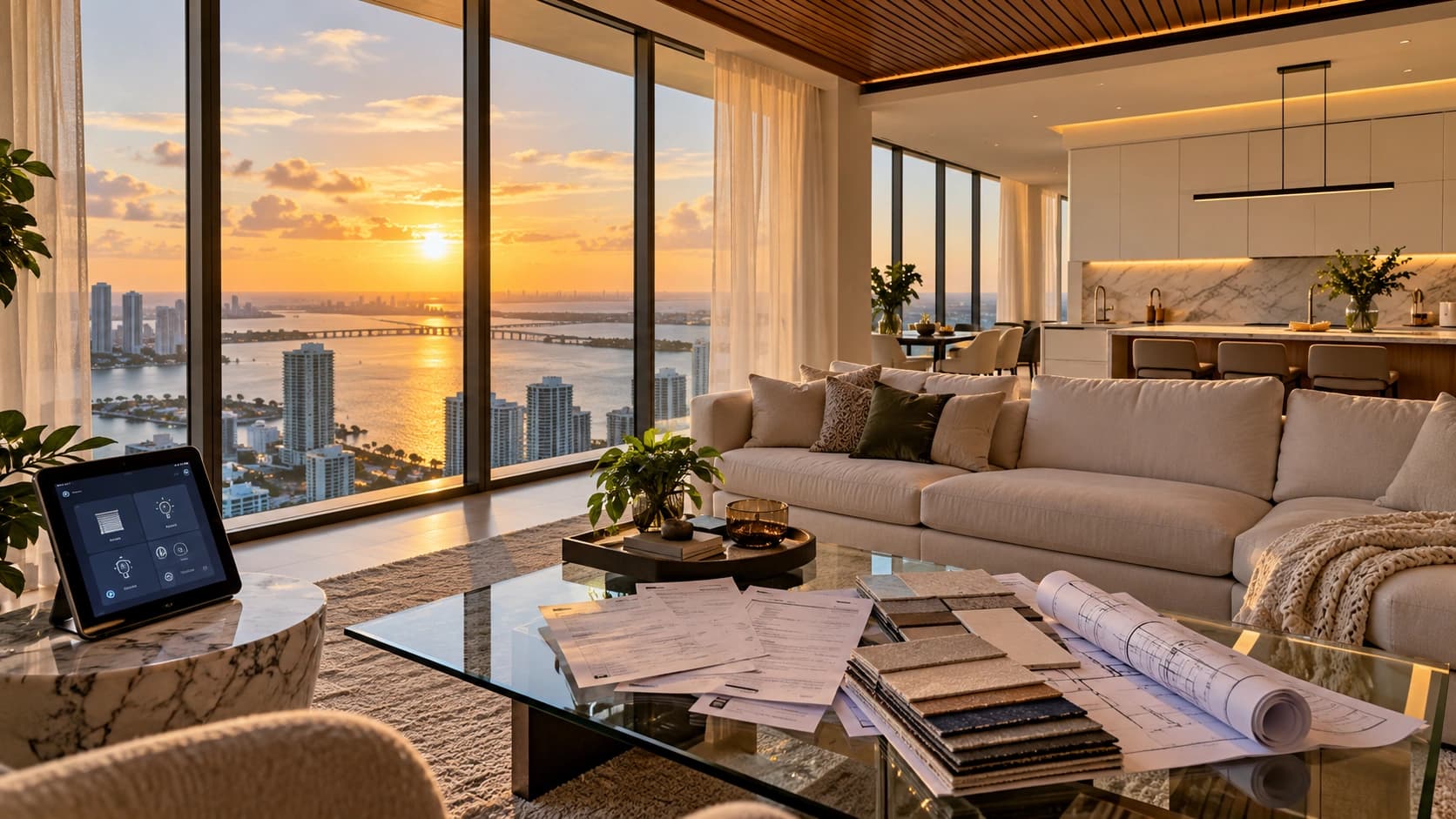
The Plaintiff alleged that the Defendants soon began requesting upgrades by email, text, phone, and in person. The requests included automated curtains and lights controlled by an iPad, white kitchen cabinets, and a redesigned foyer. The Defendants also allegedly asked to replace 17 doors instead of the two originally budgeted. The Plaintiff further claimed it spent about $8,500 on a sofa budgeted at $3,000. It also cited terrace and closet upgrades and an added sprinkler system.
Injury
The Plaintiff said the work was nearly complete by September 30, 2021. On October 6, 2021, the Trust signed an exclusive listing agreement with ONE Sotheby’s International Realty. The listing price was $4,050,000. Four days later, the Plaintiff sent an updated invoice. It listed a grand total of $362,000 plus tax, including a 20% designer fee. After crediting $92,500 in payments, the invoice showed a balance of $269,500 plus tax.
On May 4, 2022, the Trust agreed to sell the penthouse to Jessica Cohen for $2,990,000. The Plaintiff alleged that the Defendants first objected to its invoice when it demanded payment. On May 9, 2022, the Plaintiff recorded a lien against the unit for the unpaid $269,500.
The Plaintiff said it agreed to release the lien after Maderia and his agents threatened a lawsuit. They also allegedly threatened a complaint with the Florida Real Estate Commission. Under a May 17, 2022, escrow agreement, the Plaintiff received $46,000 at closing. Another $237,500 from the sale proceeds went into escrow while the parties tried to resolve the dispute.
Separately, the Plaintiff claimed it rented Maderia an apartment at the Epic condominium during the renovation. He stayed there from September 21 to November 21, 2021. The Plaintiff billed $14,433.79 for rent, cleaning, and electricity. It said that invoice remained unpaid.
Damages
The Plaintiff sought $223,500 for the renovation balance after subtracting the $46,000 paid at closing. It also sought $14,433.79 for the apartment. Its demand letters valued the furnishings the Defendants allegedly sold with the unit at $134,382.35. Under Florida’s civil theft statute, the letters sought $403,147.05, three times that amount. The Plaintiff also requested attorney’s fees, costs, and interest. It reserved the right to seek punitive damages.
Key Arguments and Proceedings
Legal Representation
Plaintiff(s): Sure Business Corp.
Counsel for Plaintiff(s): Michael J. Schlesinger | Eliz Demren | John Evron Kirkpatrick | Ronald M. Rosengarten
Defendant(s): The Justin Maderia Trust | Justin Maderia
Counsel for Defendant(s): Renee Marie Smith
Key Arguments or Remarks by Counsel
Claims
The Amended Complaint, filed on August 31, 2023, raised 11 counts. Breach of contract and breach of a contract implied in fact covered both the renovation and the apartment. Civil theft and conversion targeted furnishings the Plaintiff said it had bought and still owned. The Plaintiff alleged the Defendants sold those items with the unit without paying for them.
The Plaintiff also pleaded unjust enrichment, quantum meruit, and promissory estoppel as alternatives to its contract claim. It argued that its furnishings and improvements let the Defendants sell the unit above market value. Other counts alleged breach of the implied duty of good faith and fair dealing and fraud in the inducement. Two account stated counts sought $223,500 from all Defendants and $14,433.79 from Maderia individually.
Defense
In their May 2024 Answer, the Defendants admitted the contract, the sale price, and the lien filing. They denied most other allegations. They claimed the contract set a spending limit of $138,500. They also argued the October 2021 invoice covered work never approved through written change orders.
The Defendants then filed counterclaims for breach of fiduciary duty and breach of contract. They alleged the Plaintiff refused to cooperate on an earlier $3,100,000 offer to protect Poggio’s commission. They also claimed Poggio stopped performing her listing duties after they refused to pay the invoice. According to the counterclaims, the Plaintiff’s assistant removed the Plaintiff’s artwork and furnishings before closing. The Defendants further alleged that poor workmanship forced them to pay the Buyer $20,000 after closing.
The Court dismissed the counterclaims without prejudice in July 2024. It dismissed the amended counterclaim in October 2024, and the docket reflects no further counterclaim.
In September 2025, the Defendants filed amended affirmative defenses. They asserted unclean hands, claiming the Plaintiff failed to deliver the contracted services. They also asserted that they had paid the full contract price. The Plaintiff replied that the estimate expressly allowed for changes and additions. It added that the Defendants approved, observed, and never objected to the extra work.
Jury Verdict
The jury returned a unanimous verdict on May 22, 2026. It found that the Defendants breached both the written contract and an implied contract. Jurors also found for the Plaintiff on unjust enrichment, promissory estoppel, and quantum meruit.
For each of those five claims, the jury set damages at $81,492.87. A handwritten note on the verdict form said each figure included $14,433.79 for the Epic apartment rent.
However, the jury rejected the civil theft and conversion claims and awarded nothing under either theory. It also rejected the account stated claim for $269,500 on the renovation invoice. Jurors did find the Defendants liable on the $14,433.79 account stated claim for the apartment.
Post-trial Motions
On September 3, 2026, U.S. District Judge Darrin P. Gayles entered Final Judgment for the Plaintiff against both Defendants. The judgment covered the contract, implied contract, unjust enrichment, quantum meruit, and promissory estoppel counts, plus the apartment account stated count. It awarded $81,492.87 in damages plus $26,245.62 in prejudgment interest, for a total of $107,738.49. Post-judgment interest would accrue at the federal statutory rate until payment. The Court kept jurisdiction to award attorney’s fees and costs and to decide post-judgment motions.
Court Documents:
Documents are available for purchase upon request at [email protected]