
Case Facts
The MDL consolidates thousands of personal injury suits over implanted port catheters (IPCs) designed, manufactured, and marketed by Becton Dickenson and Company, C. R. Bard, Inc., Bard Access Systems, Inc., and Bard Peripheral Vascular, Inc. Plaintiffs allege that barium sulfate in the devices degrades catheter integrity and that manufacturing defects cause fracture, infection, and blood clots. To support those claims, plaintiffs retained Ahmed El-Ghannam, Ph.D., as a materials science expert. El-Ghannam holds a Ph.D. in bioengineering from the University of Pennsylvania and is a professor of mechanical engineering and engineering science at the University of North Carolina, where he has taught since 2007. Defendants moved under Federal Rule of Evidence 702 to exclude a series of his opinions - challenging his scanning electron microscopy and EDS testing methods, his definition of "biocompatibility," his sample size, and the foundation for several of his conclusions (Doc. 5202).
The Setup
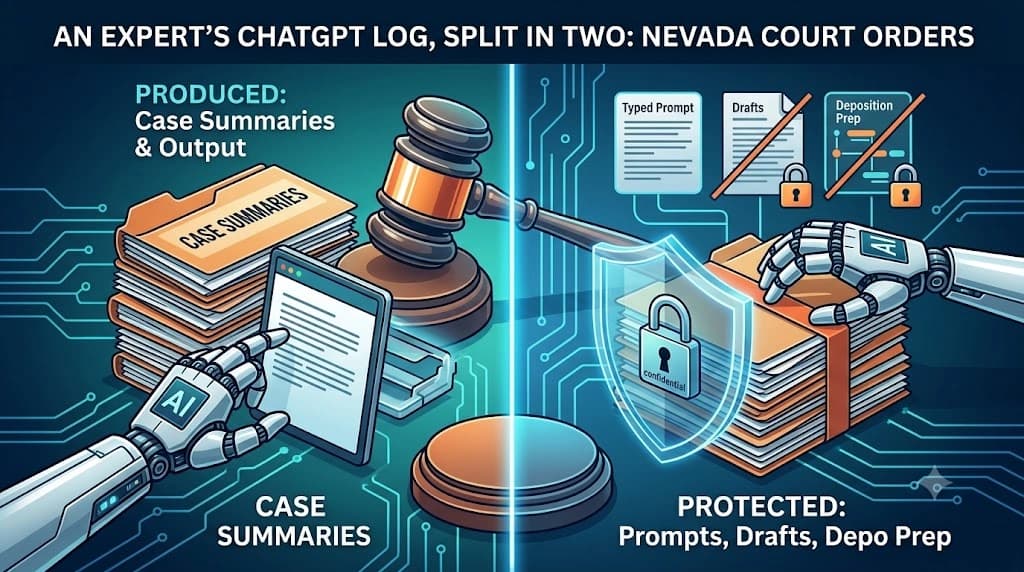
During his deposition, El-Ghannam acknowledged using ChatGPT while preparing his report. Asked about it, he testified:
“I use all engines, including ChatGPT, and I go to the references and read these articles and put my report based on that.” (Doc. 6022-1 at 12.)
Pressed on whether he had copied text directly from the tool, he said:
“I really don’t remember… But my general way of writing my report is that I read and check the references and write my report on that basis.” (Doc. 6022-1 at 16.)
Separately, in a different, case-specific report El-Ghannam had submitted elsewhere in the same MDL, citations had been flagged as AI-hallucinated. That other case has since been dismissed (Doc. 8389).
The Challenge
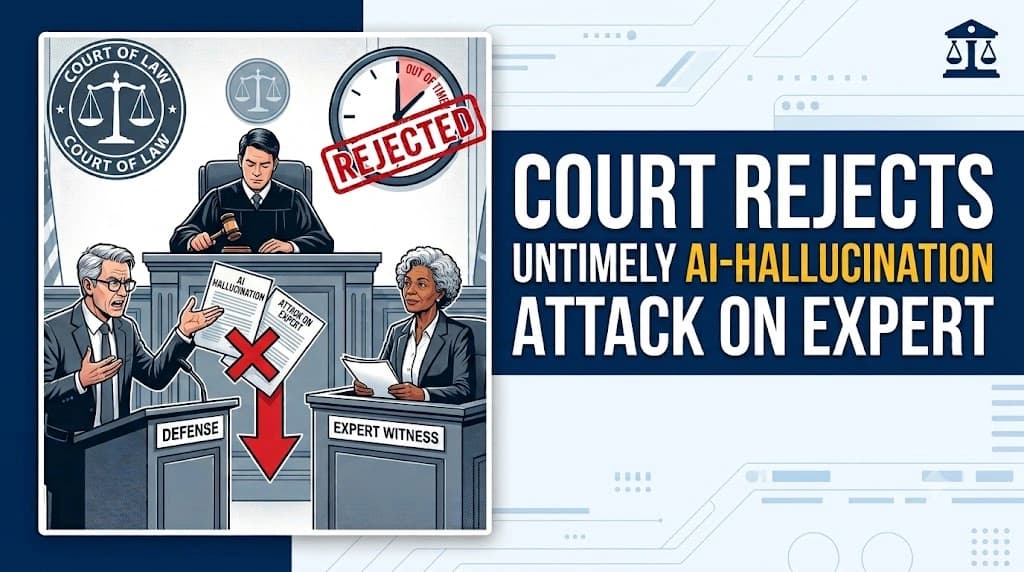
Defendants did not raise the AI issue in their opening motion. It surfaced for the first time in their reply brief, where they argued that El-Ghannam “gave deliberately misleading testimony” about his AI use “that destroys his credibility and reliability and renders his entire opinion inadmissible” (Doc. 6022 at 2).
The Court declined to consider the argument on that basis alone, holding that courts will not consider arguments raised for the first time in a reply brief. It went on to address the substance anyway. Defendants, the Court observed, “cite no particular part of El-Ghannam’s general report that they claim was AI-generated.” Instead, they argued that “numerous citations are now suspicious” because of the hallucinated citations found in that separate, now-dismissed case’s report - while conceding that “Bard has not identified any fully hallucinated citations in the General Report” actually at issue (Doc. 6022 at 5).
“Mere suspicion is not enough to exclude El-Ghannam’s opinions.”
The Court added that using AI for research purposes is not, on its own, disqualifying: AI, it wrote, “in many ways… has the potential to revolutionize legal practice for the better.”
El-Ghannam maintained that he had written the report himself. Asked directly whether he used “an artificial intelligence platform or program to write or edit” his report, he answered, “I wrote the report by myself” (Doc. 6022-1 at 9). The report is signed by him and confirms that the opinions offered are his own (Doc. 5202-1 at 4-5, 103).
The Ruling
Applying Rule 702’s gatekeeping standard, the Court granted Defendants’ motion in part and denied it in part — but the AI-use argument was not among the grounds for exclusion. The two opinions the Court actually struck had nothing to do with artificial intelligence. It excluded El-Ghannam’s opinion that catheter surface cracking was likely caused by Bard’s manufacturing processes, finding he “never explains how he reached the conclusion” and that “merely generating hypotheses – even reasonable ones – is not enough.” It also excluded his opinion on the cause of one patient’s (“Patient 1”) infection and biofilm, for which he “provides little foundation.” Every other challenge - to his SEM and EDS methodology, his biocompatibility opinions, his sample size, and his AI use - was rejected, and those opinions remain admissible.
The Kicker
The only opinions the Court actually struck had nothing to do with a machine. El-Ghannam lost ground on two narrow points because he never explained his own reasoning - not because he used ChatGPT to help find and read his references.
How the Challenge Unfolded
→ Defendants raised the AI-misconduct argument only in their reply brief, after briefing on the motion had otherwise closed.
→ The Court declined to consider it on that procedural ground alone.
→ Addressing the merits regardless, the Court found Defendants had not identified any specific AI-hallucinated citation in the report actually under review.
→ The suspicion Defendants raised rested instead on a citation problem in a separate report, from a different and now-dismissed case in the same MDL.
→ El-Ghannam’s own testimony was that he used ChatGPT to locate and read references, then wrote the report himself.
→ The Court held that “mere suspicion is not enough” to exclude his opinions.
The Lesson
The order draws a line between disclosed, research-stage AI use and AI-generated report content that goes unverified. El-Ghannam’s account - using ChatGPT to help locate sources he then read and cited himself - was not, on this record, treated the same as submitting fabricated citations. The ruling also shows how much a credibility attack depends on timing and specificity: raised only in reply, and without pointing to a single hallucinated citation in the report actually being challenged, the argument didn’t get past the threshold question of whether the Court would even reach it. The other case referenced in the order - where hallucinated citations reportedly did turn up in an El-Ghannam report - was resolved by dismissal before its AI issue produced a ruling on the merits.
Takeaways
If you’re retaining experts:
Ask experts directly, and early, how they used any AI tools in preparing a report, and get that explanation on the record before an opposing party frames it as concealment. An expert who can describe a research-and-verify workflow - finding sources, reading them, writing the analysis independently - is in a materially different position than one who cannot account for a citation at all.
If you’re an expert witness:
Be prepared to explain, specifically, what any AI tool was used for and what wasn’t. “I wrote the report myself” held up here because El-Ghannam could also describe, consistently, how he used ChatGPT - to help locate and read references, not to generate conclusions. Vague or evasive answers about AI use invite exactly the credibility challenge Defendants tried to bring.
If you’re challenging an expert’s AI use:
General suspicion isn’t enough. This order shows a court looking for a specific, identified problem - an actual fabricated citation or quote in the report being challenged - not an inference drawn from a different report in a different case. Raise the argument in the opening motion, not the reply, and come with the citation in hand.