

Case Background
The U.S. Equal Employment Opportunity Commission (EEOC) sued Northwest Arkansas Hospitals, LLC. The hospital does business as Northwest Medical Center-Bentonville. The case proceeded in the U.S. District Court for the Western District of Arkansas, Fayetteville Division.
The EEOC brought the action under Title VII of the Civil Rights Act of 1964. It also relied on Title I of the Civil Rights Act of 1991.
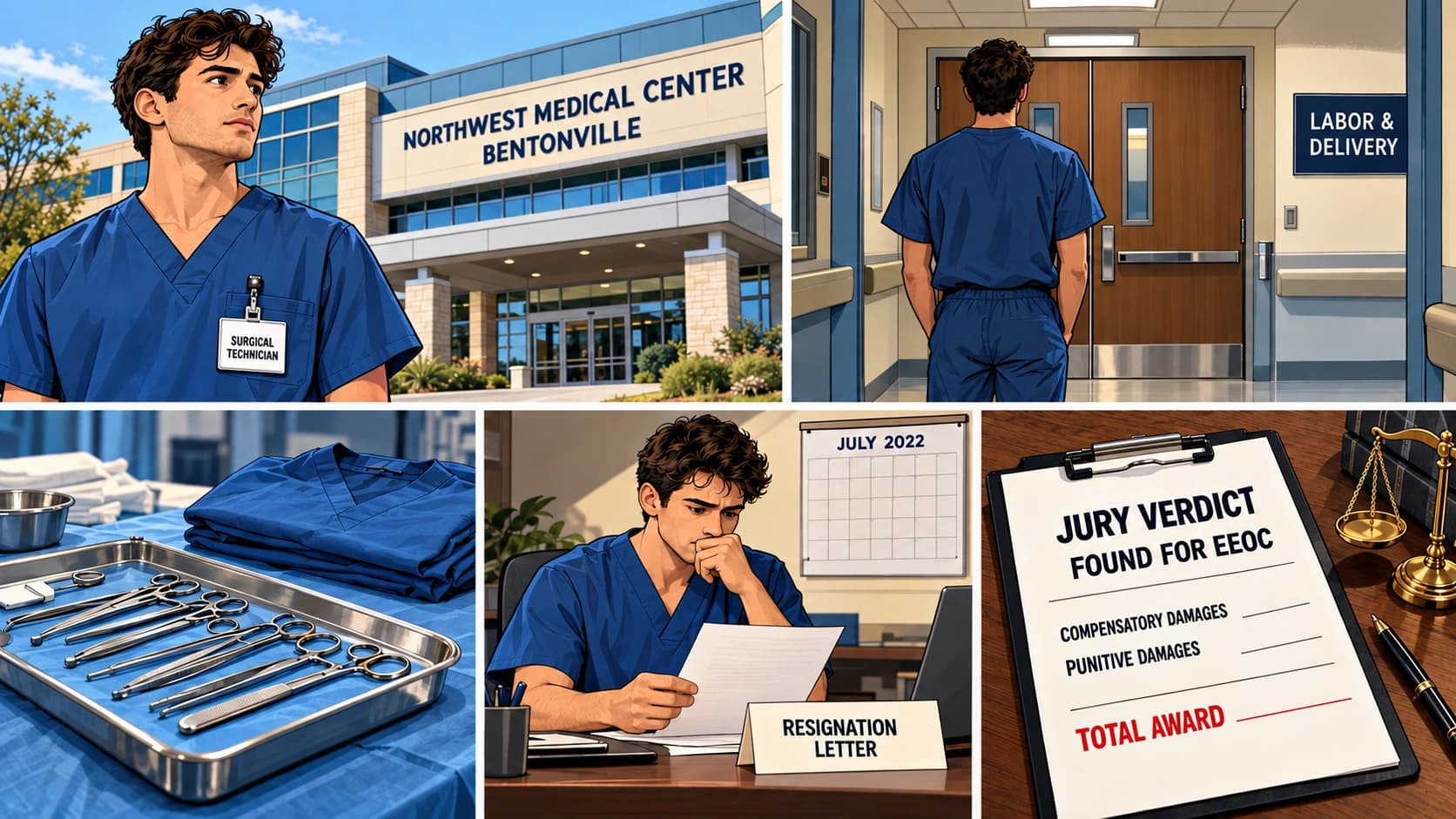
According to the amended complaint, Chavez applied for a surgical technician position on or about December 7, 2021. The position was in the hospital's Labor and Delivery Unit. According to the summary judgment ruling, he started work on January 10, 2022, as a part-time, noncertified surgical technician. The ruling also noted that the hospital had never before hired a noncertified surgical technician in labor and delivery.
The amended complaint stated that the job involved setting up instruments, taking patient vitals, and placing fetal monitors. It also included cleaning after procedures, bathing babies, assisting during deliveries, and taking blood samples to the lab.
Cause
The EEOC alleged that the hospital subjected Chavez to different employment terms, conditions, or privileges because he was male. It alleged that Drs. Katie Beal and Amy Fry prevented Chavez from performing portions of his assigned duties.
The EEOC alleged that the doctors allowed uncertified female employees to work during vaginal and Cesarean deliveries. It alleged that they prevented Chavez from setting up for deliveries, remaining in delivery rooms, and cleaning after deliveries. He also allegedly could not observe procedures or assist with patient care.
The EEOC also alleged that Chavez lost the on-the-job training and experience available to female surgical technicians. It alleged that the restrictions affected his employment conditions and professional development.
Injury
The alleged employment injury involved Chavez's exclusion from certain labor and delivery procedures. The EEOC claimed that the restrictions prevented him from fully performing the duties of his position. It claimed they also limited his on-the-job training.
The amended complaint also alleged that Chavez experienced humiliation and isolation during deliveries and that his working conditions became intolerable. The EEOC alleged that he ultimately resigned because of the conditions.
According to the summary judgment ruling, Chavez emailed his two weeks' notice on July 7, 2022. He later told his manager, Jennie McClain, that his other job had a shorter commute. He also said he would soon start a full-time licensed practical nursing program. He gave Chief Nursing Officer Kimberly Arnold the same reasons. The Court noted that he did not report sex discrimination as a reason for resigning.
Damages
The amended complaint sought back pay with prejudgment interest. It also sought other relief necessary to address the alleged effects of the employment practices. It further sought compensation for past and future pecuniary losses and nonpecuniary losses.
The requested nonpecuniary damages included emotional pain, suffering, inconvenience, loss of enjoyment of life, and humiliation. The EEOC also sought punitive damages and injunctive relief concerning Northwest Arkansas Hospitals' employment practices.
Key Arguments and Proceedings
Legal Representation
Plaintiff: Equal Employment Opportunity Commission
Counsel for Plaintiff: Gary Sullivan | James Monroe Scurlock | Carter Meader Sox | Maryna Jackson [Terminated: 12/02/2025] | Jennifer Corbin Bearden [Terminated: 06/16/2025] | Faye A. Williams
Defendant: Northwest Arkansas Hospitals, LLC d/b/a Northwest Medical Center-Bentonville
Counsel for Defendant: James Matthew Gary [Terminated: 12/29/2025] | Gillian G. O'Hara | Robert J. Toth II | Peyton Caroline Watts
Key Arguments or Remarks by Counsel
At summary judgment, the EEOC pointed to comments attributed to the two doctors. McClain, then Director of Women's Services, testified that Dr. Beal said the unit had an all-female staff for a reason. A certified surgical technician testified that Dr. Fry said she did not want a male in rooms.
The hospital pointed instead to two January 2022 deliveries in which Chavez was asked to leave the room. It also relied on a January 26, 2022, patient complaint about his presence during her delivery. The hospital's own investigation, however, dismissed that complaint after reviewing its badge tracking records.
At trial, the EEOC's exhibits included the hospital's 2022 Code of Conduct and an employment policy. They also included text messages between Kimberly Arnold and Jennie McClain. The EEOC further offered the hospital's findings on a patient complaint and Chavez's resignation.
The hospital's exhibits included its employee handbook, diversity training materials, and Chavez's job description. They also included his application, resume, and employment records from two other hospitals.
Claims
The EEOC asserted a Title VII sex discrimination claim concerning Chavez's employment terms, conditions, and privileges. It alleged that Chavez faced restrictions on participating in certain deliveries because he was male. The amended complaint also included a constructive discharge claim, alleging that intolerable working conditions forced Chavez to resign.
Northwest Arkansas Hospitals moved to dismiss the constructive discharge claim on April 24, 2025, when it filed its answer. The Court granted that motion on December 18, 2025. By the summary judgment stage, the Court described the case as a single sex discrimination claim. The Court also noted that the EEOC did not rely on Chavez's resignation as the adverse employment action.
Defense
In its answer to the amended complaint, Northwest Arkansas Hospitals denied discriminating against Chavez. It argued that its employment decisions had legitimate, nondiscriminatory explanations.
The hospital maintained that patient privacy, preferences, dignity, safety, and religious concerns justified limiting Chavez's participation in certain deliveries. It also cited Chavez's qualifications, experience, and operational needs. In addition, the hospital asserted a bona fide occupational qualification defense.
The hospital argued that Chavez suffered no adverse employment action. It maintained that he received opportunities consistent with his qualifications. It further asserted that his voluntary resignation was unrelated to the alleged discrimination. The hospital also claimed it would have made the same decisions regardless of any alleged discrimination.
At summary judgment, the hospital argued that Drs. Beal and Fry excluded Chavez because of unprofessional conduct, not his sex. It also cited his alleged failure to respect patient privacy.
Pre-Trial Motions
The hospital moved for summary judgment, and the Court denied the motion on May 28, 2026. The Court found that a reasonable jury could view the exclusion as a disadvantageous change in employment conditions. It also found genuine disputes over why the doctors excluded Chavez. It further found disputes over why the hospital allowed them to do so.
Jury Verdict
A jury of eight heard the case during a five-day trial that began July 20, 2026. The Court submitted the case to the jury through written interrogatories. On July 24, 2026, the jury unanimously found in favor of the EEOC on the sex discrimination claim.
The verdict form then asked whether the hospital proved it would have made the same changes anyway. That question applied regardless of Chavez's sex or any physician's sex-based preference. The jury answered "No."
The jury found Chavez's damages to be $5,000. The Court's order described that amount as compensatory damages. The jury separately assessed $100,000 in punitive damages against the hospital. The Court polled the jury, and every juror confirmed each interrogatory response.
Post-trial Motions
In its July 28, 2026, order, the Court allowed the EEOC to seek injunctive relief, fees, and costs. The deadline for that motion was August 7, 2026. The EEOC filed a motion for injunctive relief on that date. It also filed a bill of costs for $12,309.88. The hospital opposed both filings on August 21, 2026. The EEOC replied on August 28, 2026. The Court stated it would enter judgment after resolving the motion.
Court Documents:
Documents are available for purchase upon request at [email protected]