

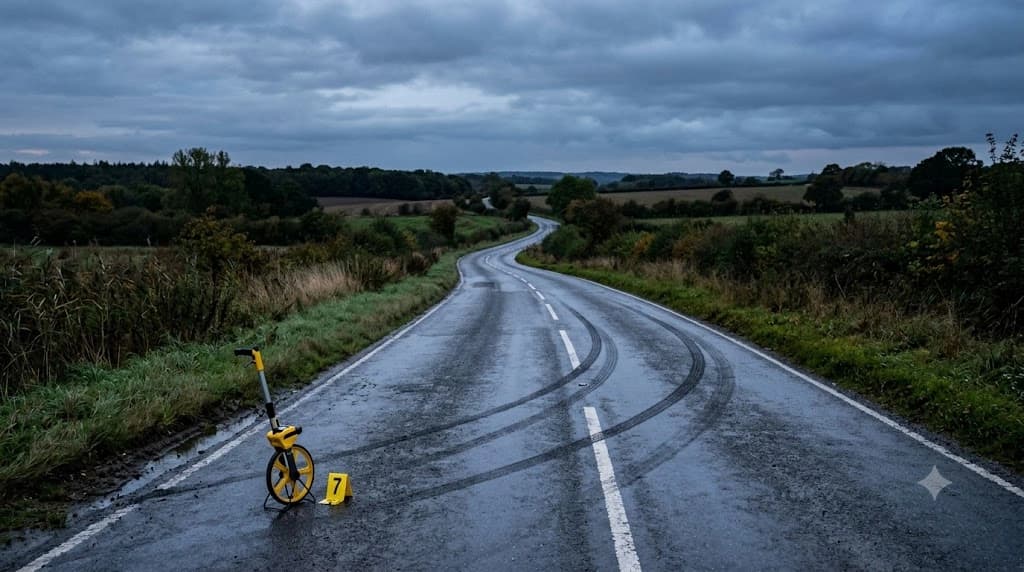
A Pole Sheared in Two
On September 29, 2001, at about 10:40 p.m., a car left a rural road in Kitsap County, Washington. It crossed the center line at a sweeping curve and struck a telephone pole hard enough to shear it in two. One passenger died at the scene, and the other was critically injured.
The speed limit on that road was 40 mph. The driver later told a sheriff's deputy he had been going 60 mph and swerved to avoid a deer. The State's accident reconstruction expert entered the scene data into a physics-based computer program. His estimate was about 80 mph.
That gap between two numbers is the work of accident reconstruction. These experts use scene measurements, tire marks, vehicle damage and rest positions to work out how a crash happened. They estimate speed, angle of impact, sequence of events and each vehicle's position on the road.
Courts hear from them because those answers depend on physics and measurement. Speed and change in velocity cannot be read from a photograph. A trained reconstructionist calculates them and explains the steps.
The five rulings below, from three trial courts and two appellate courts, show what courts accepted when that work was challenged.
Where Reconstruction Experts Appear in Litigation
Two snowmobiles collided head-on in a fatal crash that reached a federal court in Michigan. A car rear-ended another at a traffic signal in New Mexico. A car struck a pole in Washington, and the driver faced a vehicular homicide prosecution. Two vehicles collided in Livingston Parish, Louisiana, one of them a truck pulling a trailer. A tractor-trailer and a UPS delivery truck collided on a Mississippi highway.
In these cases, reconstruction experts spoke to liability. They estimated speed and change in velocity. They placed vehicles on the road and fixed angles of impact. One traced a delivery truck's path from GPS records. Another described how a body moves inside a car during a low-speed rear impact.
In the New Mexico case, Defendants conceded negligence. The jury had to decide whether the crash caused the claimed injuries and damages. The reconstructionist's estimate of the impact's severity went to that question of causation.
The challenges followed familiar lines. Opponents attacked qualifications. They pointed to the lack of a college degree, part-time consulting work, limited experience with the vehicle type, and the absence of a biomechanics degree.
They attacked method. Some argued that opinions rested on visual inspection instead of calculation. One argued that an opinion rested on hindsight and speculation.
They attacked the data. In Mississippi, the GPS records came with a disclaimer from the company that produced them. In Washington, the defense argued that a computer simulation program was not generally accepted in the scientific community.
The Cases
Show v. Shadian: Both Sides' Reconstructionists Cleared
Show v. Shadian, United States District Court for the Western District of Michigan, Northern Division, Case No. 2:19-cv-209. Order entered October 27, 2021.
Lisa Show, as personal representative of the Estate of Douglas Show, sued Jodi Shadian, as personal representative of the Estate of John Shadian. The two decedents had been involved in a fatal head-on snowmobile collision. Each side moved in limine to exclude the other's experts.
Plaintiff's expert had worked fifteen years with the Michigan State Police, ten of them as a Traffic Crash Reconstruction Specialist. He had taught traffic crash investigation at a regional police academy at Delta Community College since 2000. He had taken about forty or more reconstruction courses, totaling more than 1,000 hours of training. He was accredited by the Accreditation Commission for Traffic Accident Reconstruction (ACTAR). He had run his own reconstruction firm since 2003.
He concluded that the Polaris struck the Yamaha at a steep angle and that the Polaris was left of center before impact. He obtained photographs and laser scans of the snowmobiles, created diagrams and visited the scene. He relied on crush profiles, vehicle dynamics, final rest positions and rotation.
Defendant argued that his opinions were not based in evidence and lacked any stated method. Defendant also said he had no specific experience with snowmobile collisions.
Judge Hala Y. Jarbou found him qualified. With the State Police, he had handled snowmobile crashes among many other kinds. The Court held that specialization within a general field goes to weight and credibility, not admissibility. His description of how he positioned the vehicles was adequate to show the testimony was not unsupported speculation. "It is the responsibility of the jury to evaluate the expert's conclusions," the Court wrote. It confined him to his field of accident reconstruction and denied the motion.
Defendant's expert had spent about nineteen years in State Police accident investigation, eleven in its Reconstruction Unit. He founded a consulting company in 1994 and had attended 60 to 70 or more reconstruction courses, seminars and conferences. He belonged to the Michigan Association of Traffic Accident Investigators and the International Association of Accident Reconstruction Specialists. He visited the scene, took elevation measurements and photographs, and created diagrams.
Plaintiff attacked his limited snowmobile experience, his lack of calculations on visibility and the high point of the location, and his visual method for the angles of impact. The Court rejected each point. Missing calculations on specific questions did not make his whole testimony unreliable. His angle-of-impact opinion rested on the same kind of evidence as the other expert's. The Court held that a difference between the two opinions was not evidence that either was unreliable.
That motion was also denied. The order left the dispute over angle and position for the jury, with a qualified reconstructionist on each side.
Sanders v. Pruett: Low-Speed Impact Testimony Upheld on Appeal
Sanders v. Pruett, Court of Appeals of New Mexico, No. A-1-CA-35051. Memorandum opinion decided November 5, 2018.
Jessica Sanders sued Margery Pruett and her father, Tom Pruett. She claimed injuries to her head, neck and back. She alleged that Margery Pruett rear-ended her vehicle at low speed while she was stopped at a traffic signal. Defendants conceded that Margery Pruett was negligent. The jury had to decide whether that negligence caused the claimed injuries and damages.
Defendants retained a civil engineer and accident reconstructionist. He had twenty-five years of experience as a reconstruction specialist and held ACTAR accreditation. He had trained in low-speed crash testing and the practical application of biomechanics through the Texas Association of Accident Reconstruction Specialists and the Society of Accident Reconstructionists. He had also taken part as a subject in low-speed crash tests. He told the jury he should not be called a biomechanical engineer.
He estimated the change in speed of Plaintiff's vehicle, the delta-V, at two and one-half to five miles per hour. He relied on published crash tests, peer-reviewed literature, photographs of Plaintiff's vehicle and his own inspection of Defendants' vehicle. Assuming a restrained occupant with a headrest, he testified there was no mechanism of injury. He also said he would not expect the occupant to strike her head on the steering wheel, as Plaintiff claimed.
Plaintiff moved before trial to exclude him. She argued he was not qualified on biomechanical issues and that his testimony lacked a sound basis. Her own expert said he was offering a medical opinion. The district court denied the motion in a written order after a hearing. It found that accident reconstruction includes low-speed collisions, occupant movement and the effect of such impacts on the human body. The jury returned a verdict for Defendants.
On appeal, Judge M. Monica Zamora wrote for the Court of Appeals and found no abuse of discretion. The Court relied on its earlier decisions in Baerwald v. Flores and State v. Vigil. Under those cases, a degree in biomechanics was not required. His education, training and experience satisfied Rule 11-702.
The Court also found that his trial testimony stayed within his field. It noted that "there was no opinion testimony about the causation of Plaintiff's specific injuries as a result of this motor vehicle accident." The Court affirmed the judgment, with one judge concurring in the result only.
The testimony was admitted, the jury found for Defendants, and the admission was upheld on appeal.
State v. Phillips: Computer Simulation Passes the Frye Test
State v. Phillips, Court of Appeals of Washington, Division Two, No. 29804-0-II. Opinion filed October 5, 2004, published in part.
Kevin Michael Phillips was the driver in the Kitsap County crash. The State charged him on September 25, 2002, with vehicular homicide and vehicular assault. The investigating deputy had found tire marks crossing the center line and leaving the road, and prepared a diagram. Phillips told the deputy he had swerved for a deer at 60 mph.
The State's expert had 30 years' experience in accident reconstruction. He used PC-Crash, a program that performs physics calculations to reconstruct and simulate crashes. He had used it since 1995 or 1996, more than a thousand times.
Working from the deputy's diagram, he entered data into the program. He adjusted potential speeds to simulate the car's path over the tire marks, through the bushes and into the pole. He testified that the car was traveling at about 80 mph. In his opinion, speed, not a swerve, explained the failure to negotiate the curve. A defense engineer testified to 60 mph based on the tire marks.
Phillips did not challenge the expert's qualifications. He argued that PC-Crash was not generally accepted in the scientific community under the Frye standard. The trial court held a Frye hearing and admitted the testimony. The jury convicted on October 9, 2002, and the trial court imposed a standard range sentence of 30 months.
Chief Judge Quinn-Brintnall wrote for the Court of Appeals. The expert had testified that the software applies long-accepted laws of physics. Reconstruction experts could make the same calculations by hand or on spreadsheets. The program's advantage was breaking a simulation into 15-millisecond segments.
He also addressed two validation articles on the program, one favorable and one critical. He testified that the critical article had been discredited and may have been withdrawn. He named users of the program, including the Washington State Patrol Major Accident Investigation Team.
Reviewing de novo, the Court found the program sufficiently accepted in the field to satisfy Frye. It held: "An otherwise qualified accident reconstruction expert is not prohibited from giving expert opinion testimony on the cause of an accident merely because he uses the assistance of such a software program in making his calculations." Challenges to how he used the software went to weight, not admissibility.
The Court affirmed the conviction. The Washington Supreme Court denied review in 2005.
Sandlin v. Urbina: Experience Over Degrees
Sandlin v. Urbina, United States District Court for the Middle District of Louisiana, Civil Action No. 19-00556-BAJ-RLB. Ruling and order of March 4, 2022.
The case arose from a collision in Livingston Parish, Louisiana, between Plaintiff Danielle Sandlin's vehicle and a vehicle driven by Defendant Denis Urbina. Danielle Sandlin sued for herself and, with James W. Sandlin Jr., on behalf of their minor child. Plaintiffs alleged that Urbina was negligent and sought to hold his employer, Benitez, vicariously liable. Each side then moved to exclude the other's accident reconstruction expert.
Plaintiffs' expert had been a police officer for more than 20 years. He had worked in the Baton Rouge Police Department's traffic homicide unit since 2001. He supervised its traffic homicide and hit and run divisions, where his duties included reconstructing accidents. Plaintiffs said he had completed more than 600 hours of coursework, including 400 hours through the Northwestern University Traffic Institute. He had trained more than 200 agencies on reconstruction software. He had been accepted as a reconstruction expert on fourteen earlier occasions.
To reach his conclusions, he reviewed photographs of the vehicles at the scene, satellite imagery and the crash report. He also read the depositions of both drivers and the investigating officer. He also inspected the collision site and took his own photographs.
Defendants argued he had no college degree, had published no articles on reconstruction and worked as a reconstructionist only part-time. They also argued he did not follow proper reconstruction standards and relied on hindsight and speculation. Plaintiffs answered that Defendants' own reconstruction expert had testified he was qualified.
Judge Brian A. Jackson found that Defendants offered no compelling basis to conclude he was unqualified. On method, the Court looked to two earlier Middle District rulings. One found a site inspection and photographs reliable enough for admissibility. It treated any failure to test or calculate as a matter for the jury. The other accepted a scene inspection combined with reports, photographs, measurements and testimony.
The Court found this case analogous and held his method sufficient for admissibility. It added that the gatekeeper role "is not intended to serve as a replacement for the adversary system." The motion was denied in full.
Plaintiffs' expert was cleared on both qualifications and method. The ruling treated two decades of traffic homicide work and a documented scene investigation as enough for the jury to hear him.
Magee v. Noe: A Challenge to GPS Data Goes to Weight
Magee v. Noe, United States District Court for the Southern District of Mississippi, Eastern Division, Civil No. 2:20cv183-HSO-MTP. Order of January 5, 2023.
On April 18, 2019, a tractor-trailer driven by Defendant James L. Hilliard and a UPS delivery truck driven by Plaintiff Christopher Magee collided on U.S. Highway 98 in Marion County, Mississippi. Christopher and Jamyra Magee sued Hilliard and his employer, Michael R. Noe d/b/a On Time Shipping. Magee testified he had been in the right westbound lane for about half a mile. Hilliard maintained that the UPS truck had been stopped in the median and moved into the lanes ahead of him.
UPS produced telematics data recording the truck's time, location, speed and braking. A two-page disclaimer from UPS's legal department came with it. The disclaimer said UPS testing had found tolerances that undermined the accuracy and reliability of the data. UPS admitted it could not say whether this data was reliable.
Plaintiffs retained an accident reconstruction expert. Defendants did not challenge his qualifications as a reconstructionist. He reviewed the accident report, depositions, witness statements and initial disclosures, and inspected the crash site. He correlated the GPS data with other evidence, such as the time on the crash report, to trace Magee's movements before the crash. He found the data consistent with Magee's account. The defense reconstruction expert would not rely on the data because of the disclaimers.
Defendants argued that the data was unreliable, so opinions built on it were unreliable too. The previously assigned judge denied that challenge at a May 13, 2022 hearing. After the case was reassigned, Defendants raised it again.
Judge Halil Suleyman Ozerden denied the renewed motion as an untimely Daubert motion. The motions deadline had passed on September 15, 2021, and Defendants showed no good cause to extend it. The Court then held that the motion would fail on the merits even if timely. The expert's review of the crash and the accounts gave him sufficient facts to plot a vehicle's path. He appeared to have used reliable principles and methods. Doubts about the data went to weight. "The determination of the accuracy of that evidence is one for the jury," the Court wrote.
The same order held that, on the current record, the telematics data was not self-authenticating under Rules 902(11) and 902(13). The Court left open whether Plaintiffs could authenticate it at trial.
His testimony stayed in the case. Whether the data itself would come in turned on a separate authentication question.
What the Rulings Have in Common
Three of the six experts came out of police crash investigation units. None of the courts treated a missing degree as disqualifying. In Louisiana, twenty years of traffic homicide work and hundreds of hours of coursework were enough. In New Mexico, training and experience took the place of a biomechanics degree. ACTAR accreditation appeared in two of the records.
Specialized experience was not required either. The Michigan court held that limited work with snowmobiles went to weight.
On method, the courts looked at how each expert reached the opinion, not whether the opinion was right. The methods accepted were the ordinary tools of the field. They included scene inspections, photographs, measurements, diagrams, crush profiles, rest positions and rotation.
Two experts went further. The Washington expert used simulation software and showed that its calculations could be done by hand. The New Mexico expert relied on published crash tests and peer-reviewed studies of low-speed impacts.
Disagreement did not defeat admission. The Michigan experts reached different angles of impact, and the Court said that difference made neither unreliable. In Mississippi, doubts about the underlying GPS data went to weight. In Washington, a single critical article did not show a significant dispute among experts.
Fit came down to scope. The courts admitted testimony that stayed inside reconstruction. The Michigan order confined one expert to that field. The New Mexico court stressed that its expert offered no opinion on what caused Plaintiff's specific injuries.
Practical Points for Attorneys
The renewed challenge in Magee failed first on timing. The Daubert deadline had passed more than a year earlier, and the Court would not reopen it without good cause.
Credentials drew attention wherever qualifications were contested. The records that held up listed training hours, accreditation, teaching and earlier acceptance as an expert. A curriculum vitae with those details gave the courts something specific to cite.
The method has to be explained in the expert's own words. The Michigan experts described the factors they used: crush profiles, rest positions, rotation and photo perspectives. That description was enough to show their opinions were not speculation, even where certain calculations were missing.
Third-party data deserves a second source. The Mississippi expert did not rest on the GPS records alone. He correlated them with the crash report, the depositions and his own site inspection. That broader base let the Court treat the data dispute as a question of weight.
Software opinions call for a foundation in physics. The Washington expert explained what the program calculated, said the same results could be reached by hand, and answered the critical literature. The Court also noted his years of use and the program's use by a state patrol unit.
Scope protects the testimony. In New Mexico, the expert described forces and occupant motion but stopped short of diagnosing injuries. The Court of Appeals relied on that line in affirming. In Michigan, the Court confined Plaintiff's expert to reconstruction after Defendant raised a concern about toxicology.
The Record Across Five Courts
Between 2004 and 2023, courts in five states reviewed the work of the six reconstructionists featured here. Plaintiffs retained three of them. Defendants retained two. The State retained one.
Their evidence ranged from tire marks and crush damage to simulation software and GPS records. The challenges against them targeted credentials, method and data. Each court allowed the featured expert's reconstruction testimony and left its weight to the trier of fact. In New Mexico and Washington, juries then returned verdicts for the side that called the expert, and both appellate courts affirmed.
Attorneys who want to retain an accident reconstruction expert can find one on Exlitem. Win Cases With Data, Not Guesswork. The platform holds 52,748+ expert profiles and 245k+ Daubert records across 5,000+ specialties. Search by discipline at exlitem.com.