

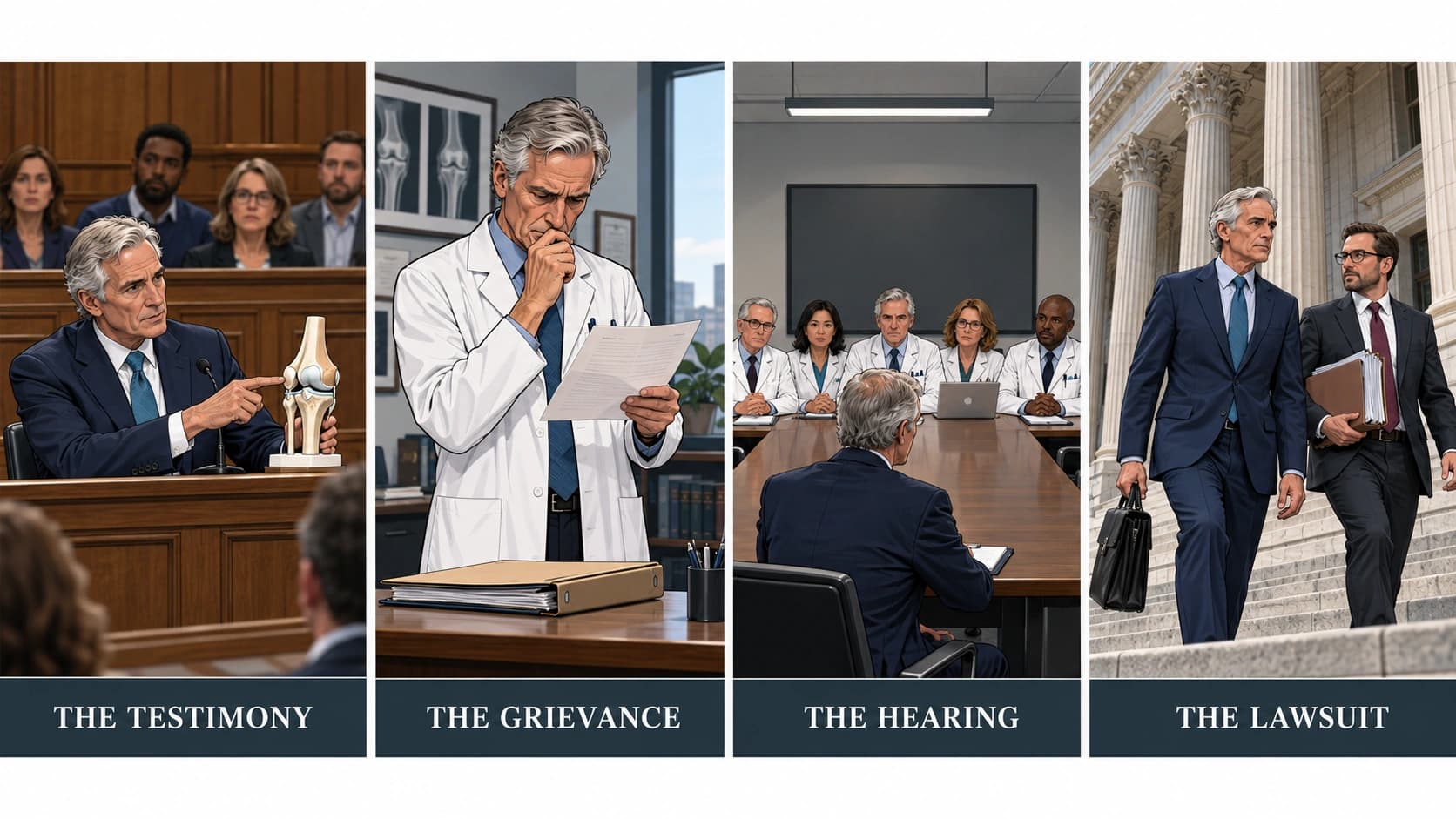
Thomas M. DeBerardino, MD, an orthopedic surgery expert witness who has testified in nearly 100 cases, sued the American Academy of Orthopaedic Surgeons and the American Association of Orthopaedic Surgeons (together, AAOS) on October 22, 2026, in federal court in San Antonio.
The complaint alleges AAOS uses its expert witness grievance program to punish surgeons who testify for patients, while sparing those who testify for defendant doctors. The suit was first reported by the San Antonio Express-News.
Why it matters: Courts have weighed this question for 25 years: can a private medical society discipline members over what they say in court? The answer shapes how attorneys vet experts, and how orthopedic and other medical expert witnesses weigh the risk of testifying against peers.
The grievances
Four surgeons DeBerardino had testified against filed grievances with AAOS between 2022 and 2024, the complaint says. Each came after the underlying case had ended.
According to the complaint, the four matters were:
A wrist fracture case in Louisiana that the surgeon's insurer settled.
A Connecticut wrongful death case over blood clot prevention, where a jury found the surgeon negligent and awarded $12.5 million.
A knee replacement case that ended without a trial.
A second wrongful death case over blood clot prevention that settled confidentially.
The complaint says no court has excluded his opinions since he began testifying in 2013, and he was never impeached in any of the four matters.
AAOS's findings. AAOS's October 2024 notice in its AAOS Now publication suspended him for one year. It found he knowingly gave false testimony in one matter and made statements that were not fair and impartial. AAOS later expelled him on July 21, 2025, and announced the expulsion on February 25, 2026.
His account of the process. The complaint says AAOS:
Raised violations for the first time at hearings, without notice.
Excluded his witness's testimony as hearsay while letting grievants testify freely.
Ignored what he calls false sworn statements by two grievants about confidentiality agreements.
Refused to let him resign in 2023, leaving him open to more grievances.
The complaint also disputes six specific descriptions of his testimony in the suspension notice. One example: AAOS wrote that he described an injury as a "double crush." He says he called it "almost" a double crush, as an analogy for the jury.
The fallout
The complaint ties a string of professional losses to the discipline, ending with two leadership titles stripped days before he sued.
Date | What happened, per the complaint |
|---|---|
Oct 14, 2026 | UT Health San Antonio removes him as Sports Medicine Division Chief |
Oct 12, 2026 | UTSA removes him as Head Team Orthopedic Surgeon |
Jul 16, 2026 | Counsel who retained him moves to substitute him as an expert, citing the expulsion |
Feb 25, 2026 | AAOS publishes the expulsion and mails it to members |
Jul 21, 2025 | AAOS expels him |
Jan 28, 2025 | A research review board denies his study until the suspension is resolved |
Nov 14, 2024 | He is removed as president of the Clinical Orthopaedic Society |
Oct 23, 2024 | AAOS publishes the suspension, next to two surgeons expelled after sexual assault convictions |
The complaint also says one court admitted testimony about his expulsion, then declared a mistrial.
The claims
The suit's boldest theory is that AAOS acts as a court. By reviewing courtroom testimony after a case ends, the complaint argues, AAOS exercises judicial power and becomes a state actor.
The seven counts:
First Amendment retaliation (§ 1983): punishing him for protected speech in court.
Content and viewpoint discrimination (§ 1983): disciplining only plaintiff-side experts.
Due process: hearings he calls predetermined, run in breach of AAOS's own rules.
Defamation by implication and false light: publishing his suspension beside two criminal expulsions.
Defamation: the six disputed descriptions of his testimony.
Tortious interference with his expert witness business.
Declaratory judgment under Texas law: that AAOS's bylaws are void under Texas's ban on the corporate practice of medicine, and that his testimony broke no AAOS standard.
Experts have sued before
Experts who attacked how a society described them have sometimes won. Those who attacked a society's right to discipline them have mostly lost.
Year | Case | Court | Outcome |
|---|---|---|---|
2025 | E.D. Cal. | Neurosurgeon says the society refused his resignation, then suspended him. Defamation suit dismissed with leave to amend; court said he must first overturn the discipline. | |
2016 | 5th Cir. | Part of a censure vacated for lack of due process; the rest upheld. | |
2016 | E.D. Pa. | AAOS dismissed; no First Amendment claim because AAOS is not a government entity. | |
2014 | 3d Cir. | Jury awarded $196,000 against AAOS for false light over an AAOS Now article; affirmed. | |
2006 | Fla. 1st DCA | Peer review immunity does not cover reviews of expert testimony; defamation suit revived. | |
2001 | 7th Cir. | Suspension upheld; "revenge" claim rejected. Supreme Court declined review in 2002. |
Graboff is the closest match. AAOS suspended orthopedic surgeon Steven Graboff in 2009 and described the case in AAOS Now. A jury found the article contained no false statements, but still portrayed him in a false light. DeBerardino's false light count makes the same argument.
The constitutional claims face the steepest climb. In Cerciello, a court rejected a First Amendment claim against AAOS because it is a private body. DeBerardino's § 1983 counts depend on persuading a court otherwise.
Texas law adds a hurdle. In Barrash, the Fifth Circuit, which covers Texas, found no Texas court had recognized a contract challenge to a private association's discipline. It left most of the censure in place.
The plaintiff-bias question
The complaint's sharpest claim comes from another attorney's court filing. That motion says AAOS has disciplined at least 30 orthopedic surgeons in 20 years, all of whom testified for plaintiffs.
A court has heard this argument before. Neurosurgeon Donald Austin made the same claim against the American Association of Neurological Surgeons in 2001. Judge Richard Posner found an innocent explanation: a surgeon accused of negligence has reason to complain, while a plaintiff's expert rarely complains about the defense expert.
Posner backed society review of testimony: "More policing of expert witnessing is required, not less." He also conceded the risk of bias: "Professional associations have their own axes to grind."
AAOS's own record shows the imbalance, with one exception. At a single June 2009 meeting, the AAOS board sanctioned five experts. Four had worked for plaintiffs. The fifth, George A. Arangio, MD, was censured over testimony for the defense.
Expert | Retained by | Sanction |
|---|---|---|
Steven R. Graboff, MD | Plaintiff | 2-year suspension (later won a $196,000 false light verdict over AAOS's article) |
Edwin H. Season III, MD | Plaintiff | Two consecutive 1-year suspensions |
Robert W. Bright, MD | Plaintiff | 1-year suspension |
Irving P. Ratner, MD | Plaintiff | Censure |
George A. Arangio, MD | Defense | Censure |
Censure is the lightest sanction AAOS issues. We found no other defense-side case.
What it means for attorneys and experts
Society discipline follows an expert into every future case, whatever the outcome of this suit.
It becomes impeachment material. In 2002, defense counsel cross-examined Austin about his AANS suspension at a later trial. DeBerardino describes the same pattern today: motions in limine, a substitution request and a mistrial.
It is public and lasting. AAOS publishes findings by name and city. A suspension can also be reported to the National Practitioner Data Bank, as in Cerciello.
It can arrive years later. AAOS accepts grievances only after the related case has concluded, so discipline can surface long after testimony.
For retaining counsel, that means checking professional society actions during expert vetting, before opposing counsel does. For experts, it means knowing their society's rules, including whether they can resign while a grievance is pending.
What's next
AAOS has not yet responded in court. A motion to dismiss is likely, and past cases point to three questions:
State action: will the court treat a private medical society as a government actor? Precedent says no.
Reviewability: must he overturn the discipline before suing for damages, as the court suggested in Lemons?
False light: does the suspension notice's placement beside criminal cases carry a false implication, as the jury found for a different AAOS article in Graboff?