
A Week That Rewarded Attorneys Watching Closely
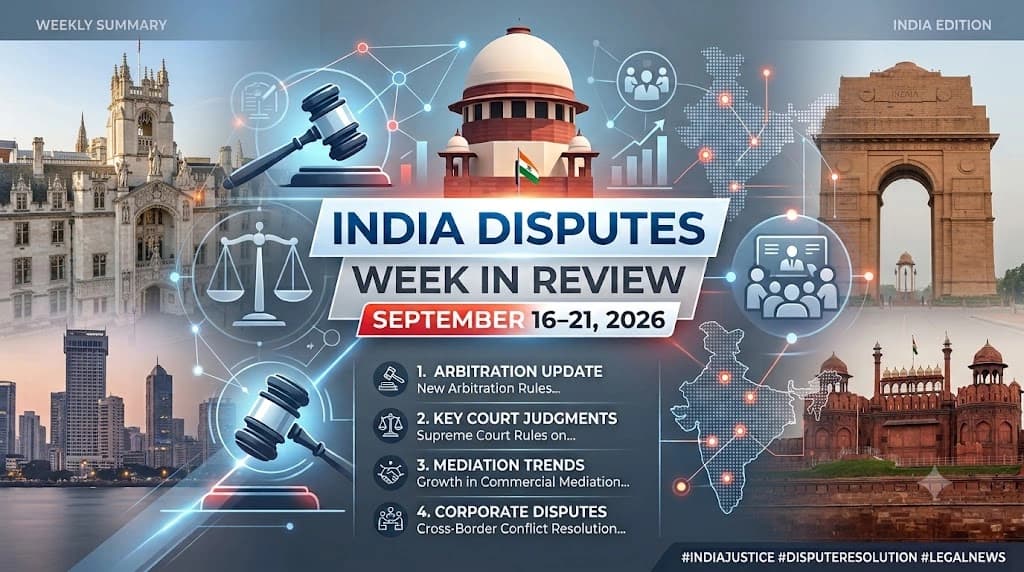
Weeks like this one rarely announce themselves with a single headline. No single judgment this week carried the drama of a landmark constitutional ruling or a multi-billion-rupee award. Instead, what emerged from six days of High Court and Supreme Court activity - layered on top of continuing regulatory and institutional developments - was a set of consistent signals about where Indian arbitration, construction disputes, forensic investigation, and expert-evidence practice are heading. For attorneys advising clients on live disputes, and for the expert witnesses who support them, these signals matter more than any single decision.
This roundup pulls together the week's arbitration jurisprudence, two significant Karnataka High Court rulings on construction quantum claims, continuing fallout from the BharatPe-Centrum warrant dispute, the Enforcement Directorate's capacity overhaul, institutional mediation's steady march from statute to infrastructure, and - arguably the most consequential development of the week for anyone relying on AI-assisted research - the Supreme Court's hard line on AI-generated fake citations in adjudication.
Arbitration: Courts Keep Reinforcing Kompetenz-Kompetenz
If there is one throughline connecting the week's arbitration news, it is this: Indian courts, at every level, continued to defer jurisdictional questions to arbitral tribunals rather than deciding them at the referral or writ stage. This is not a new trend, but the week produced three separate data points reinforcing it, each from a different court and a different fact pattern.
The most significant of these was the Supreme Court's ruling in GVV Constructions Private Limited v. Union of India (2026 INSC 976), decided on September 8 by Justices P.S. Narasimha and Alok Aradhe, and still generating commentary through this week. The case arose out of a familiar and recurring problem in railway and public-works contracting: a contract is terminated under the Indian Railways' Standard General Conditions of Contract, the contractor challenges the termination as procedurally improper, and the question becomes whether the dispute falls within an “excepted matters” clause that would take it outside the scope of arbitration altogether. The Telangana High Court's Division Bench had weighed in on the scope of that exclusion at the writ stage. The Supreme Court set that approach right: whether a particular claim is genuinely covered by an excepted-matters exclusion is itself a jurisdictional question under Section 16 of the Arbitration and Conciliation Act, 1996 - and it is for the arbitral tribunal, not a writ court, to answer it in the first instance.
This matters well beyond the facts of one railway contract. Excepted-matters clauses are boilerplate across government works contracts - PWD agreements, railway contracts, and much of India's infrastructure contracting follows broadly similar templates. Contractors and government departments alike have long used writ petitions to try to resolve, at the threshold, whether a dispute is arbitrable at all. GVV Constructions tells both sides that this route is now considerably narrower: absent a truly manifest exclusion, the tribunal decides its own competence first, and a writ court's role is limited to policing that process rather than pre-empting it. For attorneys drafting or litigating under GCC-style contracts, this is worth building into client advice now, not after the next termination dispute lands.
A second data point came from the Telangana High Court itself, in UBR's Housing and Infra Developers LLP v. Vanga Sudheer Reddy and Anr., a Section 11(5)/(6)(b) application for appointment of an arbitrator arising from a real-estate development Sub-MoU. The respondents resisted appointment on two grounds: that a pending civil suit already covered the dispute, and that the Vidya Drolia non-arbitrability framework - including concerns about third-party rights and the need for centralized adjudication - should bar arbitration. The Court found the arbitration clause plainly existed and was undisputed, that the pending suit concerned different agreements, and that the non-arbitrability objections required deeper factual inquiry than a Section 11 proceeding permits. Consistent with the now well-settled principle of minimal judicial intervention at the referral stage, the Court appointed a sole arbitrator - Justice Ramesh Ranganathan, former Chief Justice of the Uttarakhand High Court - and left every substantive objection for the tribunal to resolve.
The third arbitration-adjacent development this week was procedural rather than jurisdictional, but no less useful for practitioners: the Madhya Pradesh High Court's ruling in Moshers v. Shri Mittal Agritech Pvt. Ltd. on what happens after a foreign award is declared enforceable. Having already found a foreign GAFTA award enforceable under Sections 47 to 49, the Court was asked by the award-debtor to send the matter to a subordinate civil court for execution, on the theory that the High Court itself lacked ordinary original civil jurisdiction and execution machinery. The Court rejected that argument outright, holding that enforcement and execution of a foreign award proceed as a single composite proceeding: once a High Court declares an award enforceable, that award becomes a deemed decree of the same court, which may then proceed to execution under Order XXI of the Civil Procedure Code without the need for a separate transfer. For India's cross-border trade and commodities sector - GAFTA, FOSFA and similar trade-association awards are common in agricultural and shipping disputes - this closes off a delay tactic that award-debtors have used to fragment enforcement across multiple fora.
Attorneys tracking non-signatory and guarantor issues should also keep half an eye on the Supreme Court's continuing composite-transaction jurisprudence, following on from National Skill Development Corporation v. Surya Wires earlier this month, where the Court applied the Cox and Kings framework to hold that an arbitration clause in a loan agreement can bind a personal guarantor through a contemporaneous personal guarantee. Read alongside GVV Constructions and UBR's Housing, the pattern across the Indian judiciary this month is unmistakable: courts are handing more, not less, to arbitral tribunals, and are increasingly reluctant to let jurisdictional or arbitrability objections be resolved anywhere else first.
Construction Disputes and Quantum: The Evidence Bar Just Got Higher
Two Karnataka High Court rulings this week deserve close attention from anyone advising on, or acting as an expert in, construction arbitration - because together they signal a court taking a noticeably firmer line on what counts as adequate proof of a quantum claim.
In State Project Director, Rashtriya Madhyamika Shiksha Abhiyan v. KMV Projects and Anr., the Karnataka High Court heard a Section 34/37 appeal arising from one of nine materially similar construction packages under a state education infrastructure programme. The underlying tribunal had awarded amounts for price adjustment and escalation, unproductive overhead charges, and loss of expected profit on unexecuted balance work. Applying reasoning it had already developed in a lead appeal involving a near-identical award, the High Court found that the claims for escalation, overhead charges and lost profit were unsupported by any averments or evidence capable of substantiating the amounts claimed - and set aside those portions of the award, along with the consequential interest and costs that flowed from them.
The companion ruling, Burma Automotives Pvt. Ltd. v. Commissioner, Hubli Dharwad Municipal Corporation and Anr., took a more surgical approach to the same underlying tension between deference to tribunal fact-finding and the limits of Section 34/37 review. There, the tribunal had found that auto-tipper compartments supplied to a municipal corporation did not conform to the stipulated SS 202 fabrication specification, had rusted, and required re-fabrication - factual findings the High Court declined to disturb, since reappreciation of evidence has no place in Section 34/37 proceedings. But the award still fell short on a narrower point: the interest calculation did not track the statutory rate and monthly compounding formula mandated under Sections 16 and 17 of the MSMED Act for delayed payments to micro and small enterprises. The Court set aside the award only on that point, leaving the contractor free to re-agitate the interest question before the Arbitration and Conciliation Centre, Bengaluru.
Read together, these two rulings send a clear message to anyone building a construction arbitration claim in India: tribunals - and the courts reviewing their awards - are no longer inclined to accept escalation, overhead, and loss-of-profit figures asserted in the abstract. Contemporaneous documentation, cost breakdowns tied to specific delay events, and expert quantum reports that trace figures back to primary project records are becoming the practical minimum, not a nice-to-have. For quantum experts instructed in Indian construction arbitrations, the Karnataka rulings are a useful citation for exactly the kind of methodological rigour tribunals will expect - and a cautionary tale for claims teams that have historically relied on formulaic escalation clauses without underlying proof. Separately, the MSMED interest point in Burma Automotives is a reminder that statutory interest regimes can override even a carefully reasoned award if the arithmetic doesn't match the statute - a detail easy to overlook when the headline liability finding survives intact.
BharatPe v. Centrum: Section 9 as the New Battleground for Corporate Instrument Disputes
The week's most closely watched piece of commercial litigation continued to be the fallout from BharatPe's parent, Resilient Innovations, suing Centrum Financial Services and JBCG Advisory over the transfer of roughly ₹190 crore in Unity Small Finance Bank warrants. The Delhi High Court issued notice on the Section 9 interim-relief petition on September 9, with the matter next listed for October 1; arbitration has already been invoked in parallel, with Justice Vineet Saran (Retd.) nominated as arbitrator.
The dispute is a useful current illustration of a broader pattern Exlitem has been tracking: Indian courts are increasingly being asked to grant interim protection over corporate instruments - warrants, shares, pledged securities - while a parallel arbitration proceeds on the merits. Section 9 has become the default mechanism for freezing or preserving such instruments pending arbitration, precisely because it allows a party to secure the status quo without waiting for a tribunal to be constituted and seized of full jurisdiction. For counsel advising on shareholder, warrant, or promissory-instrument disputes, BharatPe-Centrum is shaping up as an instructive fact pattern on how quickly a Section 9 petition can be filed and heard relative to the underlying arbitration, and what kind of allegations (here, unauthorised transfer and encumbrance) are sufficient to get a court's attention on an urgent basis.
Forensic & Investigations: The ED's Capacity Overhaul Starts to Bite
The Enforcement Directorate's restructuring - approved this month and set to roll out from January 1, 2027 - remained a live thread through the week, with continuing commentary on what an expanded, faster ED means in practice. The headline numbers are substantial: a workforce expansion from roughly 2,029 to 3,256 sanctioned posts, an increase to 50 PMLA zones, and a stated target of cutting investigation timelines from the historical four-to-five years down to approximately 18 months. The restructuring, unveiled at the ED's 36th Quarterly Conference of Zonal Officers at IIM Bangalore, also flagged a deliberate shift toward real-time coordination with FIU-IND and SEBI, and a deeper operational role for the National Forensic Sciences University in deploying forensic and digital-forensics expertise across investigations - with crypto-crime tracing (chain-hopping, mixer use, and DeFi transaction analysis) specifically called out as a priority skill set.
For the forensic and investigations bar, and for the digital-forensics and financial-crime experts who support ED matters, asset-tracing engagements, and parallel civil or arbitral proceedings, this is not a story to file away until 2027. Instruction patterns, evidence-preservation timelines, and the pool of experts equipped to work at the pace the ED is now targeting will all need to adjust well before the rollout date. Firms that build out forensic-accounting and crypto-tracing capability now - rather than waiting for the January 2027 deadline - are likely to be better positioned when caseloads compress into the ED's new 18-month target.
Practice & Market: Mediation's Slow, Steady Institutionalisation
Three years after the Mediation Act, 2023 received presidential assent, India's institutional mediation ecosystem continued its shift from statute to functioning infrastructure this week. The Commercial Mediation Conclave India 2026, held in New Delhi on September 18 under the theme “Making Mediation Mainstream,” followed closely on the heels of the India Digital ADR Summit 2026 at NFSU Gandhinagar, where former Gujarat Chief Justice Sonia Gokani used her keynote to set out an institutionalisation roadmap for mediation: formal mediator accreditation, certified supervising-mediator panels, and specialised panels for IP, life sciences, construction, and IT disputes.
This builds directly on the Mediation Council of India's formal constitution on August 27, headquartered in Delhi under Section 31(1) of the Act, which is now tasked with regulating mediation service providers and framing accreditation standards for the sector. Taken together - the Council's establishment, Justice Gokani's specialisation roadmap, and back-to-back Delhi conclaves within the space of a week - the pattern is one of steady, if unglamorous, institution-building rather than any single dramatic announcement. For disputes attorneys building out ADR practice groups, the practical takeaway is that mediator empanelment and specialisation standards are actively being written right now, which will shape referral patterns and panel composition over the next twelve to eighteen months.
The broader arbitration-institution calendar also stayed busy this week, following directly on from GHAC Arbitration Week at GIFT City and India ADR Week sessions across Mumbai, Bengaluru and Delhi earlier in the month - including the Chief Justice of India's own proposal, floated during India ADR Week, for an arbitrator conflicts-and-caseload register. None of this produced a single dated news item this week in isolation, but the cumulative signal - arbitral institutions competing for credibility, and courts openly discussing arbitrator regulation - continues to build toward exactly the kind of “India's arbitration hubs” comparative piece this desk has flagged as a flagship candidate.
Technical & Specialist Experts: The Supreme Court Draws a Hard Line on AI-Generated Citations
Arguably the most consequential single development of the week for expert witnesses and counsel alike arrived from an unexpected direction: customs law, not arbitration. In Vijay Ghanshyam Gadiya v. Union of India, the Supreme Court set aside a penalty of ₹425,27,99,100 - roughly ₹425 crore - imposed on a diamond exporter, after finding that the customs adjudicating authority's order relied on case law that was either entirely non-existent or supported by fabricated citations, and that even some genuine cases had been misattributed legal propositions they did not actually support. Justices Dipankar Datta and Sheel Nagu attributed the pattern squarely to AI hallucination, verified the appellant's contention themselves, and remanded the matter for fresh adjudication by a different customs officer of equal rank - while also leaving the door open for disciplinary action against the original decision-maker.
The ruling leans heavily on the Court's own earlier decision in Pooja Ramesh Singh v. Jammu & Kashmir Bank Ltd., which had already established a zero-tolerance standard for AI-generated precedents in judicial and quasi-judicial orders: producing, citing, or relying on fabricated case law is professional misconduct for advocates and a serious lapse for judges and adjudicators, and any decision tainted by such material must be set aside regardless of whether it actually affected the outcome. Notably, the Gadiya bench was careful to frame this as a standard for verification, not a rejection of AI tools altogether - pointing to the Supreme Court's own draft 2026 Regulations for the Use of Artificial Intelligence in Courts, currently open for public comment, and observing that AI “may well serve as training wheels but entrusting it with the pilot's seat would be both imprudent and dangerous.”
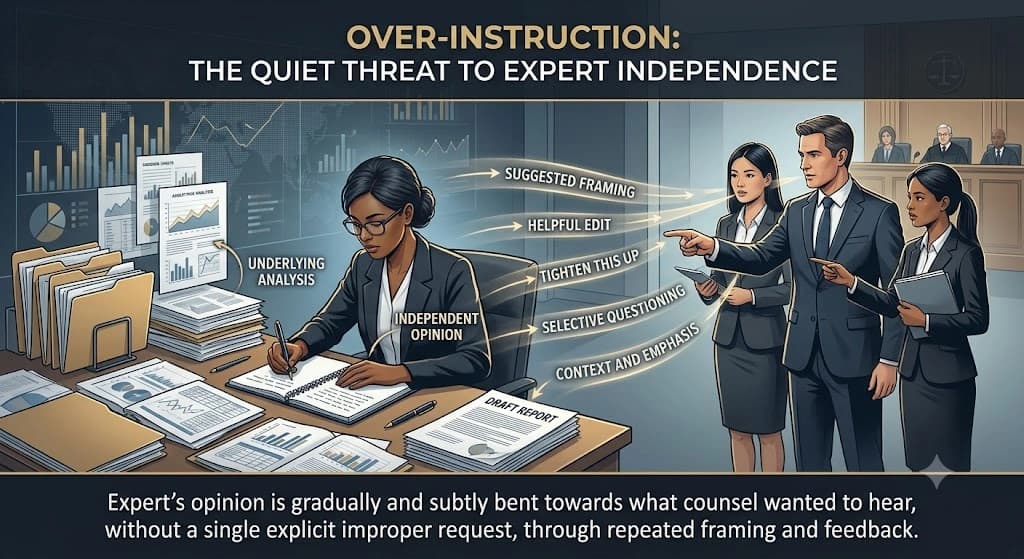
For Exlitem's core audience, this is not a peripheral technology story - it goes to the heart of expert-evidence practice. Expert witnesses, forensic accountants, and quantum consultants increasingly use AI-assisted research tools to build citation lists, cross-check methodologies, and draft portions of reports. Gadiya, read alongside Pooja Ramesh Singh, puts every adjudicator, expert, and counsel on notice that unverified AI output in a report or submission is no longer a low-risk shortcut - it is now an established basis for having an entire decision, or by extension an expert opinion relying on similarly unverified material, unwound. Firms instructing experts in Indian arbitration and litigation would be well advised to build explicit AI-verification protocols into their engagement letters and quality-control processes now, rather than waiting for a tribunal or court to test the point on a live matter.
Takeaway
The week of September 16–21 did not produce a single defining judgment, but it produced something arguably more useful for practitioners: a consistent set of signals across six separate rulings and three institutional developments. Indian courts are continuing to hand jurisdictional and arbitrability questions to arbitral tribunals rather than deciding them upfront (GVV Constructions, UBR's Housing); enforcement of foreign awards is being streamlined into a single composite process (Moshers); construction and MSME quantum claims are facing a visibly higher evidentiary bar (KMV Projects, Burma Automotives); the ED's capacity overhaul is a 2027 deadline that forensic practitioners should be preparing for today, not next year; institutional mediation is quietly building the accreditation and specialisation infrastructure that will shape ADR referrals for years to come; and the Supreme Court has now drawn an unambiguous line on AI-generated fake citations that every expert witness and counsel relying on AI-assisted research needs to internalise immediately.
For attorneys and expert witnesses navigating India's disputes landscape, the message from this week is less about any single case and more about direction of travel: less judicial intervention at the threshold, more scrutiny of the substance once a matter is actually decided, and zero tolerance for shortcuts - whether in quantum evidence or in AI-assisted legal research.
Position yourself where the legal industry looks for expertise - sign up on exlitem.com to get discovered by leading lawyers and high-value clients.