

On June 30, 2018, a 17-year-old drove a 2014 Honda CR-V through an intersection in Frisco, Texas. His 20-year-old sister sat in the front passenger seat. Another driver ran a red light at 45 to 50 miles per hour and struck the passenger side.
The force of the collision threw the driver's upper body to the right. He rolled out of the shoulder portion of his seatbelt, and his head struck his sister's head. She sustained permanent injuries to her brain, skull, face, and left eye.
A jury later heard from a biomechanical engineer on how that happened and on whether a different restraint design would have prevented it. The jury found $21,430,808.74 in damages. On November 7, 2023, the United States Court of Appeals for the Fifth Circuit affirmed the judgment and the decision to admit the engineer's testimony.
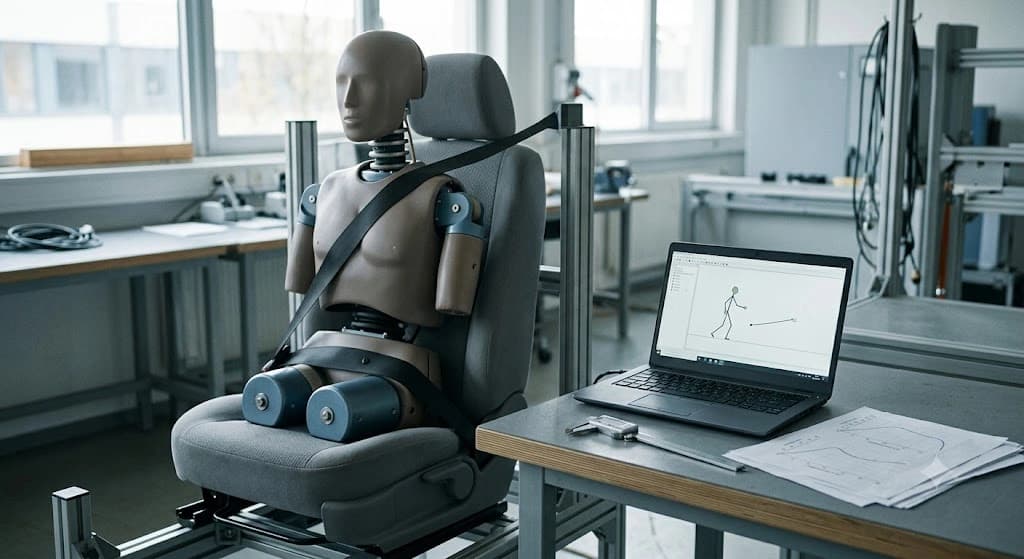
Biomechanics applies engineering principles to the human body. Its experts explain how forces move a person in a crash or a fall, and whether those forces fit the injury claimed.
This article reviews five rulings from federal courts. Two allowed a biomechanics expert's testimony in full. One reversed an exclusion. One admitted the testimony with limits. In the fifth, the Court considered the expert's opinion on summary judgment and decided the motion on another ground.
Where Biomechanics Appears in Litigation
The five cases arose from five kinds of claims. Kim was a design defect suit against a carmaker. Montgomery was a product liability and wrongful death suit over a die-cutting machine. Adamscheck was an underinsured motorist dispute after a rear-end collision. Snider was a railroad worker's injury claim under the Federal Employers' Liability Act. Morocho was a Federal Tort Claims Act suit over a collision with a postal truck.
Plaintiffs retained the biomechanics expert in one case. The defense retained the expert in the other four.
The questions fell into three groups. The first was mechanism: how a person's body moved and what it struck. In Kim, the expert explained how a driver slipped out of his seatbelt. In Snider, the expert addressed whether a conductor slipped on a stair or overstepped it. In Montgomery, the expert described how a machine applied fatal pressure to a worker's chest.
The second was force. In Adamscheck and Morocho, defense experts concluded that a low-speed impact did not fit the injuries claimed.
The third was design. In Kim, the expert's opinion was that alternative seatbelt and airbag designs would have prevented the contact that caused the injury.
The challenges followed a pattern. Opponents argued that the expert lacked the right credential. He was not a forensic pathologist in Montgomery and not a medical doctor in Snider. In Morocho, Plaintiffs disputed a biomechanics expert's ability to give causation opinions at all.
Opponents also argued that the method was thin. Honda said the expert in Kim had done no analysis of his own. Plaintiff in Snider pointed to the wrong photographs. In Adamscheck, the trial judge excluded the expert before any motion was filed.
The Rulings
Kim v. American Honda Motor Company
Su Min Kim v. American Honda Motor Company, Incorporated, United States Court of Appeals for the Fifth Circuit, No. 22-40790, filed November 7, 2023.
Su Min Kim and Ji Hun Kim sued American Honda Motor Company on May 7, 2019. They brought strict liability and negligence claims for defective design. They argued that Honda could have used a center airbag or a reverse geometry seatbelt. Both designs already existed, and Plaintiffs contended that either would have prevented Su Min Kim's injuries.
Plaintiffs offered two liability experts. One was a biomechanical engineer and accident reconstructionist. The other was an automotive engineer.
Honda moved to exclude both. It argued that Plaintiffs' biomechanical expert had not performed a risk-utility analysis of his own. In Honda's view, he had relied on and co-signed the automotive engineer's analysis of alternative designs.
The United States District Court for the Eastern District of Texas held a Daubert hearing and denied the motions. It held that Honda's complaint "attacks the merits of the design defect claim," not the expert's reliability.
The jury found Honda liable. It assigned 77 percent of the responsibility to the driver of the other car. After the District Court adjusted the award in its final judgment, Honda owed Su Min Kim $4,871,586.01 and Ji Hun Kim $57,500.
On appeal, Honda argued that the biomechanical expert's opinions on safer alternative designs were conclusory and unsupported. It also argued that the District Court had not analyzed relevancy and reliability. Circuit Judge Patrick E. Higginbotham wrote for the panel. "These arguments are unconvincing," the opinion stated.
The Fifth Circuit found that the District Court had analyzed the expert's report. The report indicated that he had applied principles of accident reconstruction, biomedical engineering, and body kinematics to the facts of the case. He had explained that the alternative seatbelt designs would have kept the driver's shoulder in the belt. He had also explained that a center airbag would have been an effective means of keeping the occupants' heads apart.
The lack of a formal risk-utility analysis was a question of substantive law, the Court held, not a requirement of Rule 702.
The Fifth Circuit affirmed. It concluded that Plaintiffs' experts "based their opinions on reliable methodologies and provided relevant, helpful testimony."
Montgomery v. Bobst Mex SA
Montgomery v. Bobst Mex SA, United States District Court for the Eastern District of Pennsylvania, Civil Action No. 24-367, decided May 1, 2026.
Michael Montgomery sustained fatal injuries while operating a Bobst Mastercut die-cutter machine. His daughter, Tabria Montgomery, sued individually and as administratrix of his estate. Her claims against Bobst Group North America, Inc. were for strict products liability, negligence, wrongful death, and survival.
Under the Pennsylvania Survival Act, an estate may recover for a decedent's conscious pain and suffering from the time of injury until death. Plaintiff retained a forensic pathologist to address the cause of death and the extent of any conscious pain and suffering.
Defendant offered its own expert in rebuttal, on the injury mechanisms involved. He held a bachelor's degree in mechanical engineering and a medical degree. He had been a licensed physician in general medicine and general surgery for more than twenty-five years. His post-graduate education covered trauma medicine, accident reconstruction, and biomechanics. He reported analyzing the biomechanics of injury in more than 3,500 injury accidents.
Defendant's expert opined that the worker died of mechanical asphyxia from overwhelming chest compression. Working from a description of the machine's mechanical activity, he opined that the pressure would have been applied in less than one to two seconds. In his opinion, the worker would not have remained conscious and aware of his situation after that.
Plaintiff moved to exclude him on qualifications alone. She argued that he was not a forensic pathologist and had never performed an autopsy. In her words, he was "primarily, a biomechanics expert."
United States Magistrate Judge José Raúl Arteaga denied the motion. The Court wrote that an expert need not have a particular medical specialty to testify about the cause of death or the duration of conscious pain and suffering. It cited an earlier decision from the same district that allowed a biomechanical engineer to testify to the cause of a brain injury.
The Court then turned to his deposition. He testified that, as a physician, he had been required to report the cause of death when a patient in his care died. He had also given expert opinions on the duration of conscious pain and suffering in earlier litigation.
The Court held that Defendant's expert "satisfies the liberal standards for expert qualification even if he is not the most qualified expert to opine on the subjects at issue." Plaintiff's concerns, the Court added, "go to the weight that the jury should afford to his opinions." The order allowed Defendant to offer his testimony at trial.
Adamscheck v. American Family Mutual Insurance Company
Adamscheck v. American Family Mutual Insurance Company, United States Court of Appeals for the Tenth Circuit, No. 15-1125, filed March 29, 2016.
Patrick Adamscheck was working as a deputy sheriff in Colorado Springs, Colorado, on June 7, 2011, when another driver rear-ended his vehicle. He settled with that driver for her $25,000 policy limit. Asserting a severe lower back injury, he then demanded the full $500,000 of underinsured motorist coverage under his own policy with American Family.
American Family offered $65,000. Plaintiff sued for breach of contract, bad faith, and unreasonable denial of benefits.
Defendant stipulated that the other driver was at fault. It disputed the cause and extent of the injuries. It pointed to $390.60 in damage to the rear bumper and to an earlier workplace injury. To support that theory, Defendant planned to call a biomechanical engineering expert.
The expert never testified. At the final pretrial conference, Plaintiff's counsel described a motion he had planned to file. He said he thought the expert's opinion was that Plaintiff could not have been hurt in this type of accident. "Well, I wouldn't allow that kind of testimony," the District Judge replied.
Defense counsel offered to lay a foundation. The Judge told her she could make a proffer.
Defendant submitted the expert's report as a written proffer on the first day of trial. In it, the expert stated that Plaintiff's "low-speed motor vehicle accident was not consistent with generating the type of significant low back problems from which he suffered."
After a five-day trial, the jury awarded $395,561 in benefits and found that Defendant had unreasonably denied the claim. With statutory damages, interest, fees, and costs, the judgment reached $1,447,028.48.
The Tenth Circuit vacated the verdict. In an opinion by Circuit Judge McHugh, it held that the District Court had "failed to fulfill its gatekeeping obligation under Rule 702." The District Court had not asked for or reviewed the expert's qualifications or proposed opinions. It had ruled on a one-sentence description supplied by the party opposing the testimony.
The Tenth Circuit declined to call the error harmless. The expert's testimony was "critical to American Family's causation theory," it wrote, and the other evidence at trial was no substitute for it. Without him, the jury heard "expert evidence that exclusively supported" Plaintiff's theory.
The ruling stopped short of admitting the testimony. The Court expressed no opinion on the expert's qualifications or on the relevance and reliability of his opinions. It remanded for a new trial and directed the District Court to conduct a Rule 702 inquiry on the record.
Snider v. Union Pacific Railroad Company
Snider v. Union Pacific Railroad Company, United States District Court for the District of Nebraska, No. 8:24CV356, decided July 10, 2026.
Rachael Snider was working as a conductor for Union Pacific near Gillette, Wyoming, on September 29, 2021. She fell while descending the stairs of a locomotive cab. She testified that she slid on the lip at the top and that the anti-slip material on the steps had worn away. The parties agreed that the grip tape was worn. They disagreed about its role in the fall.
She sued on September 10, 2024, under the Federal Employers' Liability Act.
Defendant's expert held a doctorate in biomechanics and motor control. He taught biomechanics at a university and had published in the field. He was not a medical doctor.
In his report, Defendant's expert wrote that the "biomechanics of stair descent do not support slipping as a probable or reasonable mechanism." He concluded it was more probable that Plaintiff, if she fell, had overstepped a tread or a nosing. He also opined that her preexisting lumbar spine condition, not the fall, likely explained her pain.
Plaintiff's rebuttal expert disputed the report. Among other points, he wrote that it relied on photographs showing the wrong tread conditions. Defendant's expert inspected the locomotive in person and filed two supplemental reports. In the second, he acknowledged that his earlier reports had relied on photographs showing more slip-resistant material than existed on the day of the fall. He maintained that the error did not change his conclusion. In his analysis, Plaintiff had overstepped at the top of the stairs.
Plaintiff moved to exclude him as unqualified and unreliable. Senior United States District Judge Joseph F. Bataillon granted the motion in part and denied it in part.
On qualifications, the Court found Defendant's expert qualified to give his biomechanical analysis. It barred him from three subjects. He could not testify on medical topics, such as the role of the earlier back condition in Plaintiff's pain. He could not opine on Plaintiff's credibility. He could discuss railroad rules only as needed to give context to his biomechanical analysis, a limit Defendant accepted.
On reliability, the Court called Plaintiff's critiques "well-taken." It held that the reliance on inaccurate photographs and the lack of hands-on testing "go to credibility, not admissibility." The Court was convinced that he "employed a sufficiently reliable methodology." It declined to exclude his testimony in its entirety.
The same order denied Plaintiff's motion for partial summary judgment. On causation, the Court cited the expert's opinion that the fall could have resulted from an overstep by a worker who was distracted, carrying an object, or not using the handholds. A jury would decide which account to credit.
Morocho v. United States
Morocho v. United States, United States District Court for the Eastern District of New York, No. 23-cv-09431 (JMW), decided June 11, 2026.
On January 3, 2022, a United States Postal Service truck collided with the passenger side of a 2008 Toyota RAV4 on Jerusalem Avenue in New York. The driver, Freddy Morocho, and his front-seat passenger, Wendy Lissette Diaz Esperanza, each sued the United States under the Federal Tort Claims Act. Both Plaintiffs claimed neck, back, and shoulder injuries.
Defendant moved for summary judgment, arguing in part that the accident had not caused the injuries.
Defendant offered an expert in accident reconstruction and biomechanics. She inspected the RAV4. She also reviewed the depositions, police records, photographs, and medical records. She determined that the vehicle had experienced a low-speed side impact.
The opinion records her conclusion that "the forces experienced by an occupant in a low-speed lateral impact are low and not sufficient to move the body such that voluntary ranges of motion for the shoulder, neck and back are exceeded."
Plaintiffs disputed her ability to give causation opinions. At oral argument on May 15, 2026, they relied on a New York appellate decision from the Fourth Department. They offered no expert of their own to rebut her.
United States Magistrate Judge James M. Wicks did not adopt Plaintiffs' position. The Fourth Department decision was not binding, the Court wrote, and the Second Department takes a different view. The Court quoted a Second Department statement that "biomechanical experts are qualified to render opinions on causation."
The Court also cited federal decisions that permit biomechanical experts to address whether the force in an accident could cause certain injuries. Those decisions do not permit testimony on the specific cause of a particular injury unless the expert has medical training.
The Court did not grant summary judgment on causation. Defendant's own medical expert had found that the accident potentially caused low-grade, short-term strains. That left an issue of fact for trial.
The Court granted the motion on a different ground. Under New York's no-fault law, Plaintiffs had to show a "serious injury," and the Court held that they had not.
Defendant's biomechanics opinion stayed in the record, unrebutted, and Defendant prevailed. The ruling did not rest on that opinion.
What the Rulings Have in Common
Engineering training was enough for opinions about force and motion. The Fifth Circuit accepted a biomechanical engineer's account of how a driver left his seatbelt. The Nebraska Court found a doctorate in biomechanics sufficient for an analysis of a fall on stairs.
The courts drew a line at medicine. In Snider, the Court barred an expert without medical training from testifying about a back condition and its role in Plaintiff's pain. In Morocho, the Court cited decisions that confine biomechanical experts without medical training to whether a force could cause a type of injury. In Montgomery, the expert was a physician as well as an engineer. The Court allowed him to address cause of death and consciousness.
On method, the experts worked from records and physical evidence. The expert in Morocho inspected the vehicle. The expert in Snider inspected the locomotive. The expert in Kim applied accident reconstruction and body kinematics to the facts of the crash. The expert in Montgomery worked from a description of the machine's mechanical activity.
Three courts sent disputes about an expert's basis to the jury. Kim treated Honda's objection as an attack on the merits. Snider treated the wrong photographs as a matter of credibility. Montgomery treated the credential dispute as a matter of weight.
On fit, each opinion addressed something the retaining party had to prove or wanted to rebut. In Kim it was a safer alternative design, an element of the design defect claim. In Montgomery it was conscious pain and suffering under the Survival Act. In Adamscheck it was the insurer's alternative account of causation, which the Tenth Circuit called critical. In Snider it was the railroad's position that Plaintiff's own misstep caused the fall.
Practical Points for Attorneys
Honda's motion in Kim attacked the expert for skipping a risk-utility analysis. Both courts treated that as an argument about what Plaintiffs had to prove on the merits. It did not show that his methods were unreliable. A challenge built around an element of the claim did not succeed as a Rule 702 motion.
The motion in Montgomery challenged qualifications and nothing else. The Court noted that Plaintiff had not contested reliability or fit. The proponent answered with deposition testimony about what the expert had done in practice, and the Court relied on it.
Adamscheck turned on the record. Defense counsel asked to lay a foundation and then filed the expert's report as a proffer. The Tenth Circuit drew on that report to describe what the jury had not heard. The Court also refused Plaintiff's request for a limited remand and a hearing after the fact. It reasoned that no district court would be well positioned to make valid findings at that stage.
In Snider, the defense expert had used the wrong photographs in two reports. He inspected the locomotive himself and addressed the error in a supplemental report before the Court ruled. The railroad also agreed that he would not interpret its rules. The biomechanical core of his testimony survived. The medical and credibility opinions did not.
Morocho shows a different risk. The biomechanics opinion went unrebutted, yet summary judgment on causation failed. Defendant's own medical expert had acknowledged that the accident potentially caused low-grade strains. The two defense opinions did not line up, and the Court said so.
These points are observations from five rulings. They are not legal advice.
After the Rulings
The oldest of the five rulings dates from March 2016 and the newest from July 2026. In Kim, a judgment of nearly $5 million stood. In Adamscheck, a judgment of more than $1.4 million did not, because the jury never heard the defense expert. In Montgomery and Snider, the experts were cleared to testify at trial, one in full and one within limits. In Morocho, the case ended on another ground.
Each dispute came down to what a human body did under force, and whether an expert in biomechanics could explain it to a jury.
Attorneys who want to retain a biomechanics expert can find one on Exlitem. Win Cases With Data, Not Guesswork. The platform holds 52,748+ expert profiles and 245k+ Daubert records across 5,000+ specialties. Search by discipline at exlitem.com.